Step past the bronze statue of Henry Clay on the third floor of the Capitol and turn into the narrow stairwell leading to room H-312. At 1:45 in the morning, the marble corridors downstairs are vacant, swept clean by custodial crews under amber security lights. Inside this tucked-away chamber, the air smells of scorched percolator coffee, dry printer toner, and the wool of damp suit jackets draped over swivel chairs. There are no television cameras here, only the low, continuous whir of high-speed laser printers churning through reams of parchment.
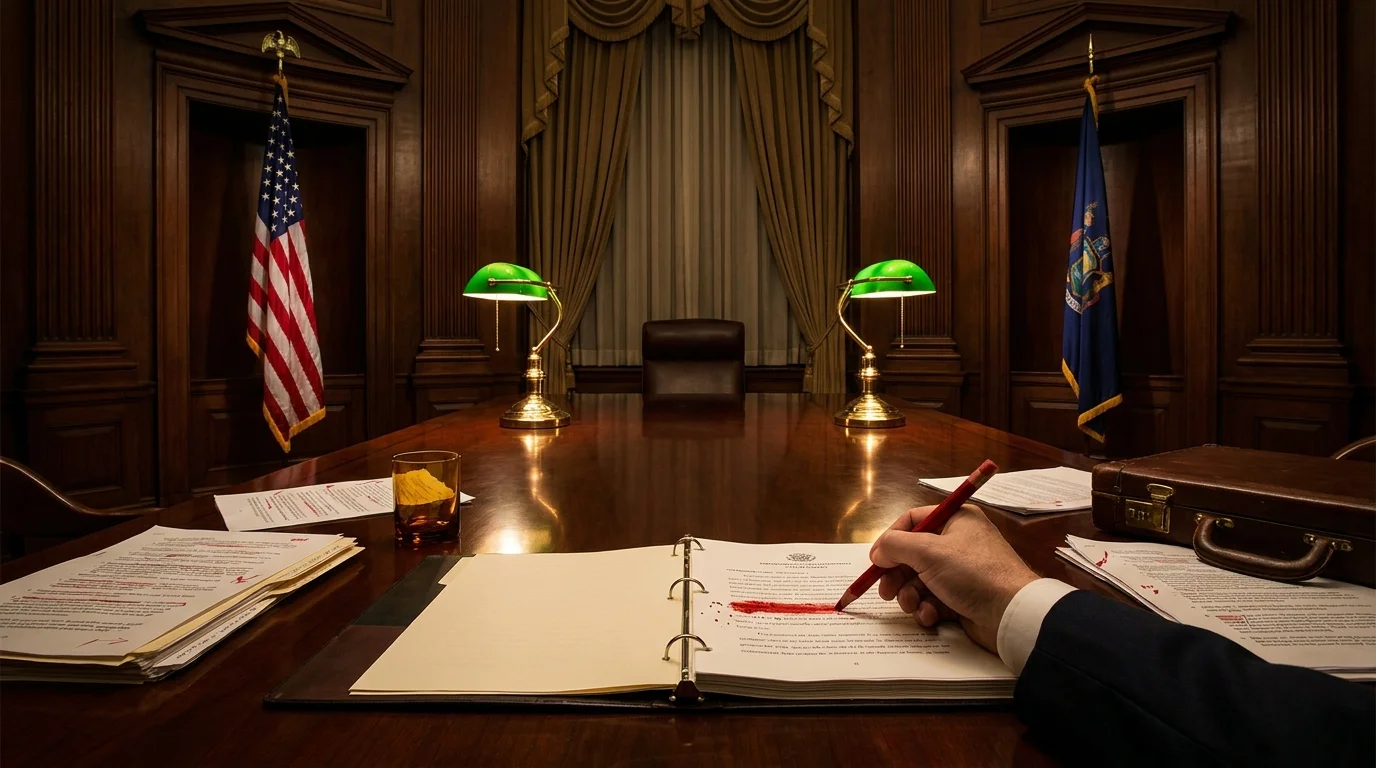
You might expect national policy to be forged in the dramatic glare of the House chamber, punctuated by impassioned podium speeches and ticking electronic vote boards. But when government hangs on a threadbare majority, real statutory power narrows down to a scarred mahogany table and a clerk holding a blunt, paper-wrapped crimson pencil. With one firm drag across a printed rider, an entire sub-agency loses its funding, or an obscure regional tax carveout springs into existence.
The thick wax of that red grease pencil cuts across crisp 24-pound legislative paper with a soft, tearing scrape. In the Capitol’s engine room, this wax line is absolute. It strips out non-germane provisions negotiated over months of public hearings, replacing them with hand-scratched managerial substitutes that the rank-and-file membership will only see thirty minutes before casting their vote.
The Illusion of the Open Floor
Most civics textbooks teach that laws travel a tidy highway from subcommittee hearings to open floor debate, gathering amendments like hitchhikers along the way. That story gives us comfort, suggesting our representatives stand as equal participants in a wide-open exchange of ideas. In reality, the floor is largely theater; the House Rules Committee is the hydraulic press that flattens dissent and pre-determines every outcome before the opening gavel falls.
Think of the Rules Committee not as a neutral traffic cop, but as a high-security sorting facility where the majority leadership controls every valve. Under a structured or closed rule, the committee determines exactly how many minutes each side may speak, which amendments are ruled out of order, and whether a bill can be altered at all once it reaches the floor. When lawmakers arrive at midnight to reconcile contradictory party promises, they do not hold open floor votes—they trade wax-penciled strike-throughs in committee backrooms.
The Clerk’s Silent Scribe
Consider Marcus Vance, 54, a veteran procedural clerk who has spent twenty-eight years managing the paper flow beneath the Capitol dome. Long before digital drafting tools became standard, Marcus kept a wooden box of Chinese grease markers in his desk drawer, their strings dangling to strip away rings of paper as the wax wore down. Today, even with digital archives and networked databases, leadership still demands printed, tabbed parchment binders for late-night rule write-ups.
“A digital file leaves a metadata trail and requires network access that can leak before leadership is ready to whip the count,” Vance once explained over a paper cup of black tea in the cloakroom. “When the Speaker’s team and the ranking dissenters finally reach terms at two in the morning, we take the physical bill text, draw a red wax line through three paragraphs on page 840, scrawl the compromise language directly in the left margin, and send that exact sheet down to the Government Publishing Office. What is marked in grease is what gets enacted.”
- South Carolina primary bus tours force candidates onto sticky church folding chairs
- Donorbox mobile checkout screens trigger preselected tipping fees on cracked smartphone glass
- Pew Research phone scripts switch evening callback quotas after loud dinner clatter interrupts
- Mario Cuomo keynote notes reveal tight margins filled with rhythmic phonetic slash marks
- DOJ election monitors in Wyoming enforce sudden Republican leadership pivots on federal oversight
The Three Mechanical Filters of H-312
Understanding how late-night markups shape statutory outcomes requires breaking down the procedural levers that the Rules Committee pulls behind its heavy oak doors. These mechanisms do not make headlines, yet they dictate the tax codes, regulatory boundaries, and public funding levels of the entire country.
1. The Self-Executing Rule
This is the ultimate legislative sleight-of-hand. When the Rules Committee adopts a rule containing self-executing provisions, the underlying bill is deemed to have been amended the moment the rule itself passes the full House. This maneuver allows leadership to insert controversial compromises—or erase toxic provisions—without forcing vulnerable members to take a direct, recorded vote on the specific change.
By bundling the amendment directly into the procedural resolution, lawmakers can deflect tough electoral questions back home by claiming they merely voted on a standard scheduling measure rather than the contentious policy buried inside it.
2. Germane Strike-Throughs and Germaneness Waivers
Under House Rule XVI, amendments must be germane to the subject matter of the base text. However, during midnight negotiations, leadership often needs to tack on unrelated policy fixes to buy off stubborn voting blocs. The Rules Committee simply marks a red line through traditional germaneness protections, waiving all points of order against the bill.
Conversely, when a backbencher introduces a grassroots amendment that threatens the delicate bipartisan bargain, the committee clerk scratches a red line across the petition, declaring it non-germane before it can ever see daylight on the House floor.
3. The Closed Rule Lockdown
When high-stakes funding bills or debt-ceiling compromises are on the line, the committee issues a completely closed rule. No floor amendments from either party are made in order. The choice offered to the 435 members of the House is reduced to an unyielding binary: accept the exact text negotiated in room H-312, or watch the program shutter entirely.
This closed architecture ensures that delicate backroom concessions remain completely intact, shielded from rogue amendments that could blow up the leadership coalition at the eleventh hour.
How to Trace Real Legislative Power Moves
If you want to understand where a law was actually decided, stop watching the televised floor speeches and start reading committee prints. By applying a few analytical steps, you can trace the exact friction points where a bill transformed from a public proposal into an enacted compromise.
- Download the ‘Committee Print’ version: Compare the reported bill from the standing committee (such as Ways and Means or Judiciary) against the Rules Committee Print posted on the Rules website. Any stark difference between these two documents is where leadership altered the text.
- Examine the Rule Resolution (H. Res.): Look for phrases like ‘the amendment printed in part A of the report shall be considered as adopted.’ This signals a self-executing change inserted at the last moment.
- Track the ‘Manager’s Amendment’: This document, often dropped into the hopper past midnight, contains the consolidated hand-edits made by leadership to lock in the final votes needed for passage.
- Review the Points of Order Waivers: Check which statutory budget caps or procedural hurdles were formally waived. If a rule waives Section 302(f) of the Congressional Budget Act, leadership is spending money outside established budget ceilings to seal the deal.
By shifting your attention toward the procedural machinery of the committee, you cut through the partisan rhetoric and see the precise trade-offs negotiated by the few individuals who hold the levers of power.
The Quiet Geometry of Compromise
Watching legislation through the lens of late-night markups alters your understanding of democratic power. The friction, shouting, and cable news soundbites that dominate the political cycle are largely performance. The real work of maintaining a functional government across deep partisan divides happens in quiet rooms, under bad lighting, managed by exhausted aides with wax pencils.
A thick red wax line drawn across a statute is not a sign that the system is broken; it is the physical evidence of the system absorbing pressure. In a divided republic, total victory is an illusion. The scratched margins and last-minute substitute sheets are the scars left behind when opposing factions are forced to share the same constitutional space.
“Floor debate is where members explain their philosophies to voters; the Rules Committee markup is where they quietly trade their leverage for survival.”
| Key Point | Procedural Detail | Added Value for the Reader |
|---|---|---|
| Committee Print | The draft language modified directly by Rules Committee staff before reaching the floor. | Shows you exactly what leadership altered after public committee hearings ended. |
| Self-Executing Rule | A single vote on the procedural rule automatically alters the underlying legislation. | Reveals how lawmakers pass unpopular policy riders without taking direct recorded votes. |
| Germaneness Waiver | Lifts the standard requirement that amendments must relate strictly to the core bill topic. | Explains how unrelated pork or policy fixes get attached to urgent spending bills. |
| Manager’s Amendment | A consolidated bundle of last-minute changes drafted to secure holdout votes. | Pinpoints the exact concessions granted to swing factions in the final hours. |
Frequently Asked Questions
Why does the Rules Committee use grease pens instead of digital tracking?
Physical markup copies ensure chain of custody during closed-door negotiations and prevent unauthorized digital leaks before the final rule is formally reported.Can rank-and-file members propose changes during a closed markup?
Members can submit amendments to the Rules Committee, but leadership members on the committee vote along party lines to decide which, if any, will be debated on the floor.How does the Speaker maintain absolute control over the Rules Committee?
The majority party holds a disproportionate 9-to-4 seat advantage on the Rules Committee, guaranteeing the Speaker never loses a procedural vote in the chamber.What is the difference between a clean bill and a marked-up rule print?
A clean bill reflects the original sponsor’s language, whereas a rule print contains leadership’s managerial edits, line strikes, and bundled compromises.Where can citizens read the real-time changes made in H-312?
All posted committee prints, rule texts, and manager amendments are filed on rules.house.gov within hours of adoption, before they reach the House floor for a vote.