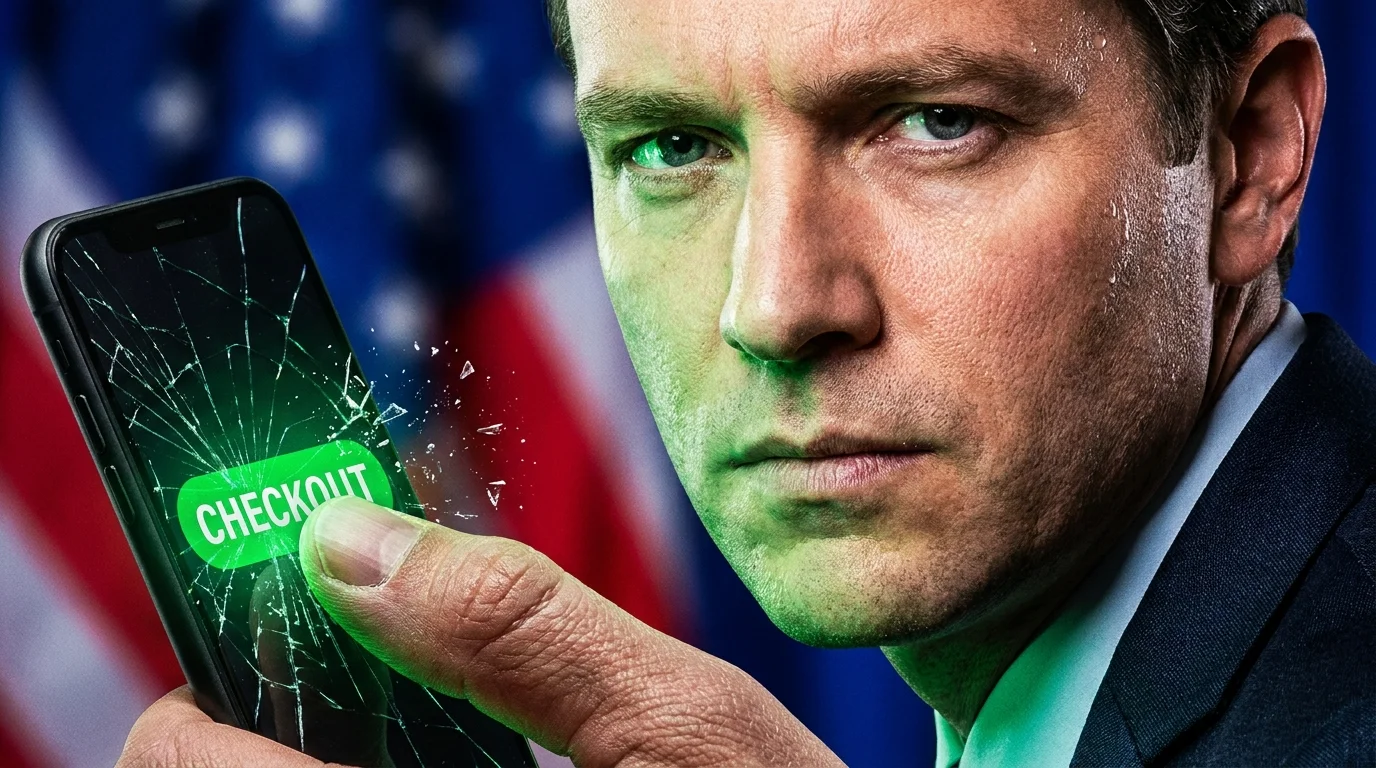
The room is quiet except for the low hum of an air conditioner, the streetlights outside casting long, amber ribs across your living room ceiling. It is late, nearly midnight, and your thumb rests against the jagged hairline fracture spidering across your phone screen. A campaign video finishes playing—an impassioned plea from a challenger running for Congress in your home district—and you decide to do what millions of Americans do every week: send fifteen dollars to balance the scales against corporate pacs.
You tap the link, landing on a clean, mobile-optimized checkout interface. Right under the green confirmation button, a tiny glowing green toggle sits preselected, nestled against a row of micro-copy. Your fifteen-dollar donation quietly morphs into eighteen dollars and seventy-five cents before you even key in your credit card security code.
On that cracked piece of glass, you believe you are participating in pure grassroots democracy. Yet beneath the clean sans-serif typography, modern political payment software operates on calculated friction, turning your financial goodwill into an extractive fintech laboratory.
The Invisible Tollbooth: When Support Meets Extraction
For the past decade, political organizers told you that small-dollar donors hold the real leverage in American elections. When thousands of citizens chip in ten or twenty dollars, candidates bypass smoke-filled backrooms and mega-donor retreats. But as platforms like Donorbox and ActBlue scaled into billion-dollar pipeline hubs, financial technology quietly replaced political idealism with aggressive behavioral economics.
Think of these checkout screens not as digital collection baskets, but as automated airport tollbooths. When you walk up to drop a dollar into a bucket, nobody reaches into your back pocket to pull out an extra thirty cents for the bucket manufacturer. On mobile interfaces, however, platforms leverage your urgency, pre-ticking 15% to 20% platform tips alongside default recurring monthly pledges.
When you are squinting through glare or navigating broken touchscreens, your thumb instinctively aims for the largest high-contrast button. Designers know this. They build interfaces where rejecting an optional tip requires three deliberate, counter-intuitive taps across low-contrast dropdowns, while accepting the extra fee requires only doing nothing.
- Pew Research phone scripts switch evening callback quotas after loud dinner clatter interrupts
- Mario Cuomo keynote notes reveal tight margins filled with rhythmic phonetic slash marks
- DOJ election monitors in Wyoming enforce sudden Republican leadership pivots on federal oversight
- Ohio governor race debates derail suburban party coalitions over disputed local property levies
- Strait of Hormuz naval security bills trigger emergency congressional floor votes over tanker escorts
Marcus Vance, a 43-year-old former field director in Columbus, Ohio, witnessed this dynamic firsthand during two consecutive mid-term campaigns. “We tracked donor drop-off rates daily, and the software companies constantly pushed us to leave auto-recurring toggles and default tipping turned on,” Marcus explained during a strategy debrief. “They framed it as ‘donor optimization,’ but in reality, it was just taxing the people who could least afford to lose twenty bucks unexpectedly every month.”
The Three Dark Patterns Bleeding Low-Dollar Backers
To protect your household budget while still making your voice heard, you need to recognize how modern political payment funnels steer your taps.
1. The Pre-Checked Software Gratuity
The most pervasive pattern is the synthetic tip jar. When you initiate a contribution, the software automatically calculates an additional 12% to 18% fee on top of your chosen sum, pre-populating the total before you review it. The language often suggests that this fee keeps the candidate’s campaign software free, when in reality it subsidizes high-margin processing architecture and venture-backed margins.
2. The Camouflaged Recurring Commitment
A second design trap relies on subtle color associations. A glowing checkbox styled in matching brand colors frequently defaults your one-time gift into an ongoing monthly debit. On a cracked or low-brightness screen, the faint text reading ‘Make this a monthly contribution’ blends seamlessly into the terms of service disclaimer below.
3. The Guilt-Framed Processing Offset
Modern forms also deploy a psychological guilt trigger: asking you to cover the standard 2.9% plus 30-cent credit card processing charge so ‘100% of your gift goes to the front lines.’ While seemingly modest, stacking this offset with a default platform tip can inflate a $10 grassroots donation by nearly 30%.
The Clean-Checkout Protocol: Reclaiming Your Dollar
You do not have to abandon grassroots organizing to keep your digital checking account secure. Applying a few deliberate habits before hitting submit will safeguard your funds.
- Audit the final charge amount: Never click the primary call-to-action until you manually match the displayed total against the exact dollar amount you intended to give.
- Force the tipping dropdown to zero: Look for the small text or chevron next to the platform tip line. Tap it, select ‘Other’ or ‘Custom,’ and manually enter $0.00.
- Verify the recurring status: Ensure the recurring pledge box is completely hollow before submitting your card details.
- Use single-use virtual card numbers: If your bank or credit card provider offers virtual cards with set spending limits, generate a one-time card capped at your intended contribution amount to prevent unauthorized secondary debits.
By enforcing these small checkpoints, you keep your political leverage intact without surrendering your financial boundaries to automated billing engines.
The Bigger Picture: Rebuilding Authentic Grassroots Power
Small-dollar political donations were supposed to strip power away from corporate boardrooms and place it squarely in your hands. But when payment platforms exploit human visual habits to siphon unearned tips and hidden commitments, they mirror the very extractive systems grassroots movements seek to dismantle.
Every time you pause on a checkout page, clear a pre-selected fee, and confirm your real donation total, you push back against passive consumer design. Real political solidarity requires intentionality—not just in who you vote for, but in how you guard your hard-earned resources on the screen.
“True citizen power comes from deliberate choices, not from user interfaces designed to quietly decide your contribution for you.”
| Fundraising Mechanism | Interface Reality | Donor Protection Strategy |
|---|---|---|
| Default Platform Tip | Pre-selected 10% to 20% platform surcharge added to cart | Select ‘Custom Amount’ and manually type 0 |
| Recurring Gift Toggle | Pre-checked box disguised as terms-of-service agreement | Scan for active green checks before typing card numbers |
| Processing Fee Offset | Appeals to donor guilt to absorb payment processing overhead | Opt out unless you explicitly budgeted for operational fees |
Frequently Asked Questions
Does my entire political donation go directly to the candidate?
Standard credit card processing takes roughly 2.9% plus 30 cents per transaction. Any extra fees depend entirely on whether you uncheck the optional tipping and software fees presented during checkout.Are pre-checked recurring donation boxes legal?
While several states and the Federal Election Commission have scrutinized pre-checked recurring options, they remain widely deployed across state and federal campaign platforms unless prohibited by local platform policies.How can I cancel a recurring political donation if I was enrolled by accident?
Log into the receipt email you received immediately after donating, click the transaction management link, and cancel the recurring schedule directly, or contact your credit card issuer to block future vendor debits.Why do fundraising software platforms ask for tips?
Tipping structures allow platforms to market their services to political campaigns as ‘zero-fee’ or low-cost, shifting their operating margins directly onto individual donors at the point of sale.Is giving through a mobile phone browser less secure than desktop?
The encryption is identical, but mobile screens make small default toggles, micro-disclaimers, and fee add-ons harder to detect before you hit submit.