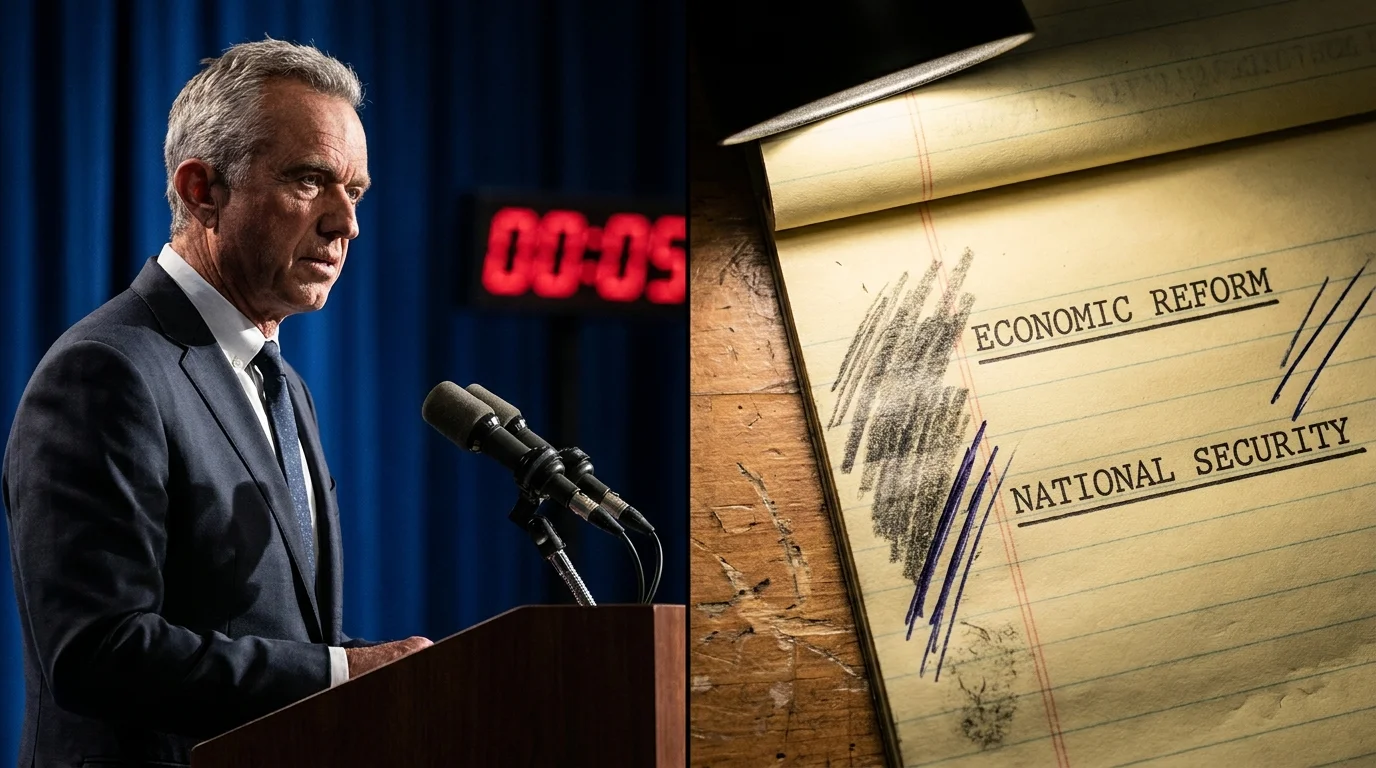
Picture a sheet of canary-yellow legal pad paper resting under the warm glare of a desk lamp. In the narrow left-hand margin, thick graphite gouges into the woodpulp fiber—slanted double lines, jagged brackets, and rhythmic phonetic slash marks cut so deep they leave physical ridges on the page beneath.
When Mario Cuomo stepped to the podium at the 1984 Democratic National Convention in San Francisco, the world heard an orator seized by spontaneous moral fire. His voice rose and dropped in rolling tidal waves, making a stadium of five thousand roaring delegates feel as intimate as a quiet living room in Queens.
Yet behind that electric delivery sat pages mapped out like a conductor’s master score. What looked like raw instinct was deliberate engineering, built sound by sound to command the physics of a crowded room.
You are taught to believe that historic persuasion belongs only to gifted speakers who step before an audience and let lightning strike. But examine the archival records of legendary political moments, and that romantic myth falls apart. Persuasion is not a mystery of personality; it is a discipline of acoustic pacing.
The Illusion of Raw Charisma and the Metronome in the Margin
Audiences rarely remember the exact policy paragraphs you recite, but their nervous systems react instantly to the cadence of your delivery. When a speaker rushes through complex thoughts without pause, listeners tighten their shoulders and tune out. The human ear needs acoustic landing pads to process weight and resolve tension.
Cuomo understood that spoken language behaves more like percussion than literature. The written word demands continuous reading, but spoken persuasion requires deliberate voids of quiet where the room can breathe with you.
By marking up text with heavy diagonal strokes, he created an artificial metronome. A single slash dictated a catch-breath; a double slash commanded a full two-beat hold to let an idea drop into the room; a triple slash signaled an intentional pause wide enough to invite a wave of applause.
- DOJ election monitors in Wyoming enforce sudden Republican leadership pivots on federal oversight
- Ohio governor race debates derail suburban party coalitions over disputed local property levies
- Strait of Hormuz naval security bills trigger emergency congressional floor votes over tanker escorts
- State capitol constituent delegation binders demand handwritten testimony to flip contested committee votes
- Nuclear regulatory licensing rules switch clean energy investments toward small modular steel reactors
Instead of hoping for a crowd to connect with an idea, he engineered the exact moments where their response was inevitable.
The Secret Behind the Archival Sheets
Elena Vance, a 42-year-old political archivist and rhetoric researcher in Washington, spends her days cataloging mid-century speaking drafts under white cotton gloves. She points out that the difference between an amateur draft and a historic address is almost always found in the margins rather than the vocabulary.
“When you pull Cuomo’s draft boxes, you do not see pristine prose,” Vance explains. “You see a physical battleground of rhythm. He would cross out beautiful adjectives just to insert a monosyllabic verb that hit like a drumbeat. If a sentence lacked an organic resting point, he would force one into the text with a graphite slash so hard it tore the corner of the margin.”
The Notation System: How Cadence Controls the Room
You can apply these exact notations to any address, high-stakes presentation, or public hearing. Understanding the mechanical purpose of each mark allows you to dictate the pulse of the room before you ever open your mouth.
The Single Slash: Micro-Breaths and Cadence Control
Written grammar serves the eye, not the vocal cords. Commas exist for syntax, but the single diagonal mark (/) exists to steady your pulse. Placing this mark right before a key noun prevents you from running out of air at the end of a thought.
The Double Slash: The Anchor Pause
Marking a double stroke (//) creates a deliberate two-second boundary. Silence forces the audience to lean inward, turning a standard statement into a dramatic revelation. It communicates total comfort with the room’s silence, projecting an unshakeable sense of authority.
The Phonetic Underline: Syllabic Weight
When you underline a single syllable within a word rather than the whole word itself, you instruct your vocal cords to drop half an octave. This prevents the upward inflection that makes statements sound like nervous questions, grounding your points with physical finality.
Adapting the Score to Your Speaking Arena
Different speaking environments require distinct acoustic architectures. You cannot deliver a high-energy ballroom speech in a low-ceilinged conference room without overwhelming your listeners.
- For the Crowded Hall: Space your double slashes generously after punchlines and sharp declarations. Large rooms have natural acoustic decay; speaking over your own echo creates auditory mud.
- For the Boardroom or Town Council: Rely heavily on single-slash micro-pauses. This slows your natural baseline speed by twenty percent, signaling composure and emotional control under direct scrutiny.
- For Digital or Broadcast Presentations: Underline stressed syllables to keep your audio levels consistent, preventing the microphone clipping that happens when untrained speakers shout to create emphasis.
The Mindful Blueprint: Scoring Your Next Address
Scoring a draft is a tactile, mindful exercise. Print your notes in a large typeface with triple line spacing, leaving wide margins for your hand to work.
- Read your draft aloud at half-speed: Notice where your chest naturally calls for oxygen, and place a single graphite slash at each point.
- Mark your applause or reaction gates: Add a double slash (//) after your three most important concepts, forcing yourself to hold still and count two full seconds in your head.
- Underline downward inflections: Identify the final word of every major claim and underline the first syllable to anchor your pitch downward.
- Prune polysyllabic clutter: Replace three-syllable Latinate words with direct, sensory terms that cut cleanly through room noise.
The Quiet Sovereignty of Measured Time
Real authority on a stage does not come from booming volume or wild hand gestures. It comes from having the discipline to claim the silence between your words.
Owning the pauses in your delivery tells your audience that you are not rushing to win their approval. When you master the scored pause, you stop chasing the room’s attention—you simply build the quiet spaces where they have no choice but to listen.
The power of an orator is not measured by the speed of their words, but by the weight of the silence they are willing to hold.
| Notation Element | Acoustic Mechanics | Added Value for the Speaker |
|---|---|---|
| Single Slash ( / ) | Dictates a fractional micro-breath before a critical phrase. | Prevents vocal strain and eliminates nervous filler words like ‘um’ or ‘ah’. |
| Double Slash ( // ) | Enforces a full two-to-three second silence. | Gives listeners time to digest complex claims and creates room for organic audience response. |
| Phonetic Underline | Commands a pitch drop on a targeted syllable. | Removes accidental upward inflections, making declarations sound grounded and certain. |
Frequently Asked Questions
How do I practice using phonetic slashes without sounding robotic?
Read your scored text along with a simple metronome set to 60 beats per minute. Treat the slashes as rests in music rather than hard stops, allowing your natural breathing to fill the gap.Should I write my slashes by hand or type them out?
Always write them by hand with a soft graphite pencil. The physical act of marking the page engages muscle memory and helps your vocal cords anticipate the pauses before you speak.How long should an intentional double-slash pause feel?
In your head, an intentional pause will feel uncomfortably long—almost like an eternity. To the audience, however, that two-second break registers as calm confidence and poise.Can this scoring system be used for spontaneous Q&A sessions?
Yes. You can train your mind to insert mental slashes before answering tough questions. Taking two full seconds of silence before your first syllable makes your answer sound considered and deliberate.What is the most common mistake speakers make with rhetorical pauses?
Filling the silence with nervous body movements, such as shuffling papers or shifting weight. When you hit a double slash, keep your feet planted and maintain eye contact with a single person in the room.