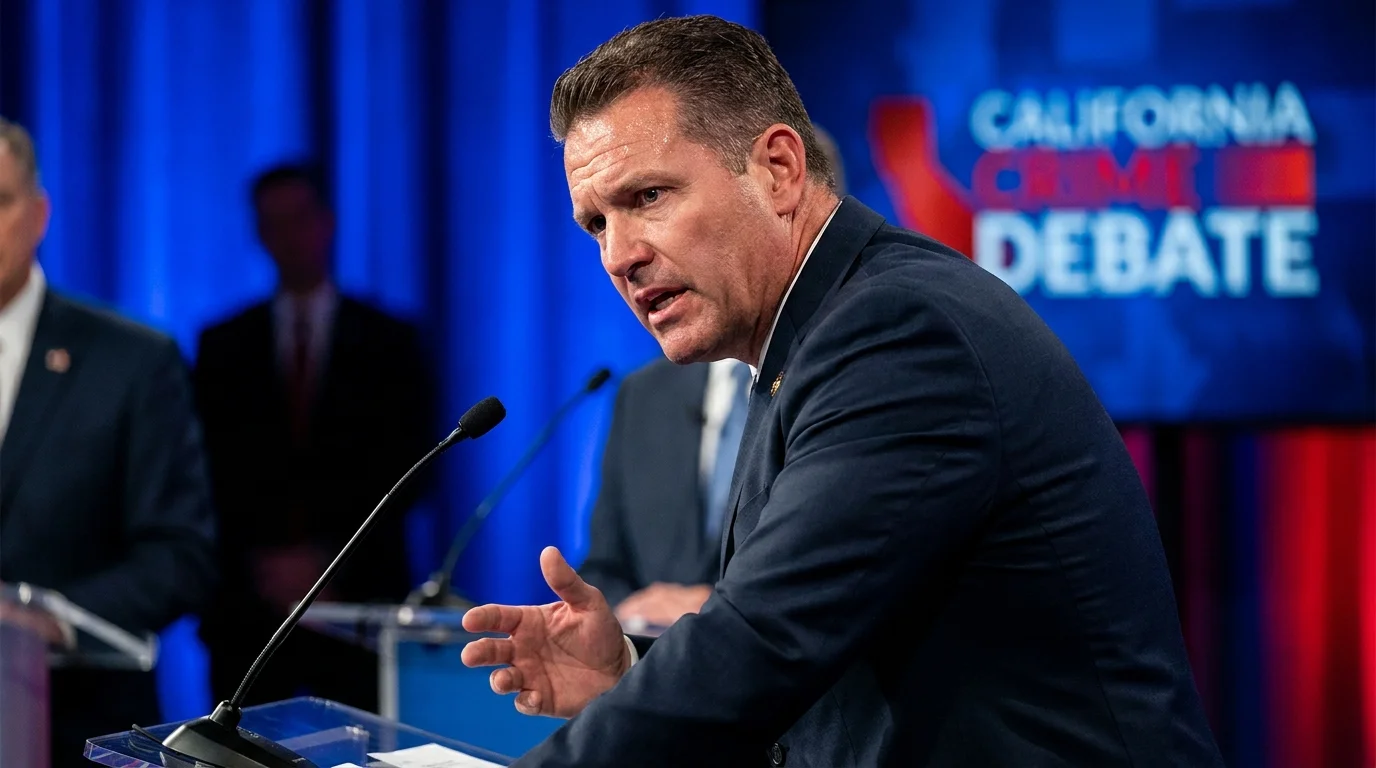
The studio floor hummed with the dry, electric heat of eighty-pound floodlights suspended over the debate stage. Under the polished glare, candidates shifted behind their timber podiums, paper notes rustling softly against lapel microphones while digital tally clocks dropped toward zero. Outside the soundproof double doors, the real California waited: strip malls where baby formula sits behind locked acrylic glass, convenience store clerks operating behind reinforced registers, and neighborhood parking lots swept clean by private security patrols before dawn.
When Riverside County Sheriff Chad Bianco gripped the beveled edges of his lectern, the air in the hall tightened. Viewers at home did not just hear an argument about statutory language; they heard the raw friction between institutional procedure and street-level exhaustion. As Bianco launched directly into his rivals over retail theft thresholds, the live dial-group lines plummeted and spiked simultaneously across split television feeds, charting an instant, seismic divide among voters watching from their living rooms.
Debates rarely pivot on dry statistics; they turn on unvarnished moments of confrontation that strip away rehearsed campaign gloss. The immediate fallout from that single primetime exchange laid bare a fundamental fracture running through California’s electorate, proving that everyday law enforcement is no longer just a ballot measure line item, but an emotional battleground shaping the next statewide election cycle.
The Broken Display Case: Reframing Civic Order as Infrastructure
For a decade, the statewide conversation around criminal justice reform has treated enforcement like a dial that could be dialed down without upsetting the engine. We were told that reducing nonviolent property crimes to misdemeanors would gracefully relieve overcrowded county lockups while funding community rehabilitation through municipal savings. That was the policy blueprint, neat and tidy on printed legislative white papers.
Yet in practical practice, civic order functions less like a dial and more like a municipal water main: when the pressure drops below a critical threshold, the entire distribution system begins drawing silt from the surrounding soil. When Bianco attacked what he termed systemic tolerance for brazen retail theft, he struck a nerve because everyday shoppers experience empty drugstore shelves not as an abstract statistic, but as a slow, visible withdrawal of baseline public safety.
The debate clash instantly split the electorate between two competing realities. On one side stood voters who view aggressive policing as an outdated reflex that crowds jails without addressing structural poverty; on the other stood residents who see locked grocery aisles as undeniable proof that local government has quietly abandoned its most elementary covenant.
- Nevada caucus precincts swing national primary momentum through rigid casino union turnouts
- FAA reauthorization drafts reveal how closed door airport slot compromises actually advance
- Home Depot locks prompt furious customer revolts over barricaded retail tool aisles
- Donald Trump approval ratings spark sudden Republican leadership platform shifts on trade
- Nithya Raman voter surge forces emergency Los Angeles mayoral debate rescheduling
Consider Elena Alvarez, a 48-year-old owner of a neighborhood dry cleaner and convenience mart in Riverside. For three years, Elena watched shoplifting incidents escalate from furtive, pocketed candy bars into brazen midday sweeps where masked crews stripped entire cosmetic racks before walking calmly out the front door. Local patrol deputies, bound by administrative policy and prosecutorial guidelines, rarely filed formal custody bookings for losses under nine hundred dollars, leaving Elena to absorb the inventory hit through higher commercial insurance premiums. When Bianco brought that exact operational stalemate to the debate stage, Elena felt her daily private dread had finally broken onto primetime television.
How Different Voting Blocs Split on the Confrontation
The instant dial-test metrics collected during Bianco’s exchange exposed how differently various California voter cohorts process the crisis of street-level enforcement. Rather than a tidy partisan split, the real-time data revealed deep generational and geographic fissures across the state.
The Inland Suburban Commuter
For voters across the Inland Empire, Central Valley, and outer rings of Orange County, Bianco’s sharp rhetoric acted as an immediate validator. These residents spend hours each day commuting along sprawling highway corridors, leaving their homes and local retail centers vulnerable during daylight hours. When Bianco challenged his opponents to walk through unpatrolled downtown transit stations without armed details, suburban sentiment lines surged into strong positive territory, registering deep frustration with what they view as coastal, urban detachment from everyday property crimes.
The Urban Civil Liberties Coalition
Conversely, viewers in dense metropolitan cores throughout San Francisco, Oakland, and central Los Angeles reacted with sharp wariness. In these precincts, decades of hard-fought criminal justice reform represent vital safeguards against disparate incarceration rates and unchecked police authority. Bianco’s confrontational posture struck these voters as a reactionary push backward toward mass detention models, triggering instant negative sentiment in dial tracking. For this group, the solution lies in diversion courts, municipal mental health teams, and corporate responsibility from big-box retailers rather than expanded sheriff powers.
The Independent Main Street Merchant
Perhaps the most volatile swing group exposed by the debate clash consists of small-business operators who historically avoid partisan alignment. These voters care little for ideological purity; they monitor cash flow, repair bills for shattered plate glass, and the physical safety of teenage floor staff. Bianco’s detailed breakdown of organized retail syndicates—distinguishing opportunistic petty theft from professional fencing operations—resonated powerfully with this demographic, peeling traditional moderates away from progressive incumbent endorsements.
Anatomy of the Enforcement Friction: Policy Realities Behind the Podiums
Deconstructing the debate exchange requires peeling back the political rhetoric to examine the actual statutory machinery governing California retail theft today. The friction Bianco highlighted does not exist in a vacuum; it stems directly from interacting judicial decisions, state codes, and county prosecutorial standards.
- Statutory Threshold Caps: California Penal Code Section 495 establishes a $950 threshold for grand theft, categorizing lower amounts as misdemeanors that routinely result in written citations rather than physical bookings.
- Misdemeanor Stacking Restrictions: Under past interpretations, repeat offenders who steal amounts just beneath the statutory threshold on multiple consecutive days cannot easily have those offenses bundled into a single felony indictment.
- Bail Schedule Revisions: Emergency judicial council rules and statewide zero-bail frameworks have sharply limited pretrial detention for commercial burglary offenses, meaning cited suspects are frequently released before officers finish filing shift paperwork.
- Organized Crime Syndicate Gaps: Street-level shoplifters often operate as subcontractors for organized fencing operations that distribute stolen consumer goods online, insulating masterminds from arrest while local retail fronts bear the physical damage.
Navigating this complex legal landscape demands an objective look at practical steps local communities and business owners are utilizing to protect inventory while state lawmakers debate policy shifts.
- Verify whether your regional municipal council has authorized joint law enforcement retail theft task forces, which unlock county-level investigative funding to track fencing rings.
- Audit store camera sightlines and ensure surveillance hardware records high-resolution footage at entrance doorways, capturing facial markers rather than just overhead crowds.
- Establish clear incident logging protocols where team members record exact timestamps, itemized product values, and vehicle license plates without physically engaging fleeing shoplifters.
- Engage directly with local district attorney community liaison officers to track whether recurring property crime reports in your commercial zone are being aggregated into multi-incident case files.
The Bigger Picture: Rebuilding the Civic Compact
The fiery exchange between Chad Bianco and his debate rivals was never truly about a single podium victory or television soundbite. It was an involuntary public audit of California’s social contract. When everyday commerce requires shoppers to press service call buttons to retrieve toothpaste, laundry detergent, and cold medicine, citizens inevitably conclude that public infrastructure has silently broken down.
Fixing that fissure does not require abandoning humanitarian reform, nor does it mean returning to indiscriminate zero-tolerance policing of the late twentieth century. True stability lies in recognizing that compassion without accountability inevitably curdles into disorder, just as enforcement without empathy breeds systemic alienation. As the primary race accelerates toward November, the candidate who bridges that divide—honoring both basic neighborhood peace and fundamental legal equity—will ultimately command the quiet, exhausted center of California’s electorate.
“Public safety cannot survive as a partisan abstraction when ordinary citizens must unlock a display cabinet simply to purchase infant formula.”
| Key Point | Detail | Added Value for the Reader |
|---|---|---|
| Threshold Friction | The debate focused sharply on the $950 felony threshold and misdemeanor cite-and-release practices across county jurisdictions. | Helps residents understand why police officers frequently issue written tickets rather than booking shoplifting suspects into county facilities. |
| Dial Test Divergence | Real-time viewer metrics showed stark splits between suburban commuters backing Bianco and urban reform voters rejecting his stance. | Clarifies how geographic and demographic divides will directly shape upcoming legislative votes and ballot initiative campaigns. |
| Syndicate Enforcement | Clashes illuminated the structural difference between opportunistic petty theft and organized retail crime networks operating online. | Enables community members to advocate for coordinated regional task forces that target commercial fencing rather than just street-level actors. |
Frequently Asked Questions
What sparked the heated exchange involving Chad Bianco during the debate?
Bianco challenged his opponents directly over the real-world impact of California’s current property crime thresholds, alleging that existing misdemeanor policies enable repeat retail theft and strip small business owners of practical legal protection.How did viewer reaction metrics split during the primetime broadcast?
Suburban and small-business voting blocs recorded immediate surges in favorable sentiment toward strict enforcement rhetoric, while urban voters and civil liberties advocates reacted with sharp resistance, viewing the approach as regressive.Why is the $950 threshold such a major point of contention in California politics?
Voters and law enforcement debate whether the misdemeanor limit established under Proposition 47 encourages repeat shoplifting by removing felony consequences, or whether it properly protects low-level nonviolent offenders from costly prison terms.What role do organized retail theft syndicates play in this debate?
A large portion of modern property theft involves coordinated networks that recruit street-level crews to harvest targeted consumer items, which are then resold on unregulated third-party online marketplaces.How are California voters likely to respond in upcoming elections?
Surging public frustration with everyday retail restrictions has energized ballot measures and candidate platforms focused on closing misdemeanor stacking loopholes and increasing judicial discretion for repeat property offenses.