The dry four o’clock morning air slicing across the employee parking garages behind the Las Vegas Strip does not carry the glamour of prime-time politics. You hear the rhythmic rattle of rolling laundry carts and the steady hiss of commercial steamers pressing table linens long before anyone mutters a word about presidential races. While national news desks obsess over multi-million-dollar television ad buys and glossy stump speeches, the genuine engine of electoral power hums beneath buzzing fluorescent tubes in hotel utility basements.
Step past the security turnstiles of the major resort properties, and the glossy narrative of early primary politics quickly dissolves. Campaign operatives flying in from Washington often assume high poll numbers translate cleanly into early momentum. They arrive with slick binders and high-altitude talking points, expecting voters to line up the way audiences file into an afternoon theater matinee.
The mechanical thrum of casino chillers tells an entirely different story. Out here, early state authority is not earned through a witty debate quip or a viral social clip. It is hammered out in cramped union staging rooms where line cooks, utility porters, and guest room attendants trade notes on shift handoffs and healthcare grievance backlogs before deciding whose name they will carry onto the caucus floor.
The Hydraulic Reality of the Strip’s At-Large Precincts
You have likely been taught to view voting as an isolated act of individual conscience—a private moment behind a curtain where a voter weighs policy promises in total solitude. But in the at-large caucus rooms tucked directly into the back-of-house casino properties, participation functions more like industrial hydraulics. It requires concentrated, synchronized human pressure channeled through a very narrow gate.
When an insurgent candidate hits Nevada, their primary viability hinges entirely on understanding this collective tension. Building ground-level floor power means recognizing that working-class shift laborers do not experience political proposals as abstract philosophies. They measure a campaign by whether its organizers show up to pre-dawn rallies, respect the cadence of graveyard turnarounds, and acknowledge the rigid shop-floor hierarchy that keeps a multibillion-dollar resort corridor running smoothly.
If a national campaign treats Clark County as just another media market to flood with digital banner ads, it hits an invisible wall the moment the precinct captain calls the room to order. The math of these caucus rooms does not bend to national reputation; it bends to physical presence, shared labor ties, and disciplined floor alignment.
- FAA reauthorization drafts reveal how closed door airport slot compromises actually advance
- Home Depot locks prompt furious customer revolts over barricaded retail tool aisles
- Donald Trump approval ratings spark sudden Republican leadership platform shifts on trade
- Nithya Raman voter surge forces emergency Los Angeles mayoral debate rescheduling
- Senator Mitch McConnell floor maneuvers block emergency Ukraine defense spending package
The Shop Steward’s Ledger
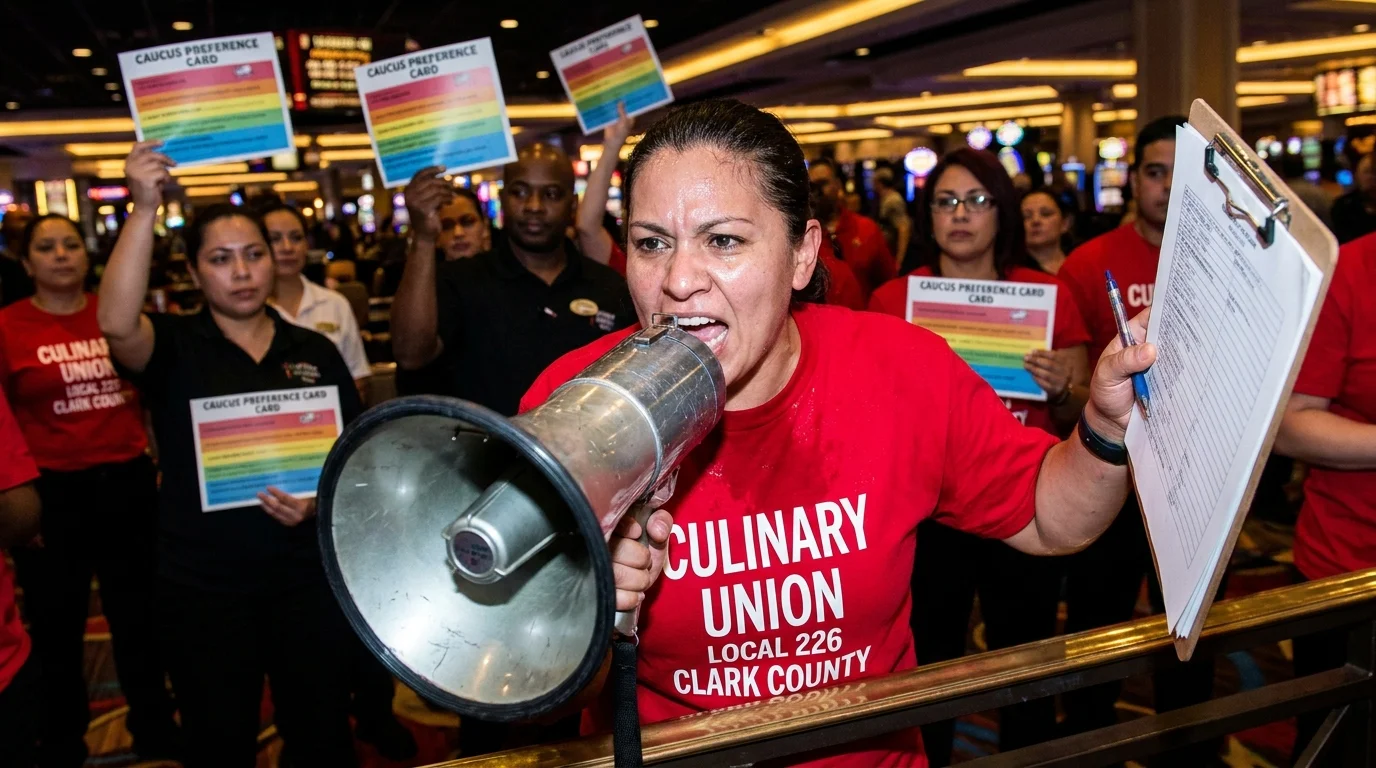
Elena Alvarez, a 49-year-old guest room attendant at the Mandalay Bay and a shop steward for Culinary Workers Union Local 226 for two decades, knows precisely how thin a candidate’s veneer really is. Over twenty years, Elena has watched half a dozen insurgent presidential hopefuls stride through the union dining hall, attempting to speak the language of blue-collar grievance through rehearsed anecdotes. She sits quietly at the corner table, her clipboard resting beside an insulated coffee thermos, taking note of which campaign aides actually understand how a casino floor operates and which ones look uncomfortable shaking hands with someone wearing latex cleaning gloves. When caucus morning arrives, Elena does not care about national endorsements or trending hashtags; she cares about the fifty-four workers on her floor who trust her guidance on healthcare protections and overtime pay. When Elena walks to a designated corner of the banquet hall, her entire department moves with her in a single, unbroken stride, instantly erasing months of outside polling advantages.
The Organizing Fault Lines Across the Shift Schedule
Navigating the complex ecosystem of Nevada caucus precincts requires breaking the voting public into distinct working realities, each governed by its own strict logistical clock:
- The Graveyard Shift Vanguard: Workers finishing their shifts at 6:00 AM arrive at morning precinct sites running on raw willpower. They have zero patience for drawn-out rhetorical flourishes or disorganization; they demand an efficient check-in process so they can cast their vote and return home to sleep.
- The Suburban Kitchen-Table Block: Outside the tourist corridor, in neighborhoods across Henderson and North Las Vegas, precinct dynamics resemble traditional suburban contests. Here, working parents juggle school drop-off schedules and rising utility bills, weighing a candidate’s concrete stance on local housing costs over grand national visions.
- The Tipped Front-of-House Segment: Bartenders, food servers, and cocktail runners whose weekly income swings with convention traffic. They look past standard talking points, seeking candidates who demonstrate a technical understanding of tipped wage tax regulations and predictable scheduling laws.
Balancing these competing shift demands is where amateur field directors fail. You cannot hold a single evening telephone town hall and assume you have spoken to the workforce. In Las Vegas, an organizer who cannot work a 24-hour cycle is essentially invisible to half the electorate.
The Precision Math: Breaking the 15 Percent Viability Floor
Surviving a Nevada caucus room requires a clinical mastery of precinct math. If you want to understand how momentum is manufactured or broken in a single afternoon, you must track the mechanics of the floor realignment process:
- Identify your designated precinct floor leader at least forty-eight hours before doors open, ensuring they hold direct personal relationships with neighbors across the voting boundary.
- Establish an immediate head count the second registration closes, calculating the room’s total attendance against the statutory viability threshold.
- Deploy trained persuaders to engage uncommitted clusters or supporters of non-viable candidates during the crucial twenty-minute realignment window.
- Maintain disciplined physical spacing in the room, creating an open, welcoming presence that draws undecided participants toward your candidate’s alignment group.
- Log the final delegate certificates with precinct chairs before leaving the room, preventing clerical reporting discrepancies before results are transmitted to headquarters.
Mastering the room’s spatial dynamics transforms raw turnout into actual state convention delegates. The margin between a breakout victory and an embarrassing third-place finish frequently comes down to less than a dozen people crossing a gymnasium floor before the final realignment whistle blows.
Your tactical organizing toolkit requires exact numbers rather than vague enthusiasm: keep your target set at exactly fifteen percent of total attendees in multi-delegate rooms to avoid elimination, limit your persuasive pitch to three minutes during the realignment scramble, and maintain a forty-minute time buffer to account for shift-worker transportation between hotel staging lots and neighborhood voting sites.
Why Ground Floor Organization Outlasts Media Momentum
When you look past the noisy spin cycles and television commentary, the reality of Nevada’s early contest offers a grounding truth. Politics is not a game played exclusively through satellite uplinks and billionaire-funded super PAC accounts. At its absolute core, power still belongs to people who gather in community center gymnasiums and resort ballrooms, standing shoulder to shoulder to demand accountability from those who seek the highest office in the land.
Understanding this balance of power returns control to your hands as a voter and an observer. When you see how a disciplined group of hospitality workers can turn the tide of a nationwide primary race simply by organizing their workplace lunchrooms, the entire national spectacle feels far less intimidating. Real influence is not granted from above; it is built patiently from the ground up, shift by shift, precinct by precinct.
“The candidate who relies on a television screen to win Clark County will always be humbled by the organizer who knows the kitchen staff by their first names.”
| Key Point | Detail | Added Value for the Reader |
|---|---|---|
| At-Large Strip Sites | Caucus locations inside major casino properties for on-shift workers. | Explains how resort workers participate without sacrificing daily shift wages. |
| 15% Viability Rule | Minimum floor support required to qualify for precinct delegate awards. | Provides the exact numerical standard needed to track live precinct returns. |
| Realignment Scramble | A 15 to 30-minute window where eliminated groups switch to viable candidates. | Reveals why second-choice preferences matter more than initial polling leads. |
| Steward Influence | Trusted workplace leaders directing department voting blocs. | Demonstrates why labor relationships outweigh national media advertising buys. |
Frequently Asked Questions
What makes Nevada caucus precincts distinct from Iowa or New Hampshire?
Nevada combines traditional neighborhood voting with specialized at-large precinct sites directly inside casino resorts, allowing hospitality shift staff to participate during work hours.How does the 15 percent viability threshold work on caucus day?
Candidates who fail to reach 15 percent of total attendees in a given room are eliminated, forcing their supporters to realign with viable candidates or mark themselves uncommitted.Why is the Culinary Union Local 226 so decisive in early primary momentum?
With roughly 60,000 members across Clark County, the union possesses an unrivaled field infrastructure capable of turning out disciplined, reliable voting blocs on short notice.Can an insurgent candidate win Nevada without institutional labor endorsements?
Yes, but only by building a massive grassroots operation that directly engages rank-and-file shift workers and suburban Latinx voters outside formal union endorsement channels.How quickly do Nevada caucus results impact national race dynamics?
Because Nevada is the first racially diverse early state on the calendar, a decisive victory here reshapes donor confidence and narrative momentum heading directly into Super Tuesday.