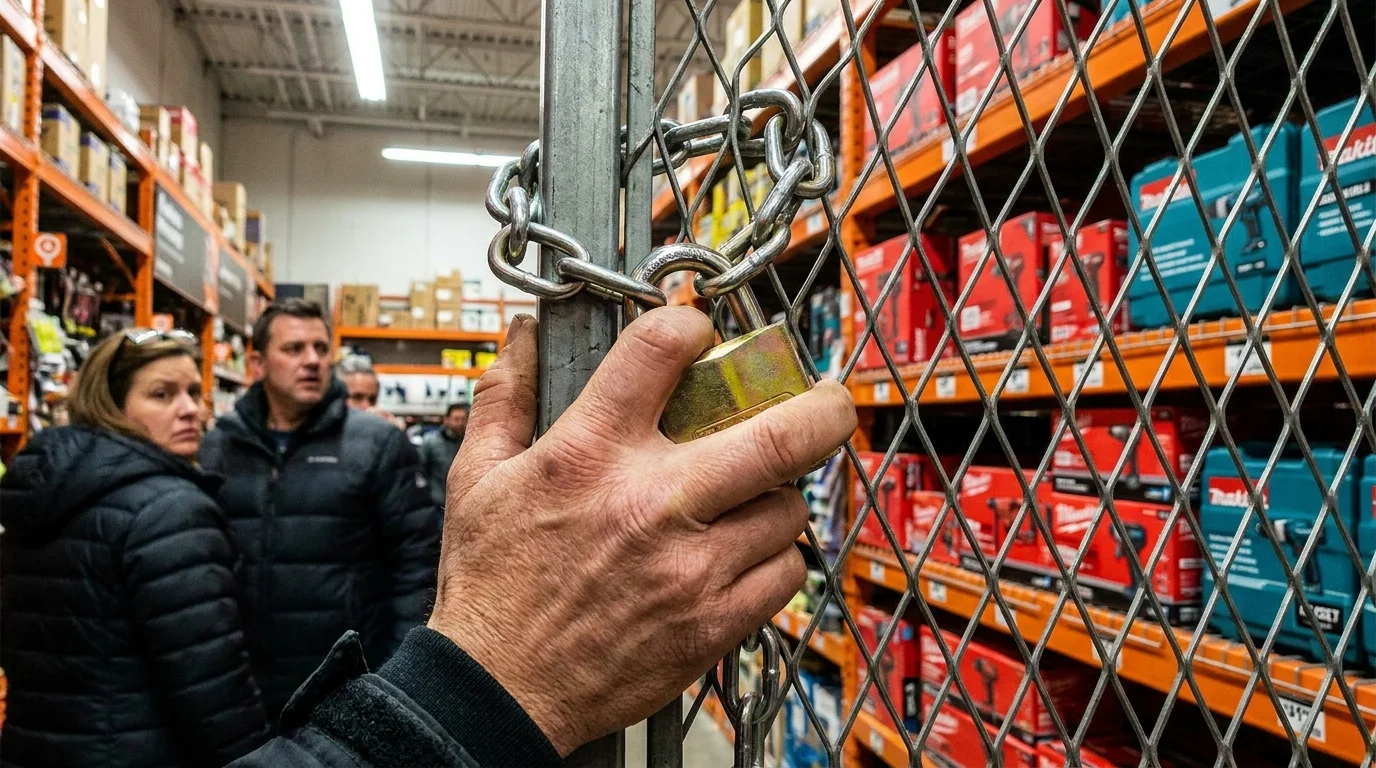
The familiar scent of cedar shavings, damp concrete, and machine grease usually carries a steady rhythm of weekend productivity. You push a squeaking flatbed cart toward the tool corals, your mind fixed on finishing a backyard deck before Sunday night. But when you turn the corner into aisle twelve, the familiar expanse of brushless drills and circular saws is obscured behind thick steel mesh, padlocked swing-gates, and glare-heavy acrylic shields.
Instead of hefting a cordless impact driver to balance its weight in your palm, you find yourself staring at an electronic call button. You press it. A pleasant recorded chime echoes overhead, promising assistance that fails to materialize while the digital clock ticks past eight minutes, then twelve. The retail floor feels quiet, punctuated only by frustrated mutters from contractors stranded beside barricaded shelves.
Around you, the transaction breaks down. Shoppers who walked in with cash and urgent renovation deadlines are abandoning full carts in the cross-aisles, turning on their heels, and walking directly toward the automatic sliding doors. What began as a corporate initiative to deter organized retail crime has morphed into a sudden rupture in daily community retail, triggering impromptu boycotts and viral outrage across the country.
The Cage Culture and the Broken Retail Compact
For decades, big-box hardware shopping relied on an unspoken, sensory contract. You inspected the chuck on a drill, checked the grip clearance with work gloves, and walked to the registers with immediate agency. Today, that physical connection has been severed, turning your neighborhood warehouse into a panopticon of locked steel cases and blinking surveillance towers.
Corporate loss-prevention suites viewed high-security cages as an algorithmic fix for shrink numbers, yet they miscalculated the human friction of waiting twenty minutes for a master key. The cage acts like breathing through a pillow—choking off casual commerce in a bid to stop illicit inventory leaks. When buying a box of structural fasteners or a basic reciprocating saw requires three separate store employees and a radio dispatch, shopping ceases to be an errand and becomes a test of endurance.
- Donald Trump approval ratings spark sudden Republican leadership platform shifts on trade
- Nithya Raman voter surge forces emergency Los Angeles mayoral debate rescheduling
- Senator Mitch McConnell floor maneuvers block emergency Ukraine defense spending package
- Voter registration forms invalidate thousands of primary ballots over missing middle initials
- Agricultural transport waivers expire tonight halting regional produce shipping across state borders
Marcus Vance, a forty-four-year-old general framing contractor in suburban Atlanta, experienced this breaking point on an ordinary Tuesday morning. Needing two replacement masonry bits and a framing nailer to keep a four-man crew working on a paid hourly schedule, he stood by a padlocked bay for twenty-two minutes before walking out empty-handed. “My crew was burning ninety dollars an hour in idle wages while I waited for someone to find a physical key ring,” Marcus explained, having since shifted his supply account to an independent regional lumberyard where open bins remain the standard.
Navigating the Hardware Barricades: Three Distinct Reality Layers
The impact of this retail hardening ripples differently depending on who holds the cart handle. How you adapt depends entirely on what is at stake when the gates stay locked.
For the On-the-Clock Tradesperson
Every delayed minute on a commercial run drains margin from a fixed-bid job. Waiting on corporate lockboxes is not merely an inconvenience; it represents direct payroll decay. Tradespeople are shifting heavily toward early-morning will-call lockers, bypassing the retail floor entirely, or negotiating commercial deliveries directly to the job site to eliminate retail floor dependency.
For the Weekend DIY Renovator
Casual home improvers often abandon unplanned impulse purchases at the first sign of a security barrier. If inspecting a replacement router requires waiting behind two other summoned shoppers, that tool purchase is instantly deferred to digital overnight delivery from a phone screen in the parking lot. The physical retail advantage of tactile certainty vanishes the second acrylic sheets block the hand.
For the Shift Floor Worker
Store associates bear the emotional blunt force of customer fury without holding the managerial authority to alter corporate store policy. Juggling cross-department master keys leaves floor staff stretched thin, answering dozens of distant pager alerts while trying to restock adjacent bays under continuous verbal pushback from weary patrons.
The Tactical Toolkit for Surviving the Locked Floor
You can avoid the gridlock of barricaded aisles by applying a few practical operational rules to your hardware runs.
- Audit inventory by app bay coordinates: Before walking inside, check local stock quantities in the mobile app. If inventory displays fewer than three units, that locked cage is frequently empty due to stock discrepancies.
- Bypass the floor call button: Head directly to the commercial Pro Desk at the back or side entrance. Pro Desk associates carry master clearance overrides and can pull locked stock faster than general floor clerks.
- Utilize exterior curbside staging: Order high-value power tools through the curbside fulfillment channel two hours in advance, forcing store pickers to navigate the keys while you remain off the floor.
- Time your arrivals to shift crossovers: The smoothest floor access occurs between 6:00 AM and 7:15 AM on weekdays, before contractor surges hit and while loss-prevention staffing is dedicated exclusively to opening cages.
The Human Cost of Friction Commerce
When retail spaces retreat behind steel bars, they do more than protect quarterly margins; they erode the quiet social trust that makes a community operate smoothly. A neighborhood hardware store has long served as a baseline of civic self-reliance—a place where problems are diagnosed, raw materials are handled, and solutions are built by hand. Swapping that trust for padlocked gates sends an implicit message that every resident entering the door is treated as a liability first and a neighbor second.
Reclaiming your peace of mind means refusing to let corporate security friction dictate your productivity. By understanding the retail pressure points, leveraging alternative fulfillment paths, and supporting regional suppliers who still value open shelves, you regain control over your time and your work. The true value of a tool has never been just the metal and motor—it is the freedom to pick it up and get the job done.
“When a business decides to padlock its merchandise away from honest hands, it trades away long-term customer goodwill for short-term shrink control.”
| Key Point | Detail | Added Value for the Reader |
|---|---|---|
| Pro Desk Access | Commercial checkout registers hold master keys and bypass floor queues. | Saves up to twenty minutes of idle waiting time per aisle visit. |
| Curbside Staging | Associates pull locked tools into staging lockers prior to your arrival. | Eliminates face-to-face friction and cage-call delays entirely. |
| Inventory Latency | On-shelf inventory under three units often indicates misplaced or phantom stock. | Prevents wasted trips to empty cages and saves weekend project time. |
Frequently Asked Questions
Why are Home Depot stores locking up everyday tools and supplies?
Retail chains have implemented padlocked cases and wire cages to combat rising organized retail crime and product shrinkage, particularly targeting portable, high-resale cordless power equipment.Do call buttons on tool cages alert workers immediately?
Yes, the electronic buttons send automated radio or pager alerts to floor associates, though chronic understaffing often causes significant response delays during peak hours.Can I buy a locked power tool online and pick it up in-store?
Yes, using the store mobile app for buy-online-pickup-in-store (BOPIS) forces employees to unlock and stage the tool in advance, saving you floor wait time.Are store managers authorized to remove locks if customers complain?
Individual store managers rarely have the authority to remove security cases, as these loss-prevention protocols are handed down by regional and corporate risk management divisions.Where can I shop if I want to inspect tools before buying?
Independent lumberyards, local cooperative hardware stores (such as Ace or True Value), and specialty woodworking shops often keep their tool displays fully accessible without security barriers.