The studio floor smells of heated gaffer tape and industrial ozone, a heavy dryness that coats your throat after five minutes under four hundred foot-candles of overhead key light. You look at the center stage from home and register crisp worsted wool suits, razor-sharp jawlines, and polished wooden podiums crafted to project an aura of effortless command. The television feed isolates their faces, cropping out the mechanical skeleton that actually dictates every syllable rolling off their tongues.
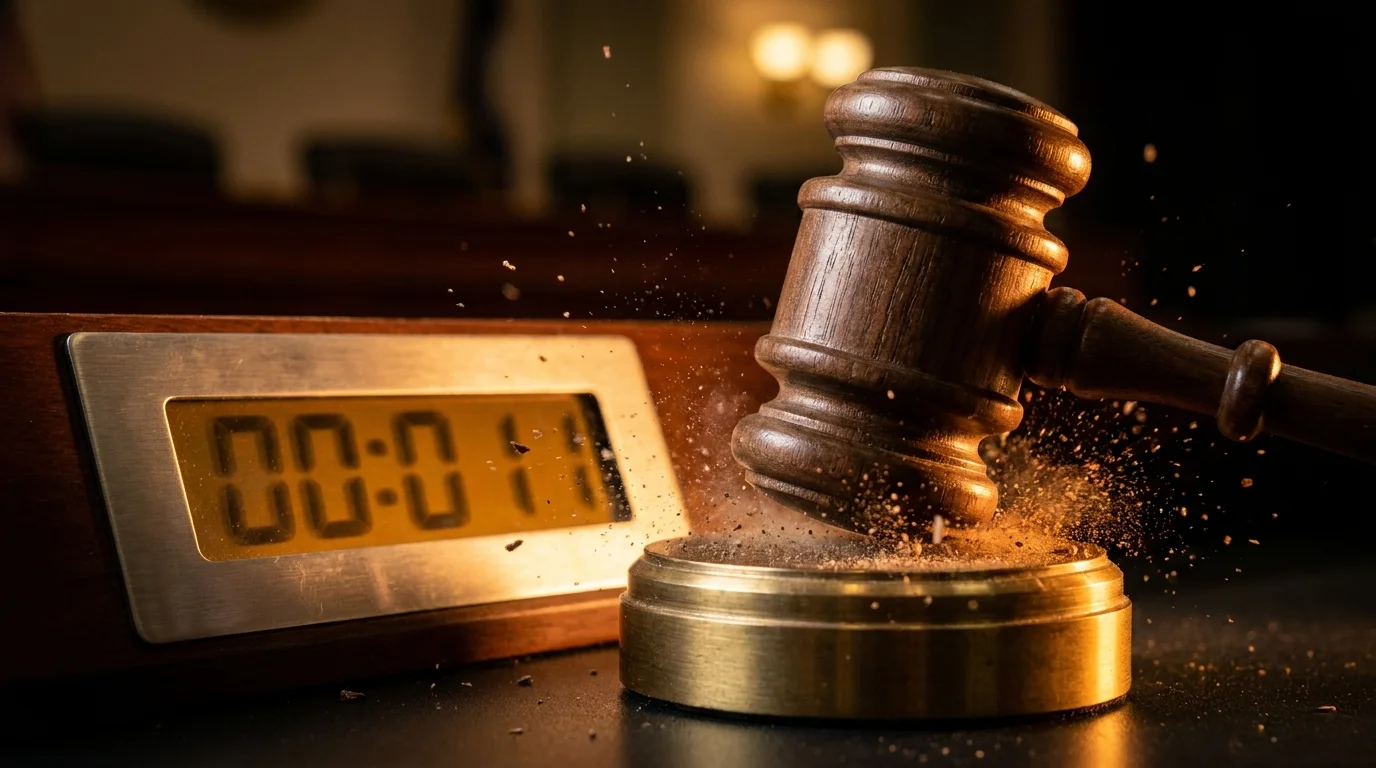
Tucked into the beveled lip of each lectern, sitting three inches below natural line of sight, rests an unpainted aluminum chassis fitted with a segment array of high-intensity light-emitting diodes. When a moderator finishes tossing a sixty-second query, that recessed bezel springs alive with cold red characters, ticking down past thirty, twenty, fifteen. Then comes the color transition that disrupts the central nervous system: blinking amber numerals flicker in peripheral vision, strobe-pulsing at twice per second to scream that five seconds remain before the open microphone abruptly cuts to dead silence.
To an audience sitting on a living room couch, the moment appears as a sudden, humiliating intellectual stall. A front-runner begins an articulate defense of energy subsidies, pauses mid-clause, glances slightly downward with dilated pupils, and abruptly blurts a half-formed slogan that sounds like high school debate panic. You assume they simply forgot their platform, or ran out of facts under cross-examination pressure. In reality, their retinas were just violently ambushed by an unforgiving optical metronome designed to induce instantaneous verbal vertigo.
The Peripheral Trap: Why Precision Breaks Under Optical Strobe
We are taught to treat public speaking as a purely cognitive exercise, an arena where deep knowledge naturally yields smooth rhetoric. If you master your brief, you should never wander into a thicket of broken sentences. Yet televised political debates are not academic symposiums; they are sensory obstacle courses engineered for broadcast pacing, where visual friction sabotages natural cadence long before mental fatigue sets in.
Think of it like driving a mountain pass at seventy miles per hour while someone rhythmically flashes high-beams across the lower rim of your windshield. You do not suddenly forget how to steer your vehicle; instead, your autonomic nervous system redirects optical processing power away from the road ahead to triage the bright intrusion at the bottom of your visual field. When an amber numeral blinks on a dark stage, your ocular saccades trigger an involuntary twitch. Your speech centers freeze for three-tenths of a second while your brain attempts to calculate remaining syllable counts against a dying digital clock.
Elena Rostova, a 48-year-old debate prep coordinator who has conditioned governors and senators through four election cycles, treats these recessed timers as physical adversaries rather than neutral stage fixtures. During locked-door mock sessions inside an empty warehouse in northern Virginia, she installs customized pulsing strobes directly into podium shells, deliberately firing off erratic flashes while candidates rehearse Medicare answers. Rostova knows that a politician can possess encyclopedic policy grasp, yet still sound utterly disoriented the second their peripheral vision registers that sudden shift from solid crimson to jumping amber.
- Quinnipiac University phone rosters strip working voters under crackling cell audio filters
- Ronald Reagan teleprompter scripts demand absolute audience silence using tiny handwritten breath marks
- Mitch McConnell floor directives switch Senate defense spending rules behind heavy brass doors
- Letitia James civil fraud judgments trigger emergency corporate asset auctions across bustling Manhattan courts
- Supreme Court emergency stay orders derail federal water pollution rules across muddy river basins
The Three Archetypes of the Countdown Breakdown
How an aspirant handles the harsh glare of the lectern countdown reveals their subconscious relationship with airtime. The timer acts as a psychological prism, splitting standard political rhetoric into distinct survival reflexes under broadcast pressure.
The Soundbite Sprinter: This candidate relies on memorized sixty-word prose blocks carefully polished by media consultants. When the blinking amber numerals catch their eyes at the eight-second mark, they instinctively downshift into hyper-speed, trying to cram a thirty-word conclusion into five seconds of real estate. You watch their shoulders rise toward their ears, their diction blur, and their breathing turn ragged, transforming an inspiring closing line into a breathless auctioneer chant.
The Explainer’s Trap: Common among technocrats and policy veterans, these speakers believe every voter craves complete institutional nuance. They treat the first forty seconds as mere throat-clearing, deliberately setting up complex legislative history before arriving at their actual solution. The moment the amber strobe starts dancing off their forearm, panic forces a catastrophic truncation of their central argument, stranding the audience with an unfinished thought that sounds like evasion.
The Screen-Stare Glacer: Some debaters lack peripheral filtering altogether, meaning they cannot process an illuminated readout without breaking eye contact with the television camera. You see their gaze visibly drop downward to verify the numbers, instantly severing the intimate optical thread connecting them to millions of undecided voters. That fleeting, quarter-second downward glance reads on high-definition screens not as time management, but as guilt, shame, or sudden loss of conviction.
The Mechanics of Mastering the Stage Clock
Survival on a televised stage requires learning to treat podium hardware as an external ambient rhythm rather than an emergency alarm. Candidates who appear relaxed and authoritative do not possess better working memories; they run strict mechanical protocols designed to insulate their speech centers from sudden visual triggers.
You can observe these exact behavioral calibrations when watching experienced performers navigate high-stakes broadcast environments without losing their composure:
- Anchoring the Focal Plane: Veteran debaters fix their eyes strictly on the bridge of an opponent’s nose or directly down the camera barrel, consciously locking their head position to keep recessed countdown hardware out of their functional foveal zone.
- The Internal Cadence Clapper: Rather than relying on stage hardware, top communicators train their speaking rhythm to internal physical pulses, structuring every response into predictable twenty-second breathing cycles.
- The Strategic Parachute: Media strategists drill specific seven-word exit phrases that make grammatical sense at any point in an answer, allowing a candidate to cleanly bail out the split second an amber flash appears.
- Ignoring the Final Strobe: Top performers deliberately train themselves to treat flashing indicators as meaningless ambient light, forcing broadcast stage managers to cut the microphone while they finish an unhurried, resonant sentence on their own terms.
The difference between a viral gaffe and an authoritative soundbite is rarely a matter of policy command. It is the physical ability to hold a steady vocal tone while an LED board two feet away flashes frantic amber warnings across your peripheral vision.
The Illusion of Intellectual Spontaneity
When you watch the next major debate cycle, peel your attention away from the scripted lines and pay close attention to the bottom edges of the screen. Look for the faint amber reflections bouncing off the cuffs of a candidate’s dark jacket, or the rhythmic amber pulses illuminating the polished chrome base of a microphone stem. Once you recognize the optical pressure cookers built into those wooden risers, the spectacle transforms from an ideological clash into an unforgiving technical performance.
Seeing this mechanical scaffolding strips away the false intimacy of modern television politics. You realize that what we casually dismiss as unfitness, deceit, or mental decay is frequently just the sheer physical disorientation of human eyes struggling against aggressive broadcast automation. When you see through the stage architecture, you no longer judge a leader by whether they survived a blinking clock, but by how skillfully they managed the hidden machinery designed to make them falter.
The lectern timer is not there to keep the broadcast organized; it is built into the woodwork to make human composure collapse on live television.
| Key Point | Detail | Added Value for the Reader |
|---|---|---|
| Peripheral LED Hazard | Recessed amber displays pulse at 2 Hz inside the lectern bezel. | Explains sudden mid-sentence pauses without blaming policy ignorance. |
| Truncation Reflex | Candidates ditch central arguments to beat an arbitrary countdown. | Helps you spot when an answer was cut short by clock panic rather than malice. |
| Downward Eye Dart | A quarter-second gaze drop breaks intimacy with the camera lens. | Teaches you to distinguish genuine evasiveness from mechanical hardware checks. |
Frequently Asked Questions About Debate Stage Dynamics
Why do debate organizers use blinking lights instead of auditory tones?
Auditory buzzers bleed directly into directional microphones and disrupt the home broadcast sound mix, whereas visual strobes remain invisible to standard camera framings while forcefully commanding the candidate’s retinas.Do all podiums feature identical time displays?
No, network layouts vary widely. Some utilize recessed multi-color LED readouts inside the counter edge, while others mount standalone digital boxes beneath the moderator tables across the studio pit.Can candidates see the timer without visibly dropping their heads?
Only if their peripheral vision is unusually wide. Because the displays sit angled below the surface to stay hidden from sweeping jib cameras, reading the exact digit usually demands a conscious dip of the chin.Why don’t campaigns insist on removing stage timers?
Network production guidelines dictate rigid commercial breaks and live broadcast blocks, leaving candidates with zero contractual leverage to alter the technical timekeeping architecture.What happens when a debater speaks straight through the warning flash?
Control room audio engineers execute an automated mute sequence on the podium microphone, leaving the candidate mouthing words silently on national television.