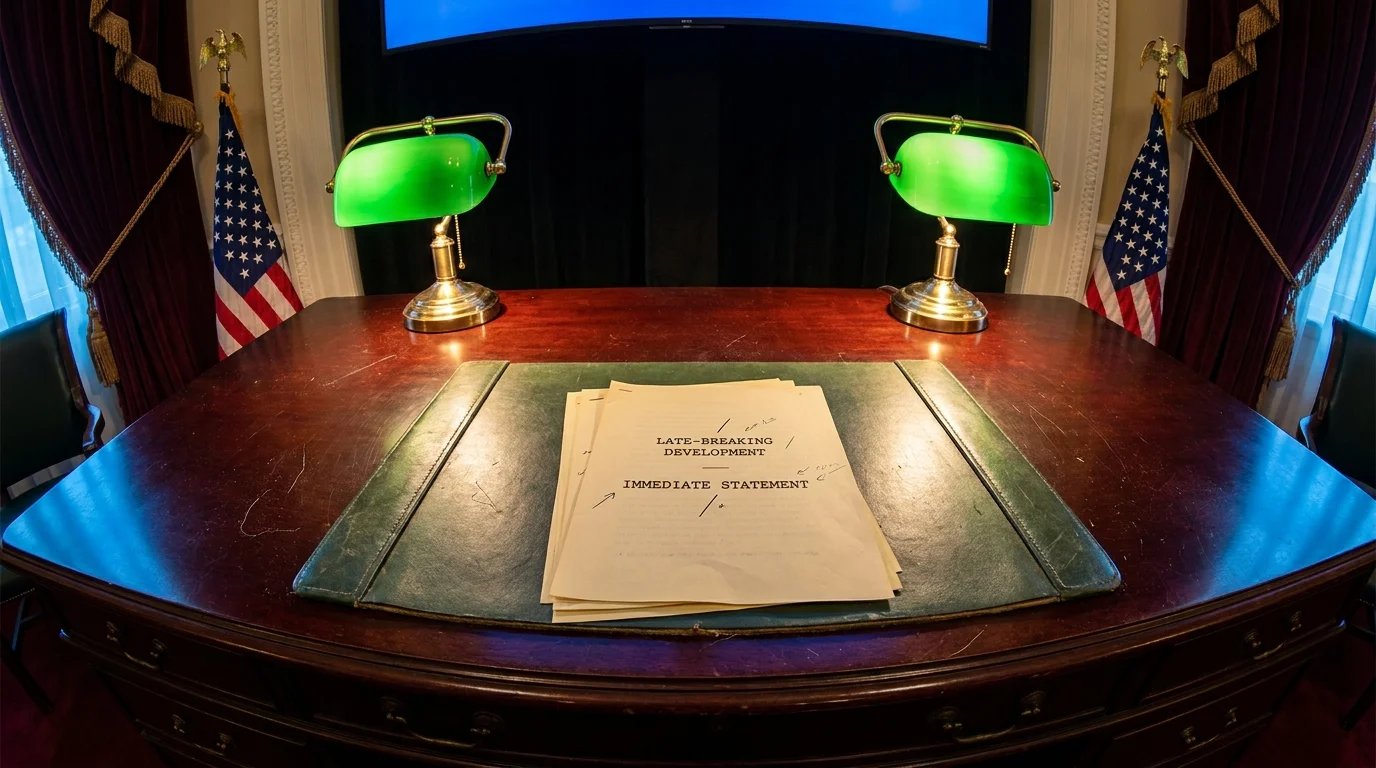
The television studio lights hum at a low sixty-cycle frequency, warming the Oval Office air until it smells faintly of dry carpet and baking vacuum tubes. You sit inches from the television monitor, watching a man who seems to be chatting with you from across a pine kitchen table. His head tilts, his shoulders drop, and an easy, grandfatherly chuckle fills the space between sentences. To millions of living rooms in 1984, this looked like raw, effortless intimacy, as natural as a porch conversation on an August evening.
Behind the dual panes of glass flanking the lectern, however, sat a completely different reality. Tiny handwritten breath marks penciled in faint graphite ran across the margins of the scrolling green text, dictating the rise and fall of every lungful of air. Those famous cadences were not born in the throat on the fly; they were engineered on bond paper with the mechanical precision of an orchestral score.
Whenever modern campaigns re-examine the gold standard of televised persuasion, they tend to obsess over speech themes, folksy jokes, and television makeup. They miss the physical scaffolding. The real secret of the Great Communicator rested in deliberate, forced decelerations that held audiences in suspended silence while the network broadcast clocks ticked down.
The Sheet Music of Sovereign Cadence
Most public speakers treat a speech like a race against their own nerves, rushing to dump information into an audience before their breath runs out. When you study Reagan’s original paper drafts preserved in presidential archives, you discover that his speechwriters never handed him pure text. They handed him sheet music designed to slow his heart rate down to match the resting pulse of a relaxed viewer on an easy chair.
The central illusion of modern political rhetoric is that warmth requires spontaneity. In broadcast studios, spontaneity usually registers as jittery eyes, swallows, and erratic pitch shifts. By embedding physical pauses directly into the cue sheets, Reagan’s team turned the teleprompter glass into an invisible metronome. A viewer at home did not hear a politician lecturing from a script; they felt the cadence of someone thinking aloud in real time.
These handwritten notations did not simply suggest where to stop; they policed the exact second a sentence died. The silence belonged to the speaker, not the applause line, starving the room of its natural impulse to interrupt until Reagan granted permission with an upward vocal inflection.
- Mitch McConnell floor directives switch Senate defense spending rules behind heavy brass doors
- Letitia James civil fraud judgments trigger emergency corporate asset auctions across bustling Manhattan courts
- Supreme Court emergency stay orders derail federal water pollution rules across muddy river basins
- Legislative casework tracking logbooks spark urgent committee vote flips across battered clipboard sign-up lines
- Universal school voucher accounts force suburban district cuts under dusty chalkboard classroom shortages
The Draft Table at 1600 Pennsylvania Avenue
In the spring of 1982, speechwriter Landon Parvin, then in his late thirties, sat hunched over a heavy wooden desk in the Old Executive Office Building, holding a soft lead pencil. Parvin understood that a printed paragraph looks nothing like spoken English. An eye can digest forty words in a sweep; an ear tires after eight. Working directly with Reagan’s physical speech cards and teleprompter typists, Parvin would mark the speech copy with slashes and small curved arcs, stripping away the dense syntax favored by State Department bureaucrats.
Parvin was scoring a vocal performance for an actor who had spent four decades learning how microphones pick up the moisture of a dry mouth. If a paragraph carried three heavy policy assertions, Parvin and his colleagues would slice the sentences into fractured clauses. A single forward slash meant a half-beat catch of air; a double slash meant a hard, two-second stop where the President had to look directly into the primary red camera light without moving an eyebrow. When Reagan stood before the cameras, he was not just delivering an address on budget reconciliations—he was playing Parvin’s graphite notes like a practiced horn player reading an arrangement.
Cadence Architecture Across Different Arenas
You cannot use the same breathing rhythm across every public room. The human voice behaves differently inside a plaster-walled studio than it does inside a marble hall packed with five hundred shouting legislators. Reagan’s production team adjusted his notation marks based on room reverberation and television network audio compression.
Understanding how these notations shifted across settings reveals how sound engineering can manufacture personal trust in high-stakes environments:
- The Oval Office Fireside (Close-Mic Architecture): Marked with single slashes every four to six words. The vocal level remained at an intimate seventy decibels, requiring Reagan to inhale through his nose to eliminate the wet, sharp sound of mouth breathing on broadcast ribbon microphones.
- The Joint Session Address (Chamber Deceleration): Heavy double-slash notations inserted before rhetorical predicates. This forced an unnatural four-second hang time, allowing the echo in the House Chamber to dissipate before the next substantive phrase hit the microphones.
- The Outdoor Campaign Rally (Wind and Crowd Counterpoint): Triple-slash breaks designed around expected crowd applause. The marks instructed Reagan to hold his eye contact with a single section of the bleachers, never shifting his head until the roar dipped below speech level.
By tailoring the mechanical tempo to the physical space, the text controlled the room rather than reacting to it.
The Forward-Slash Notation System
Applying this pacing to your own presentations does not require an executive staff or high-end teleprompter glass. It requires shifting your mindset from memorizing words to orchestrating silent gaps. Most communicators fail because they view pauses as empty dead air that needs to be filled with filler words or rushed conclusions.
You can apply the exact pacing mechanics used on presidential scripts to anchor your own authority on camera or in a boardroom:
- Print your speaking drafts in 18-point serif font: Keep only three to four words per line, leaving an inch and a half of blank margin space on both sides for physical breath marks.
- Insert single slashes (/) for half-beat catches: Place these right before your operational verbs, not at natural grammatical commas, forcing your listeners to lean into the action of the sentence.
- Insert double slashes (//) before key metrics: When you hit a double slash, close your mouth completely, drop your shoulders half an inch, and count two full seconds in your head before speaking the number.
- Use faint graphite pencil instead of ink: The softness of graphite allows you to physically alter the timing during morning rehearsals without visual clutter distracting your eye during delivery.
To master the discipline, assemble a minimalist tactical toolkit before your next high-stakes presentation: a soft No. 2 graphite pencil, a physical page timer set for ninety words per minute, and cue sheets printed only on the top two-thirds of the paper so your chin never drops toward your chest.
The Value of Controlled Stillness
When you master the art of the scripted breath, you realize that true presence has very little to do with volume or vocabulary. It is rooted in your willingness to let silence linger until the room yields to you. Authority exists in the stillness between your phrases, where listeners have the time to process what you said and anticipate what comes next.
In an age where modern media rewards relentless noise and breathless delivery, returning to the deliberate discipline of handwritten pauses offers an unexpected advantage. By commanding your own breath, you quietly command the attention of everyone watching.
Cadence is not a decorative flourish added to speech; it is the physical bridge that carries complex ideas across the gulf between two human minds.
| Key Point | Detail | Added Value for the Reader |
|---|---|---|
| Graphite Slash System | Single and double pencil marks embedded directly into teleprompter text. | Teaches you how to physically map breathing intervals onto scripts to stop rushing. |
| Chamber Reverberation Control | Pausing long enough for room echoes and applause waves to completely fade. | Prevents your core message from being swallowed by background room noise or interruptions. |
| Microphone Nose Breathing | Inhaling exclusively through nasal passages during intimate media addresses. | Eliminates abrasive gasping sounds that ruin close-up microphone recordings. |
Frequently Asked Questions
Did Ronald Reagan invent the breath mark notation system for speeches?
No, the system originated in classical theater and radio broadcast acting, where performers marked scripts to manage lung capacity and meter. Reagan’s team simply adapted these traditional stage methods for high-stakes presidential teleprompters.Why did Reagan’s team use graphite pencils instead of red ink?
Red ink created high-contrast visual glare under bright studio lights, drawing the speaker’s eyes away from the upcoming sentences. Faint graphite remained visible to the presenter without cluttering the visual field during speech delivery.How many words per minute did Reagan typically target?
His televised addresses consistently measured between 120 and 130 words per minute, significantly slower than the typical conversational rate of 150 to 180 words per minute common in modern political debates.Can you use this breath mark system with modern digital prompters?
Yes, modern prompting software allows you to insert forward slashes, colored vertical pipes, or extra line spaces to force the scrolling software to match your natural breathing cadence.What was the main psychological effect of these pauses on viewers?
The rhythmic, unhurried cadence lowered viewer anxiety and created a sense of unscripted personal honesty, making heavily vetted policy statements sound like spontaneous observations.