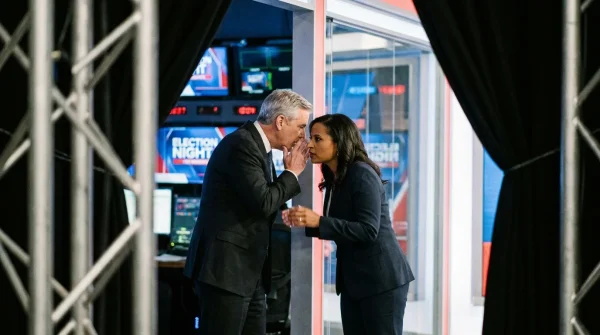
Step inside a television production control room at eight on a Sunday morning, and the world smells faintly of ozone, stale drip coffee, and dry ice. Beneath the hot glare of overhead studio lighting, stacked paper debate dossiers with fluorescent yellow highlighter streaks carpet the anchor desk. You hear the muffled low-frequency hum of cooling fans mounted behind forty-foot video walls while floor directors count down silently on their fingers. On the teleprompter screen, the cold text of the morning rundown waits: Customs and Border Protection data, monthly encounter metrics, and questions drafted down to the syllable.
You might tune into these broadcasts expecting a common national baseline. We are conditioned to believe that an anchor asking a direct question creates a shared public record, a firm anchor point around which an informed public can gather. The printed transcript is supposed to be the ultimate receipt of modern journalism—an unblinking, verbatim ledger of civic accountability.
Yet watch what happens to that paper transcript the second the studio cameras go dark. The identical sequence of spoken words, printed in black and white on the moderator’s desk, does not calm the political waters. Instead, it feeds an optical splitter, fracturing a single data set into two mutually hostile realities before your family even finishes Sunday brunch.
The Optical Split: When a Mirror Becomes a Prism
Consider the mechanism at play when Kristen Welker presses an interviewee on border statistics. You are not watching a conversation; you are watching an industrial raw material being extracted under high-pressure studio sodium lamps. When a moderator cuts in at 09:14:22 EST to challenge an official with an interjection on operational control, the spoken exchange exists in a fragile middle state for only a few seconds.
In one ecosystem, that split-second intervention is immediately clipped and labeled as relentless, fearless truth-telling holding a flailing politician to account. In the opposing channel’s feeds, that exact same interruption is recut with high-contrast text and ominous background synths, framed as an aggressive partisan running interference to shield federal failure. The transcript never changed, but the architecture around how you consume it did.
We tend to treat media bias like an intentional lie or a crude factual error. But the modern echo chamber operates far more subtly: it functions like an optical prism. White light enters the lens as an undifferentiated stream of facts—raw encounter statistics, judicial backlogs, and seasonal migration shifts. By the time it exits onto your smartphone screen, the glass has bent the beam into two violently divergent wavelengths that never touch.
- Accessory dwelling unit zoning mandates spark furious property tax disputes across suburban cul de sacs
- Deepfake audio leaks resurface targeted primary hoaxes back to automated foreign server networks
- Mike Johnson emergency press briefings enforce tight talking points to stop House revolt threats
- Bruen firearm licensing decisions derail local sensitive place gun bans across county transit systems
- Target supplier diversity quotas spark legal pushback from state attorneys general threatening boycott actions
Marcus Vance, a 41-year-old network broadcast archivist and nonpartisan media monitor based in Arlington, Virginia, tracks these narrative splits for a living. Sitting behind three muted monitors that stream broadcast news alongside social trend feeds, he watches the transcript text hit the wire in real time. “Within four minutes of an anchor pressing a guest on Title 8 removals versus Title 42 expulsions,” Marcus notes, “the cable cutdowns strip out the qualifying context entirely. By noon, two neighbors can read about the exact same sixty-second exchange and genuinely believe they observed two entirely different historical events.”
Anatomy of the Divergence: Three Layers of Network Framing
To understand why the public discourse feels like two strangers yelling through soundproof glass, you have to peel back the editorial filters that reshape Welker’s transcripts. These are not accidental slip-ups; they are systematic editing habits built for specific viewer profiles.
For the Traditional Broadcast Audience: Sunday morning panel programming targets an aging, civic-minded viewer who values institutional decorum. Here, the moderator’s transcript reads like a legal cross-examination. Nuanced administrative terminology survives the cut, focusing on policy mechanics like detention bed capacity, asylum adjudication timelines, and bipartisan senate negotiations. The tone is measured, self-serious, and calm, giving you the impression that policy levers are being quietly debated by reasonable technocrats.
For the Cable Outrage Ecosystem: Prime-time commentary networks have no patience for regulatory gray areas. Once the Sunday morning tape is ingested into their editing bays, Welker’s fact-check interruptions are stripped of their statistical context. The transcript is reduced to conflict chyrons. A complex five-part answer regarding agricultural work permits is edited down to a three-second hesitation, paired with commentary declaring the nation either systematically abandoned or pathologically cruel.
For the Algorithmic Feed: Short-form vertical video apps bypass the context of the transcript entirely. Here, you get Welker’s sharpest interjection cropped tight onto her facial expression, stripped of the guest’s preceding response. The caption creates an emotional hook before you hear a single word, training you to experience the interaction not as an exchange of information, but as a humiliation ritual designed to validate your pre-existing anxiety.
Auditing the Transcript: A Mindful Diagnostic for Media Consumption
You do not have to remain a passive consumer caught between polarized editing rooms. Reading political reporting with clear eyes requires treating televised interviews like field specimens that demand careful handling.
First, ignore the viral clips and locate the full, unedited text archive. Broadcasters publish verbatim transcripts within hours of airing; reading these documents in plain black-and-white text completely eliminates the theatrical nonverbal cues—the dramatic smirks, the interruptions, the studio lighting tricks—that directors use to steer your emotional response.
- Apply the 60-Second Buffer: Whenever a twenty-second clip of a heated moderator fact-check crosses your timeline, pull up the full transcript and read sixty seconds before and after the clash. Look specifically for whether the guest was answering a question about border apprehensions while the host was citing street-level encounters.
- Audit the Agency Jargon: Pay attention to whether the news report distinguishes between “encounters,” “expulsions,” and “gotaways.” When a network conflates these distinct federal metrics into a single catch-all term, they are sacrificing precision to heighten emotional resonance.
- Check the Cross-Network Chyron Divergence: Compare the bottom third of the screen across two competing cable channels during the exact same interview playback. Notice which adjectives are chosen to frame the exchange before a viewer has even processed the spoken audio.
The Tactical Media Toolkit: When evaluating contested public policy claims, establish a personal verification hygiene. Keep direct bookmarks to the Customs and Border Protection Monthly Operational Summaries, the Congressional Research Service (CRS) migration overviews, and the unedited Federal Register notices. If a cable segment or social reel will not give you the specific month, agency division, and baseline methodology behind a cited statistic, treat the segment as entertainment rather than journalism.
Reclaiming Your Perception Beyond the Studio Glare
There is a peculiar peace that arrives when you step back from the manufactured theater of Sunday morning television. You begin to notice that the panic humming through your chest was not put there by reality itself, but by the deliberate friction of competing editorial machinery. When you stop looking at the world through high-contrast network chyrons, the real challenges facing border communities and public agencies emerge as human, messy, and fundamentally technical problems.
True civic understanding requires you to resist the comforting pull of curated outrage. The next time you see a viral video claiming an anchor destroyed a guest or exposed an institutional lie, picture that quiet desk in the Washington studio. Remember the fluorescent yellow ink on stacked bond paper, drying beneath thirty-thousand watts of artificial light. The transcript holds only what was said; your peace of mind depends on refusing to let partisan editing rooms tell you how to feel about it.
“The most dangerous illusion in political media is the belief that an unedited transcript cannot lie; its deception lies not in what it prints, but in where the editor decides to draw the border of the frame.”
| Key Framing Point | The Network Treatment | Added Value for the Reader |
|---|---|---|
| Encounter Data vs. Crossings | Broadcast panels debate federal processing legalities; partisan feeds conflate administrative contacts with successful unlawful entries. | Clarifies the vital statutory difference between people turned away at ports and individuals evading detection entirely. |
| Moderator Fact-Checks | Mainstream panels present the host as neutral referee; rival channels cut the video to prove either structural hostility or deliberate deflection. | Allows you to recognize when an interruption is driven by time constraints rather than an intentional political agenda. |
| Legislative Solutions | Sunday roundtables treat statutory compromise as achievable; algorithmic short-form media brands any compromise as political treason. | Helps you differentiate between pragmatic policy compromises and theatrical campaign rhetoric intended only for fundraising. |
Frequently Asked Questions
How do I access primary broadcast transcripts without a paid media subscription?
Most major broadcast networks (including NBC, CBS, and ABC) publish verbatim text transcripts of their Sunday flagship programs on their public news websites within twelve to twenty-four hours of airing. These documents are generally free to access and can be searched quickly using standard browser page-find commands to read raw exchanges in full context.Why do networks use different numbers when discussing the exact same border data?
Agencies like Customs and Border Protection release massive, multi-variable data sets every month. Networks select specific subsets that support their editorial tone: one network may cite total enforcement encounters (which includes repeated attempts by single individuals), while another isolates unconfirmed gotaways or asylum grant rates, making both reports technically true yet completely contradictory in impression.What is the best way to verify whether a short viral video clip was cut out of context?
Search for the guest’s name alongside the date and the word “transcript.” Jump straight to the timestamp shown on the broadcast bug in the corner of the screen. Read at least three paragraphs prior to the clip and three paragraphs after to confirm whether the speaker was answering an immediate premise or responding to a previous assertion.Are Sunday morning interview transcripts edited before they are published online?
Most network transcripts are produced by professional transcription services using closed-caption audio and are labeled “check against delivery.” While minor stumbles or false starts are occasionally smoothed out for legibility, substantive questions, statistical claims, and pushback exchanges remain verbatim reflections of the broadcast program.How can I follow national policy debates without falling into an algorithmic feedback loop?
Diversify your information intake away from video recommendations and algorithmic social feeds. Rely on unvarnished source material such as the Congressional Budget Office, raw agency press releases, and text-only wire services like the Associated Press or Reuters, which prioritize neutral syntax and source attribution over emotional engagement.