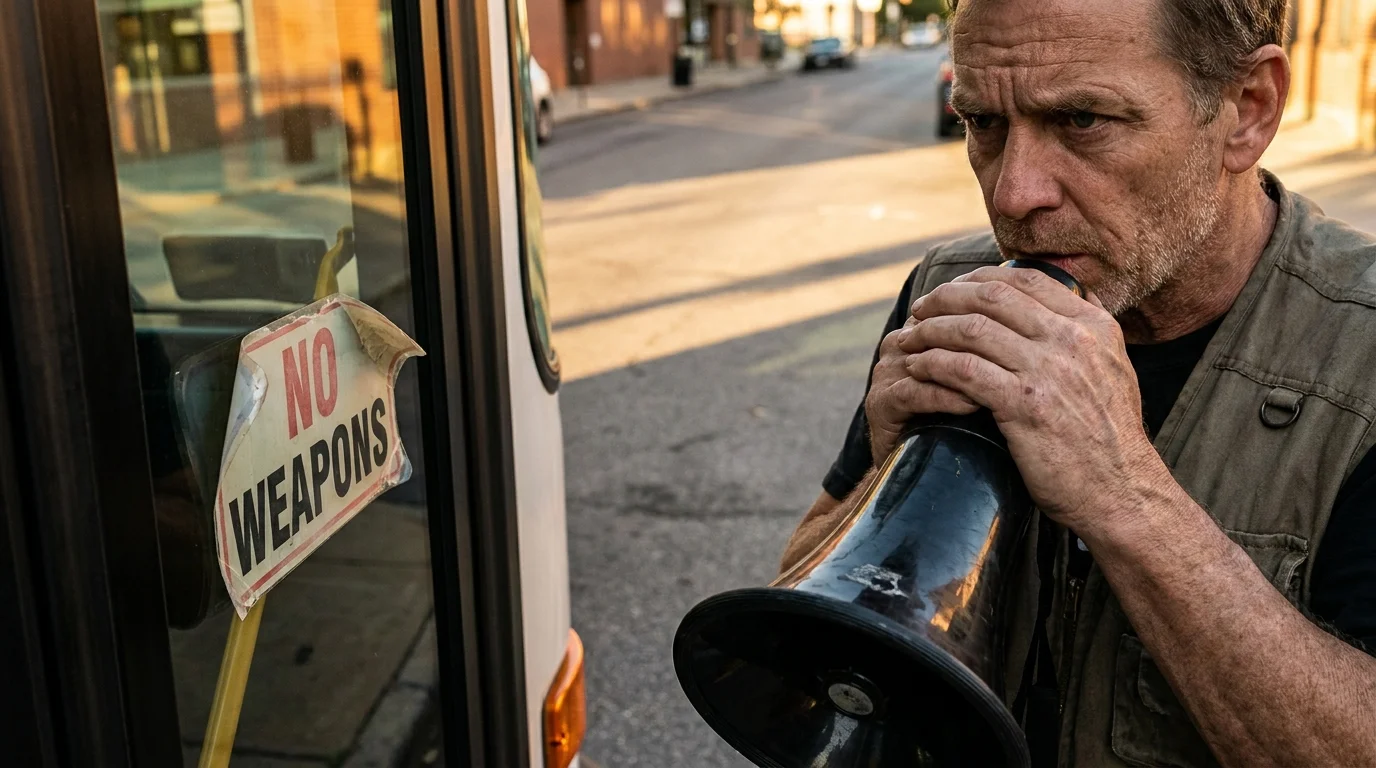
The damp heat of a late-autumn morning hangs heavy inside the transfer station, smelling faintly of ozone, spilled bodega coffee, and worn brake linings. As you step up onto the rubber-ribbed tread of the commuter bus, your shoulder brushes against the glass entry door. Right there at eye level sits a faded, red-slashed handgun decal, its clear laminate peeling at the dog-eared edges, curling away from the glass like dried parchment.
For years, you moved through municipal turnstiles under an unspoken assumption: local city councils write the street-level rules that keep crowded public cabins weapons-free. Yet behind those curled plastic stickers lies an abrupt institutional quiet. The legal ground beneath county bus terminals and light rail corridors has shifted so sharply that local transit authorities no longer know if pointing to that window sticker constitutes basic enforcement or an immediate federal civil rights liability.
When the high bench in Washington dismantled legacy concealed-carry frameworks in its landmark Bruen decision, the headlines focused on statehouse permitting desks. But the genuine rupture landed four hundred miles downstream, inside suburban county commission chambers and metropolitan transit board rooms. The sudden requirement to justify modern passenger safety rules using colonial-era legal traditions has turned standard morning security protocols into an existential administrative standoff.
You are watching the practical dissolution of the local sensitive-place doctrine in real time, where a centuries-old history test leaves city councils completely paralyzed to govern the interior of a fifty-passenger vehicle moving at forty-five miles per hour through city traffic.
The Musket Test in the Subway Car
To understand why city transit rules suddenly evaporated, you have to discard the idea that local security is determined by current municipal crime statistics or transit worker pleas. Instead, imagine your local city attorney stepping into an emergency injunction hearing carrying an eighteenth-century archive box rather than modern platform security logs.
Under the Supreme Court’s mandate, whenever a municipality restricts firearms in a public space, the burden falls squarely on the government to prove that an identical—or at least distinctly analogous—firearm restriction existed between 1791 and 1868. This is the historical analogue doctrine. If an ordinance cannot point to an unbroken tradition of American town constables banning holstered flintlocks in specific public conveyances during the founding era, the modern rule is presumptively unconstitutional.
This creates a bizarre conceptual trap for public transit. In 1791, metropolitan light rail did not exist, municipalized diesel buses did not exist, and moving millions of anonymous workers through subterranean tubes in close quarters was pure science fiction. Because early American law permitted travelers to carry weapons on rural horse-drawn stagecoaches and open turnpikes, federal judges are striking down county ordinances that attempt to designate city buses as sensitive places.
- Target supplier diversity quotas spark legal pushback from state attorneys general threatening boycott actions
- Civilian Conservation Corps revivals switch federal lands staffing away from union park rangers
- Strait of Hormuz insurance surcharges spark sudden diesel price spikes across Midwest farming hubs
- Fluoride removal mandates trigger fierce clashes between public water boards and health researchers
- Justice Democrats primary challenges expose vulnerable establishment incumbents across worn linoleum union halls
The County Attorney’s Midnight Dilemma
Consider Elena Vance, a fifty-two-year-old senior municipal litigator in a mid-sized Midwestern county. Last month, Elena sat under buzzing fluorescent light fixtures until two in the morning, cross-referencing pre-Civil War municipal charters from frontier rail lines against a federal restraining order filed by an interstate gun rights coalition.
The transit union was demanding emergency metal detectors at central hubs following a spat of platform confrontations, while her county commissioners wanted a swift misdemeanor ordinance prohibiting open or concealed carry on all county-operated commuter lines. Elena had to explain that if she filed an emergency defense citing modern platform density and driver assault rates, the presiding district judge would toss the county brief in minutes. Her only viable move was digging through dusty, fragmented territorial records from 1870 Wyoming or post-reconstruction Tennessee statutes—none of which squarely matched a regional diesel bus transit network.
Downstream Fracture: How Different Commuters Experience the Freeze
Because federal district rulings roll out unevenly across separate appellate circuits, the legal reality on public transit now changes county by county, creating immediate operational friction across metro boundaries.
For the Daily Metro Transit Rider
If your daily commute crosses three municipal boundaries, the legal envelope around your bag alters at every stoplight. In the core downtown district, transit peace officers may still attempt to enforce zero-tolerance transit rules based on older city charters. But the minute your bus rumbles across the county line into an unincorporated transit zone where a preliminary injunction has taken hold, operators are instructed to de-escalate rather than intervene. You are traveling through a legal patchwork where rights and infractions alternate by intersection.
For Transit Operators and Station Staff
Bus drivers and light-rail operators face the sharpest edge of this institutional freeze. Historically, an operator could refuse service if a passenger displayed an unconcealed holster or printed firearm. Today, dispatch protocols advise drivers to avoid confrontation over visible carry unless an overt, active threat manifests, because an erroneous stop risks exposing the municipal transit district to federal civil rights litigation.
For County Commissioners and Risk Assessors
Local insurance pools are advising municipal transit authorities to remove punitive signage altogether. Municipal risk adjusters warn that maintaining outdated transit bans while federal courts systematically issue temporary restraining orders creates severe municipal financial exposure. City councils are quietly choosing administrative silence over defending an unwinnable historical brief.
Navigating the New Transit Landscape Mindfully
Living inside an era of shifting constitutional tests does not require panic, but it does demand clear-eyed spatial awareness and practical knowledge of your local transit district’s administrative state.
Instead of relying on peeling decals or legacy assumptions about public transit rules, you can read the ground realities using a few deliberate checkpoints:
- Track Municipal Docket Updates: Check your regional transit agency’s board meeting minutes every quarter. Look specifically for legal risk disclosures regarding Title 42, Section 1983 filings or transit security code adjustments.
- Note Security Shift Patterns: When you see transit security shift away from fare-gate weapons checks toward passive presence and medical de-escalation teams, it often signals an internal directive issued after a judicial injunction.
- Know Regional Preemption Laws: Understand whether your state constitution contains an explicit firearm preemption statute, which often supersedes county-level attempts to carve out sensitive exemptions on buses and platforms.
- Evaluate Personal De-escalation Space: Recognize that in dense vehicle cabins, legal ambiguity elevates ambient tension. Practice situational awareness by sitting near exits and keeping audio volumes low enough to hear passenger disputes early.
The transition is not an accidental administrative delay; it is a structural redesign of municipal authority that puts the burden of security balance back onto the rider.
The Architecture of Local Trust
Public transportation has always been an exercise in civic intimacy. You share a moving metal bench with strangers, operating on an invisible web of collective patience, shared rules, and predictable boundaries. When those boundaries are suddenly redrawn—not by local council members responding to community meetings, but by historical treatises written before the steam locomotive was invented—it leaves an unsettling quiet in the air.
Yet understanding the mechanism behind this silence clears away the confusion. You no longer have to wonder why the peeling decal remains unreplaced or why municipal transit officers stand back at the turnstiles. You are observing a rare historical pivot point where local governance meets federal judicial reset, and learning to read that shift gives you the agency to navigate your city with clear, informed confidence.
The modern bus cabin is perhaps the purest test of community trust, built for rapid movement rather than eighteenth-century legal tests.
| Key Point | Detail | Added Value for the Reader |
|---|---|---|
| Historical Analogue Standard | Courts now require transit bans to match firearm laws active between 1791 and 1868. | Explains why contemporary transit crime statistics are routinely ruled irrelevant in court hearings. |
| The Sensitive Place Dilemma | Transit corridors lack the direct colonial-era parallels granted to courthouses and polling places. | Helps you understand why transit bans fail while courthouse security checks remain intact. |
| Driver Discretion Shift | Agencies instruct staff to prioritize passive observation over confronting non-threatening firearm carry. | Clarifies why onboard enforcement looks passive despite visible station security policies. |
| Municipal Liability Shielding | Counties pull down enforcement signage to avoid high-cost civil rights lawsuits from advocacy groups. | Reveals why peeling, outdated safety signage remains unaddressed across regional networks. |
Transit System Gun Ban FAQs
Are all weapons bans on county buses now officially void? No, but many regional transit systems face temporary restraining orders or preliminary injunctions that freeze active enforcement while cases wind through appellate review.
Why can’t cities simply declare buses ‘sensitive places’ like schools? Under the Bruen framework, sensitive place designations require unbroken historical precedents, which rarely exist for motorized public conveyances created in the twentieth century.
What should you do if an armed passenger enters your bus? Avoid direct confrontation or vocal escalation. Maintain physical distance, note your bus car number, and quietly notify transit dispatch or the vehicle operator at the next scheduled stop.
Do municipal transit unions have legal standing to reinstate bans? Unions can file workplace safety grievances against regional transit authorities, but these labor contracts cannot override federal constitutional rulings governing public spaces.
How can riders find the current firearm policy for their local line? Check the legal counsel disclosures on your transit authority’s website, or read recent county board resolutions regarding transit security adjustments.