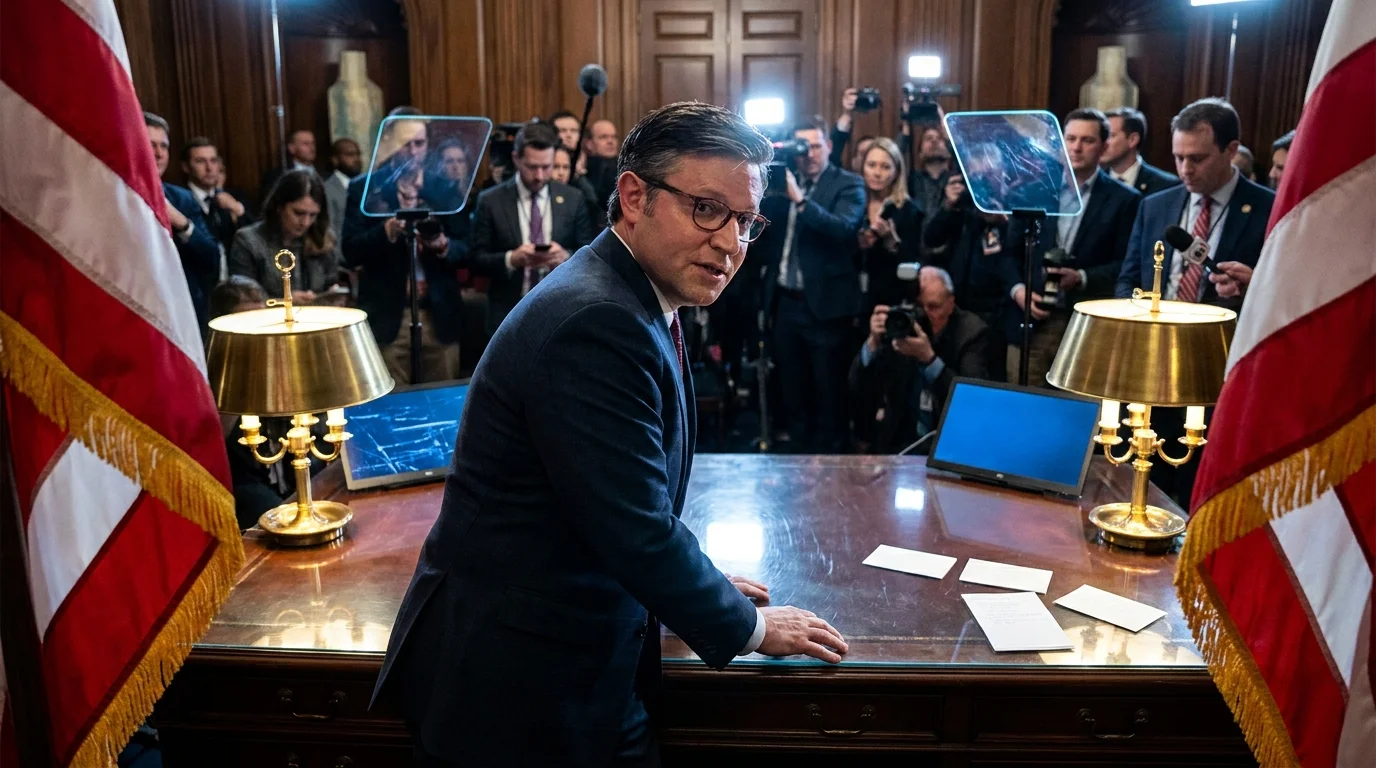
The basement corridors beneath the Capitol feel unseasonably dry, smelling faintly of heated wiring, wet wool coats, and burnt drip coffee. Glaring studio teleprompter screens cast sharp blue reflections over polished speaker lecterns, cutting through the amber gloom of the television studio rooms. Outside the soundproof double doors, dozens of camera crews crowd the tile floor, tripods locked elbow-to-elbow while line producers murmur countdowns into coiled earpieces.
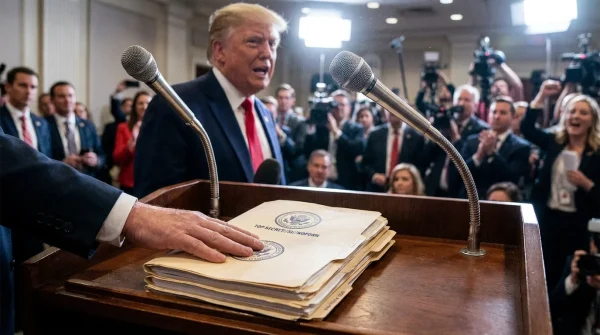
When Mike Johnson steps up to the riser, his movements carry the practiced ease of an attorney addressing a familiar jury. Yet, beneath the clean navy suit and disciplined posture, the entire staging operates as an airtight acoustic chamber. The microphones are live, but the room itself is built to suppress echoes.
You are watching a masterclass in choreographed institutional damage control. What appears to evening news viewers as an off-the-cuff display of party unity on a looming government shutdown vote is, in reality, a high-stakes containment drill designed to prevent a dozen restless backbenchers from blowing up the House floor on national television.
The Valve and the Vents: Rethinking Floor Discipline
Most observers assume legislative leadership functions like a military hierarchy where orders filter down from the speaker suite and dissenters fall in line out of fear. Real power in a paper-thin majority works far more like plumbing. When partisan pressure builds inside the boiler room of the conference, you do not weld the pipes shut; you build heavily controlled vents to bleed off steam before the entire manifold cracks.
The emergency briefings staged during vote week are not informational updates for the public. They are acoustic dampening blankets thrown over the caucus. By dominating the midday news cycle with rigid, pre-tested messaging, leadership deprives factional rebels of the oxygen they need to sustain a floor revolt.
Arthur Vance, a 54-year-old former floor director who spent twenty-two years managing floor counts through four administrations, leans back against the mahogany rail of Statuary Hall and describes the routine with cold detachment: “If an unruly member walks past five cameras without hearing his own leadership give him an exit ramp, he will build his own ramp out of dynamite. The laminated pocket cards handed out twelve minutes before the briefing cameras go red are not talking points. They are boundary markers that tell members: step beyond this chalk line, and you finance your own primary defence next spring.”
- Bruen firearm licensing decisions derail local sensitive place gun bans across county transit systems
- Target supplier diversity quotas spark legal pushback from state attorneys general threatening boycott actions
- Civilian Conservation Corps revivals switch federal lands staffing away from union park rangers
- Strait of Hormuz insurance surcharges spark sudden diesel price spikes across Midwest farming hubs
- Fluoride removal mandates trigger fierce clashes between public water boards and health researchers
The Factional Playbook: Message Control Across the Divide
Maintaining order across a caucus fractured by regional panic and fiscal hardliners requires distinct rhetorical medicine for distinct ailments. The message distributed to leadership minutes before live airtime is tiered with surgical precision.
1. The Frontline District Pragmatists
For lawmakers holding swing seats in competitive suburbs, the emergency briefing cards enforce quiet reassurance. These members are instructed to keep their language tethered strictly to local operational survival: keeping regional veteran clinics staffed, keeping airport security checkpoints moving, and protecting military paychecks. They are ordered never to engage with ideological purity tests on camera, redirecting every spending dispute back to administrative responsibility.
2. The Fiscal Insurgents
For the rebellious flank threatening motion-to-vacate petitions, leadership deploys an entirely different verbal chokehold. Rather than condemning their demands for steep cuts, the briefing framework adopts their vocabulary while boxing in their calendar. The talking points cast continuing resolutions not as surrenders, but as tactical bridgehead maneuvers necessary to force Senate concessions down the road, subtly reframing an impending compromise as aggressive positioning.
3. The Committee Gavels
Senior committee chairs receive the most rigid script of all. Because these senior lawmakers carry substantial policy credibility, any casual off-script remark could trigger a run on the floor whips. Their briefings require an absolute embargo on fiscal specifics, holding them strictly to three approved conference-wide talking tracks.
The Anatomy of the Pocket Card: What the Cameras Miss
Minutes before the red tally lights glow on the studio cameras, staff hands small, cardstock prompt sheets to key floor deputies. These cards are designed for glance-reading under blinding studio illumination. They follow a ruthless structure designed to prevent spontaneous candour.
- The Lead Sentence: A 14-word anchor asserting that House leadership remains the only functional body actively working to keep essential federal doors open.
- The Deflection Pivot: An immediate linguistic shift turning any question regarding caucus infighting back toward the Senate’s refusal to pass individual appropriations bills.
- The Forbidden Phrases: A bolded footer specifically warning members away from words like ‘omnibus,’ ‘concession,’ ‘deal,’ or ‘internal division.’
- The Time-Limit Directive: A standing rule enforcing responses under twenty-five seconds to deny cable interviewers follow-up momentum.
By enforcing this script, leadership ensures that when an emergency briefing ends, every member steps back into the hallway reciting the identical set of three-word phrases, starving Sunday talk shows of controversial soundbites.
The Tactical Toolkit of Floor Containment
Behind the podium, speaker staff manage the briefing room with exacting stagecraft:
- Podium Proximity: Surrounding the speaker with five junior members representing swing districts, physically crowding the frame to visually broadcast conference-wide solidarity.
- Strict 12-Minute Caps: Halting questions abruptly before the room can slide into combative procedural debates, citing urgent legislative business on the House floor.
- Pre-Cleared Question Sequences: Calling exclusively on beat reporters known for asking narrow technical questions rather than open-ended political speculation.
- Real-Time Screen Monitoring: Keeping off-camera production aides glued to cable news chyrons, instantly adjusting the teleprompter text if a rival network breaks news of a rogue member tweet.
Reading the Room When the Stakes Are Real
When you watch these press conferences, look past the practiced cadences and polished wood. Watch the perimeter of the room. Notice which committee chairs stay silent against the back wall, watch the paper cards turned face-down in nervous hands, and observe how quickly the lights are cut the moment the official statement finishes.
Political survival in the Capitol rarely looks like a dramatic triumph. Most of the time, it looks like a tight, controlled, gray dampening of natural human instinct, conducted on blue-tinted teleprompter glass to make sure an institution that feels ready to split at the seams makes it through another legislative afternoon without falling apart.
“Discipline on the Hill is not about persuading people to agree; it is about convincing them that breaking ranks in front of a camera costs more than swallowing an ugly vote.”
| Key Point | Detail | Added Value for the Reader |
|---|---|---|
| Laminated Briefing Cards | Cardstock message guides distributed to members 12 minutes prior to broadcast. | Exposes how uniform soundbites are pre-engineered to suppress personal dissent. |
| The Semantic Pivot | Strict prohibitions against specific trigger words like ‘concession’ and ‘omnibus.’ | Helps you spot when a politician is deliberately swapping policy terms for survival language. |
| Room Geometry | Staging swing-district members behind the podium to signal caucus solidarity. | Reveals how television framing is used to pressure undecided members on upcoming votes. |
Frequently Asked Questions
Why do emergency press briefings happen before major floor votes?
They establish the dominant political narrative before dissenters can shape public perception on cable news, signaling unified resolve to wavering members.What happens if a member defies the briefing talking points?
Lawmakers face behind-the-scenes repercussions, including reassigned committee assignments, delayed project funding, or withdrawn campaign finance support.Why are briefing responses capped at short time limits?
Short answers deny interviewers the ability to dig into internal policy fractures, preventing unscripted comments from sparking new floor disputes.How do staffers decide which members stand behind the podium?
Staff deliberately select vulnerable swing-seat lawmakers and ideological representatives to visually project caucus unity to viewers and colleagues alike.Can tight talking points actually prevent a House revolt?
They cannot stop an outright ideological split, but they rob the rebellion of the immediate media momentum needed to recruit undecided floor votes.