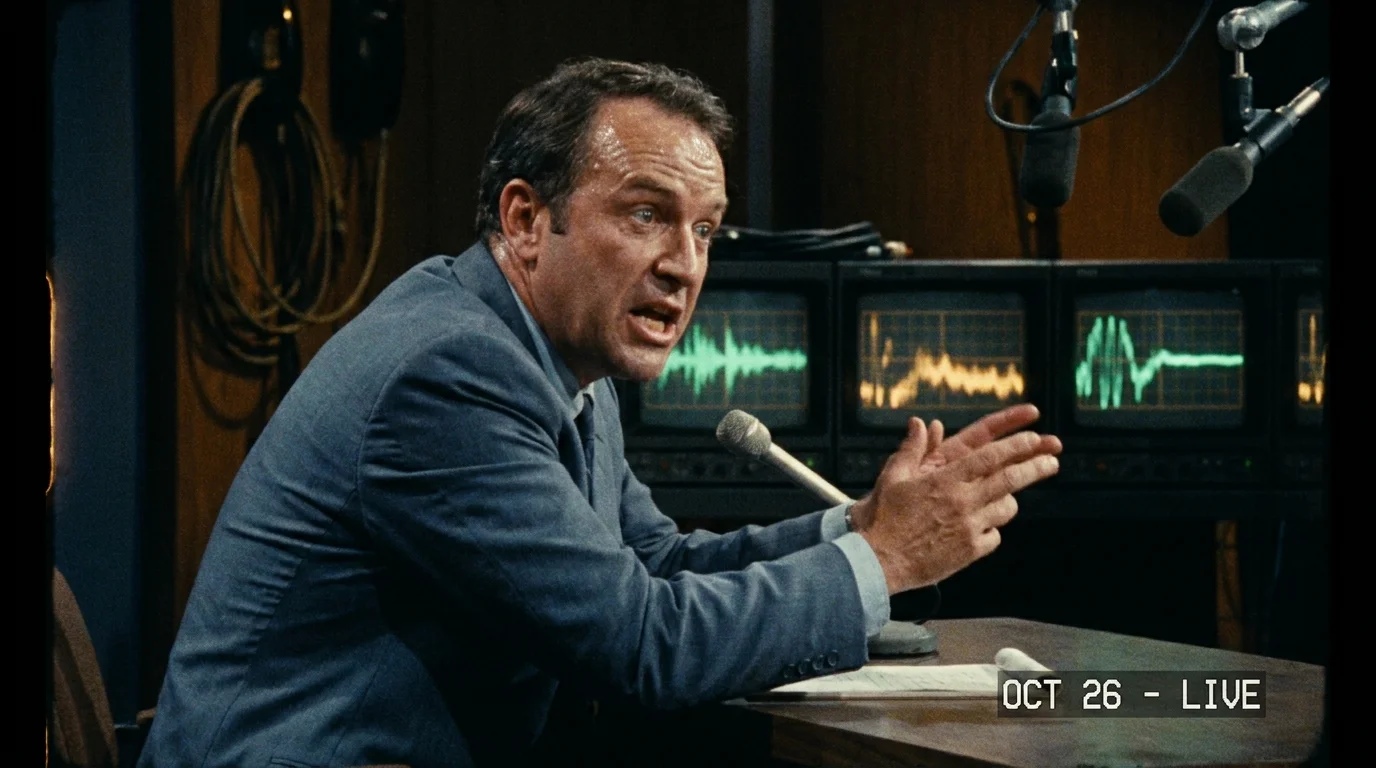
Glowing spectral waveform spikes displayed across forensic audio monitor screens cut through the dim room like neon green jagged glass. The air in the lab smells faintly of ozone and lukewarm diner coffee, a quiet contrast to the storm brewing outside the window. When an incoming voicemail lands on your device, it arrives without fanfare—just a brief chime, a caller ID matching your local county code, and a voice you would recognize anywhere.
You listen to the raspy cadence, the characteristic drop in pitch at the end of a sentence, and the slight pause that sounds just like a tired candidate speaking between campaign stops. The baritone instructs you to save your energy, advising you to stay home during the primary and conserve your ballot for the general election. To your naked ear, it carries the warm imperfections of human speech, convincing enough to make you pause before heading out into the winter drizzle.
Most people assume our evolutionary wiring protects us from being easily fooled by an imitation. We expect a synthetic voice to sound robotic, like an automated pharmacy notification or a cheap GPS navigation prompt. But the reality unspooling on modern forensic monitors is far more insidious: you are not hearing an impersonator, but a calculated supply chain designed to simulate breath, fatigue, and intimacy.
The Illusion of Flesh: Why Synthetic Voice Is an Engineering Pipeline
To grasp why these primary robocalls succeed, you have to stop thinking of a deepfake as an artistic impression and start viewing it as a plumbing network. A true human voice is an acoustic accident of damp tissue, lung volume, and teeth. When a person speaks into a telephone microphone, their vocal cords vibrate air that bounces against the room around them, creating microscopic reflections and tiny imperfections that our ears subconsciously register as real.
- Mike Johnson emergency press briefings enforce tight talking points to stop House revolt threats
- Bruen firearm licensing decisions derail local sensitive place gun bans across county transit systems
- Target supplier diversity quotas spark legal pushback from state attorneys general threatening boycott actions
- Civilian Conservation Corps revivals switch federal lands staffing away from union park rangers
- Strait of Hormuz insurance surcharges spark sudden diesel price spikes across Midwest farming hubs
A synthetic robocall, by comparison, is an assembly line built in code. An acoustic assembly line takes fragmented audio harvested from legitimate campaign rallies, strips away the ambient noise, and feeds the phonetic building blocks into an offshore neural network. It does not think or feel; it simply predicts which sound slice should mathematically follow the last. When you hear it, your brain fills in the emotional blanks that the software skipped.
Julian Mercer, 44, a veteran acoustic forensic consultant who spent two decades dissecting black-box cockpit recordings before tracking state-level political disinformation, spends his nights staring at these mathematical traces. In a recent investigation into targeted New Hampshire call batches, Mercer pulled up the raw .wav files pulled from telecom switches. While the audio sounded terrifyingly authentic through an iPhone speaker, the monitor told a radically different story: the files carried zero natural acoustic room reflections, and the sound abruptly died off at frequencies where human biological warmth normally lives.
Dissecting the Supply Chain: From Offshore Server to Your Kitchen Counter
The journey of a fake phone call does not start on the campaign trail; it begins thousands of miles away in commercial cloud infrastructure rented with disposable prepaid credit cards. Understanding this route strips the mystery away from the deception.
- The Offshore Synthesis Engine: The raw voice model is generated using commercial voice-cloning APIs hosted in jurisdictions that ignore international intellectual property and election tampering subpoenas. The software stitches together phrases that mimic casual conversation, deliberately inserting fake microphone crackles to mask digital flatness.
- The Ghost Relay Network: The resulting audio files are transferred to automated, untracked burner servers scattered across Eastern Europe and Southeast Asia. These servers act as digital washing machines, bouncing the payload across multiple virtual private networks to erase the original IP address.
- The SIP Trunk Infiltration: The foreign server uses an automated script to inject thousands of parallel calls into unregulated Session Initiation Protocol (SIP) providers. These low-tier telecommunications brokers prioritize volume over verification, allowing the perpetrators to spoof legitimate county party headquarters numbers.
- The Local Handshake: Your local cellular tower receives the spoofed data packet and routes it directly to your handset, vibrating the device in your pocket while disguising the foreign server as a neighbor down the street.
By mapping this pipeline, investigators found that these operations do not rely on rogue supercomputers. Instead, they rent cheap server time on everyday commercial networks, striking precisely forty-eight hours before voting booths open to ensure local officials cannot issue a formal debunking before the damage is done.
Catching the Ghost: The Forensics of Acoustic Auditing
When forensic engineers like Mercer examine a suspicious audio leak, they do not rely on intuition. They look for the physical laws that software code inevitably breaks when it tries to replicate human biology.
The primary giveaway lies in the spectral frequency ceiling. High-end human vocalizations, particularly the sharp friction of teeth and tongue producing sibilant sounds like ‘s’, ‘f’, and ‘th’, naturally project energy well into the 12 kHz to 16 kHz range. In cloned audio piped through automated robocall networks, this top register is completely empty. The algorithms aggressively compress the output, creating a sharp, unnatural drop-off—a brick wall at 8 kHz that no human throat could produce.
Engineers also scrutinize the micro-pauses between words. When you speak, the silence between your words is populated by tiny physiological adjustments: the click of saliva, the inhale through the nose, the faint reverberation of the floorboards beneath your boots. Synthetic audio inserts dead, mathematically pure silence—a vacuum of absolute zero between syllables that feels subtly chilling to an attentive listener.
The Tactical Toolkit for Audio Verification
- Examine the Frequency Ceiling: Drop the audio into a basic, free spectral analyzer. If all energy abruptly vanishes above 8,000 Hz with no gradual roll-off, the file has been synthesized or heavily downsampled by an automated routing script.
- Listen for Room Air: Isolate the quiet spaces between spoken words using headphones. If the ambient background noise vanishes into dead silence while the speaker pauses, you are listening to stitched machine audio.
- Check Latency Jitter: Authentic calls routed through local telephone infrastructure carry subtle timing variations. Synthetic robocall blasts sent through burner networks often exhibit rigid, automated packet timing without natural network drift.
Reclaiming the Human Voice in an Era of Synthetic Drift
Living through modern political cycles means accepting that your ears can no longer act as the final judge of truth. When an explosive audio clip surfaces on the eve of an election, the immediate impulse is emotional: shock, anger, or resignation. That emotional reaction is the precise payload the foreign server was programmed to deliver.
Learning to see the acoustic seams behind the curtain does not require an engineering degree. It simply requires a deliberate breath before reacting. Cultivating a deliberate hesitation gives the broader information ecosystem the hours it needs to run the files through forensic spectrum analyzers and trace the server logs back to their point of origin.
When you stop viewing synthetic audio as black magic and start recognizing it as an awkward, incomplete imitation of biology, the weapon loses its power. The human voice carries an organic history that no offshore cloud server can cleanly forge without leaving its digital fingerprints behind.
Read More