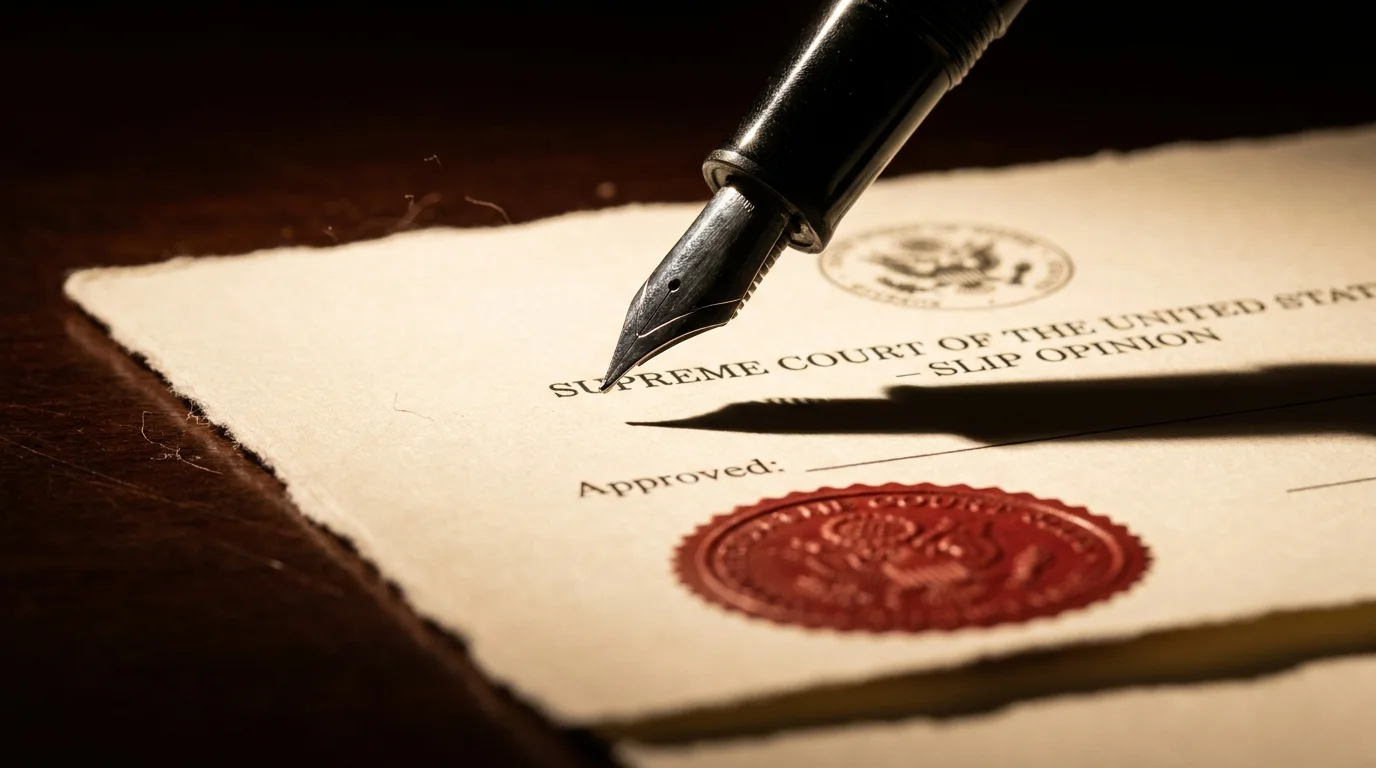
A heavy stillness settled over the fourth-floor corridor of the Department of Labor just past dawn. On ordinary mornings, the only sound you hear is the low hum of industrial copiers and the distant rattle of custodial carts over marble tile. But this morning, couriers arrived before the sun cleared the dome, dropping fresh packets bound in cream stock onto the desks of senior staff attorneys.
These were not standard digital dockets or slipshod email summaries. They were crisp deckle-edge Supreme Court slip opinions, weighted with embossed red seals that signaled an immediate, structural break in administrative precedent. As you watch the morning news scroll by on your kitchen counter, it might look like just another headline about judicial bickering. It is not.
When Chief Justice John Roberts enters the dissent ledger against White House executive authority, the entire machinery of federal enforcement stops running on autopilot. His prose does not read like an ideological tirade; it reads like a master carpenter pointing out dry rot in the foundation of your house. By breakfast, deputy counsels across ten cabinet agencies were already hitting the emergency brakes on their pending rulebooks.
The shift is personal, even if it feels distant. Every regulation that touches the safety of your tap water, the overtime protections in your paycheck, or the fees buried inside your credit card agreement runs through the exact plumbing that Roberts just targeted.
The Load-Bearing Arch: Reframing the Chief’s Silence
For two decades, you have been told to view the Supreme Court as a simple nine-seat tug-of-war. Red versus blue, progressive versus conservative, an endless arm-wrestling match played out in cable soundbites. That mental model fails completely when analyzing this dissent.
Think of federal governance instead as an old stone arch. The White House exerts downward pressure, Congress sets the horizontal span, and the Chief Justice has historically served as the keystone, maintaining friction so the entire archway does not collapse under its own weight. When Roberts dissents from an executive power grab, he is not taking an opposing political stance; he is stepping out of the archway altogether, daring the executive branch to bear the weight alone.
- Social Security COLA index calculations spark fierce clashes over grocery price inflation metrics
- Provisional ballot affirmation envelopes block hurried voters over missing black ballpoint signatures
- Pete Hegseth Pentagon leadership changes switch official Defense Department protocol on military promotions
- Appropriations manager amendment packets reverse disputed federal budget earmarks behind closed doors
- USPS whistleblower mail ballot concerns demand immediate federal sorting audits before primary deadlines
The core friction sits directly inside Title 5, Section 706 of the Administrative Procedure Act—specifically subsection (2)(C), which strips agency actions bare when they exceed statutory jurisdiction. In his blistering text, Roberts laid down a bright line: if Congress never handed an agency the explicit, unambiguous grammar to regulate a major facet of American economic life, an executive memo cannot invent it out of thin air. By questioning the administration’s reliance on open-ended emergency statutory phrasing, he dismantled twenty years of quiet bureaucratic workarounds in a single sentence.
The Midnight Audit at Constitution Avenue
Consider Marcus Vance, a 44-year-old deputy general counsel whose team occupies a fluorescent-lit corner office overlooking Constitution Avenue. For fourteen months, Vance and his staff worked seventy-hour weeks drafting a flagship rule designed to cap algorithmic overdraft penalties across national banking networks. The rule was slated for final federal register publication next Tuesday.
At 7:15 AM, Vance did not print the White House press briefing or read social media threads. He printed the Chief Justice’s dissent, pulled a yellow highlighter across page eighteen, and summoned every division chief into the conference room. “Pencils down,” Vance told them, closing his laptop. “If Roberts is writing this today, our entire enforcement mechanism gets tossed out by the Fifth Circuit before lunch on Monday. We pull the rule.”
Where the Gears Freeze: Three Impact Layers
This judicial ripple does not hit every corner of your life with identical force. The fallout separates cleanly across three distinct operational layers, each facing its own legal freeze:
- The Energy and Environmental Grid: Regional utility directors are pausing multimillion-dollar grid transitions. When federal agencies rely on expansive, catch-all environmental language to enforce plant closures or clean-fuel mandates, this dissent arms corporate litigants with an ironclad defense. You will likely see deferred capital projects, freezing planned transition surcharges on your monthly electric bill.
- Workplace and Wage Directives: Pending labor standards—ranging from remote-worker tracking bans to scheduled hikes in mandatory overtime salary thresholds—now rest on shaky legal bedrock. Agency compliance officers are stalling audits because they can no longer guarantee the courts will enforce the underlying statute.
- Consumer Finance and Digital Privacy: The regulatory shield protecting retail consumers from predatory loan underwriting or unexpected platform fees is suddenly fragile. Regulators who previously leaned on broad consumer-welfare definitions must now demonstrate narrow, explicit statutory permission from an often-deadlocked Capitol Hill.
The Tactical Audit: Navigating the Administrative Freeze
When the high court redraws the boundaries between executive intent and administrative authority, you cannot afford to rely on outdated compliance assumptions. Navigating this landscape requires precise, sober attention to detail rather than panic.
Federal agency leads and municipal legal counsels are actively deploying a four-point containment strategy to prevent their pending dockets from being struck down completely:
- Perform Immediate Statutory Audits: Review all active rulemaking records against 5 U.S.C. § 706(2)(C), flagging any policy that rests on broad emergency delegations rather than explicit legislative nouns.
- Issue Administrative Stays: Freeze enforcement dates for controversial rules still within their 60-day notice-and-comment window before public interest groups file venue-targeted lawsuits.
- Sever Collateral Provisions: Decouple core, uncontested technical standards from broader policy mandates so that partial judicial strikes do not scrap entire program architectures.
- Return to Legislative Committees: Draft narrow, surgical statutory amendments for congressional sponsor introduction, abandoning executive workaround strategies entirely.
For your own organization or household balance sheet, the rule of thumb is straightforward: assume any pending federal rate adjustment, subsidy requirement, or compliance mandate scheduled for the next six months is subject to an immediate procedural stay.
The Long View: Returning to Institutional Equilibrium
It is tempting to look at a high-stakes judicial dissent as sheer political drama, an institutional knife fight conducted through footnote citations and formal Latin maxims. Yet beneath the friction lies an unexpected gift: clarity.
When regulatory agencies operate in legal gray zones, passing sweeping mandates through subtle reinterpretations of fifty-year-old laws, your everyday life becomes quietly unpredictable. You face sudden shifts in employment status, fluctuating local utility taxes, and erratic consumer costs driven by rules that were never voted on by anyone you sent to Washington. The Chief Justice’s sharp refusal to rubber-stamp executive overreach forces the entire system to breathe through a pillow, slow down, and confront its own constitutional boundaries. Living in a republic was never designed to be fast, but it was designed to be stable.
“When the executive branch uses ambiguous statutory silence as an unlimited blank check, the judiciary does not act as an obstructionist; it acts as the auditor.”
| Key Point | Detail | Added Value for the Reader |
|---|---|---|
| Statutory Trigger | Administrative Procedure Act, 5 U.S.C. § 706(2)(C) limitation. | Identifies the exact legal mechanism halting federal enforcement dockets. |
| Direct Agency Action | Immediate emergency administrative stays on pending regulatory filings. | Explains why expected consumer rules and wage updates are abruptly delayed. |
| Downstream Impact | Shifting power from agency rulemaking back to congressional text. | Helps you anticipate long-term stability in tax, utility, and labor obligations. |
Frequently Asked Questions
What makes a dissent from the Chief Justice so influential compared to other justices?
Because Chief Justice Roberts historically acts as an institutional minimalist seeking consensus, his decision to author an explicit, sharp dissent signals to lower appellate judges that the executive branch has crossed a definitive structural boundary.Does this dissent immediately cancel existing federal regulations?
No. A dissent does not overturn current law by itself, but it provides the precise legal roadmap and authoritative language that lower courts will use to issue nationwide injunctions against active rules over the coming weeks.How will this affect local utility costs and regional projects?
Projects tied to federal administrative conditions will likely see pauses in federal grant disbursements and environmental enforcement deadlines, stabilizing short-term compliance fees on local ratepayer bills.Why is 5 U.S.C. Section 706 the center of this legal clash?
Section 706 governs the scope of judicial review over agency actions, directing courts to strike down regulatory moves that exceed an agency’s statutory jurisdiction or authority granted by Congress.What should small business owners do during this regulatory review window?
Pause major structural capital investments planned purely around recently proposed executive branch compliance rules until lower federal courts rule on the validity of those specific agency programs.