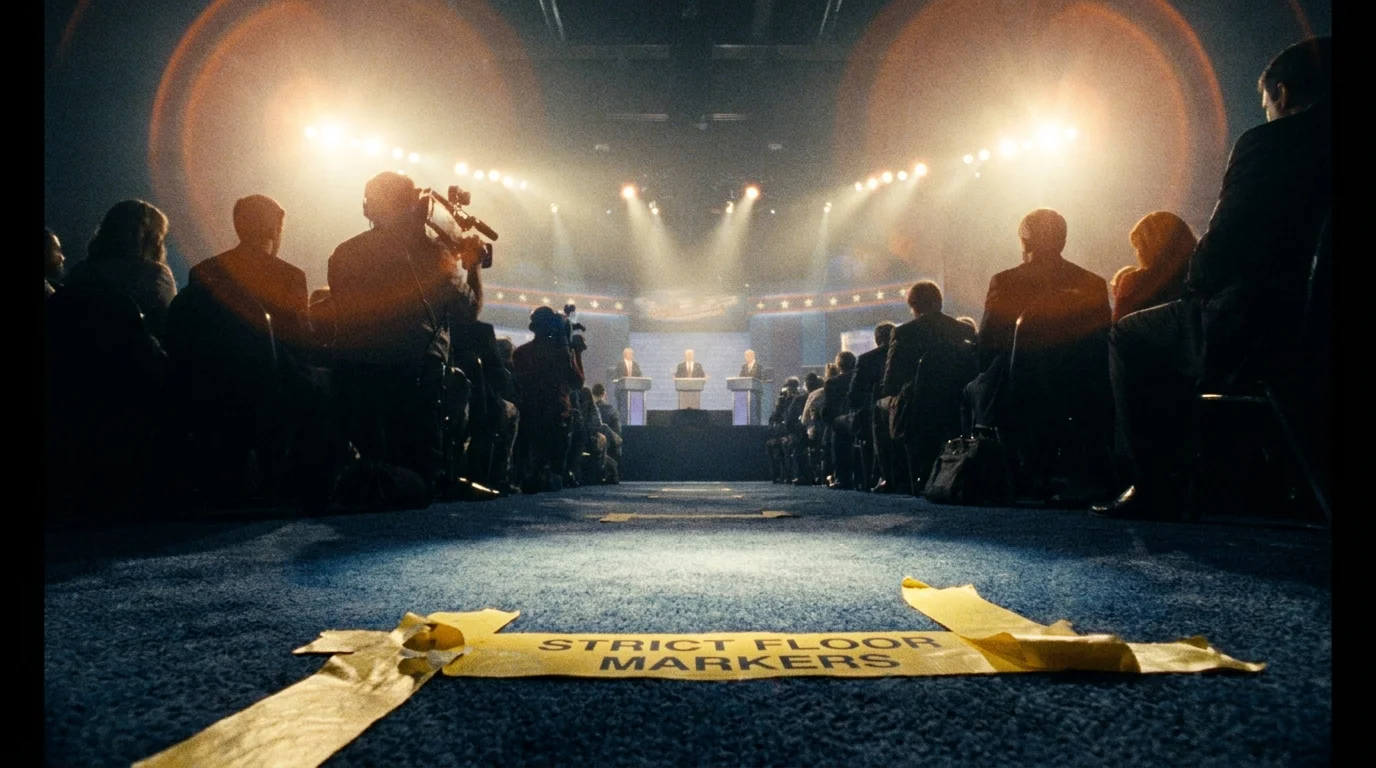
The sharp rip of yellow gaffer tape peeling against dark stage carpet echoes through the empty auditorium hours before the network broadcast begins. Production crew members walk the floor with steel tape measures, laying down bright crosshairs that lock the stage into rigid geometric boundaries. You see a grand arena set for democratic debate, but the technicians see a math problem ruled by lens focal lengths and light cones.
Every podium rests on a precise eight-foot floor grid designed to calibrate parallax angles between competing cameras. If a politician steps three inches outside their taped box, the crisp key light softens, throwing deep shadows beneath their cheekbones. What looks like natural gravitas on your living room screen is actually an intense exercise in physical confinement.
When candidates stand behind those wooden rostrums, their posture often seems stiff, almost defensive. That awkwardness is rarely a lack of personal confidence. They are fighting the claustrophobic reality of a television broadcast box engineered to punish uncontrolled physical movement.
The Illusion of Free Motion Behind the Rostrum
Television directors build high-stakes debates around split-screen framing, forcing two or three human beings into identical vertical rectangles. Because the studio cameras must maintain perfect focal parity, the floor space between lecterns is calculated down to the quarter-inch. Step too wide to emphasize a point about tax reform, and your hand vanishes into the digital void between split screens, making your argument look erratic and disjointed.
Think of the debate stage not as a public square, but as a series of invisible glass telephone booths. The candidate is free to speak, but only if they stay pinned inside a beam of high-output light that leaves zero margin for wandering feet.
- Voter registration matching models strip rural turnout signals under rigid demographic assumptions
- Barbara Jordan speech drafts enforce rhythmic pauses with heavy pencil brackets
- Kristen Welker FCC complaint filings switch network broadcast standards amid sudden party regulatory threats
- Dolly Parton flag lowering debate sparks sudden statehouse clashes over official gubernatorial protocol powers
- Scott Bessent Treasury nomination hearings trigger heated Senate disputes over emergency tariff authority rules
Marcus Vance, a 52-year-old broadcast lighting director who has managed staging for four presidential election cycles, treats these stage marks like surgical boundaries. He recalls coaching a fiery governor who habitually lunged across his lectern when challenged. Vance had to tape down a raised wooden cleat just behind the heels of the candidate’s dress shoes, giving him an invisible physical reminder to keep his chin centered inside the 32-degree key light cone.
How Floor Geometry Shapes Different Candidate Styles
Every political figure carries a unique physical footprint into an election hall, and the stage grid affects each body type differently. Surviving ninety minutes under high-definition cameras requires adjusting natural human instincts to fit the floor layout.
The Expansive Gesticulator
Candidates who rely on sweeping arm movements to project energy find themselves immediately choked by narrow lectern spacing. When two podiums sit within six feet of each other, wide hand gestures breach the opposing speaker’s visual space on wide shots, often reading as aggressive or unpolished to home viewers.
The Pacing Storyteller
Town-hall veterans who thrive by moving toward an audience struggle the most with locked floor tape. Leaving the designated audio sweet spot causes directional lavalier microphones to pick up hollow room resonance, making a strong voice sound thin and distant on national airwaves.
The Conversational Leaner
Politicians who instinctively lean forward to build intimacy risk stepping out of their primary key light. When a speaker dips forward past the taped boundary, overhead studio fixtures cast steep, unflattering shadows under their brow line, turning an earnest smile into a tired grimace.
Reading the Stage: A Viewer’s Tactical Toolkit
You can spot the subtle mechanical tricks candidates use to navigate these floor traps once you know where the broadcast boundaries sit. Watch how experienced debaters anchor themselves physically to project authority without breaking the lighting grid.
- The Three-Point Anchor: Keeping both hands lightly resting on the outer edges of the wooden lectern keeps the torso centered directly under the prime camera line.
- The Chin Pivot: Instead of turning the entire body to face a rival, experienced speakers turn only their neck, preserving their chest alignment with the primary high-definition lens.
- The Micro-Step Recovery: When an exchange grows heated and a speaker steps forward, watch their feet during the moderator’s rebuttal; seasoned pros slide back half a step to regain the lighting apex.
Understanding these stage rules changes how you evaluate televised political clashes. A calm, authoritative demeanor is rarely just a reflection of policy mastery; it is proof that a speaker knows how to thrive inside physical boundaries.
The Real Power of Controlled Restraint
The yellow tape markers eventually get stripped off the carpet, packed away in road cases along with miles of broadcast cable. Yet the discipline demanded by those tight visual parameters reveals something vital about modern leadership. When you watch candidates debate, you are not just grading their policy platforms; you are watching how they handle the intense pressure of staying steady under an unforgiving spotlight.
The sharpest political speech loses its authority the moment a speaker drifts an inch out of focus.
| Key Point | Detail | Added Value for the Reader |
|---|---|---|
| Podium Grid Spacing | Fixed 8-foot intervals locked with stage tape | Explains why politicians avoid moving between lecterns during exchanges |
| Key Light Cones | Narrow 32-degree illumination zones | Helps you spot when bad lighting distorts a candidate’s facial expression |
| Split-Screen Parallax | Camera alignments locked to precise eye levels | Reveals how sudden hand motions get cropped out of modern broadcasts |
Frequently Asked Questions
Why do debate organizers use floor tape instead of letting candidates move freely?
Television broadcasts rely on automated cameras and preset lighting zones that require fixed physical points to maintain sharp focus and consistent exposure.Do candidates get to practice on the taped floor before the debate?
Yes, campaigns participate in strict walk-throughs where aides measure eye lines, podium height, and floor boundaries before the broadcast goes live.Why do some debaters look uncharacteristically stiff on television?
They are often consciously restricting their natural hand gestures and footwork to stay inside narrow camera and lighting corridors.How does podium distance affect television audio quality?
Microphones are calibrated for specific distances; stepping away from the floor mark causes voice audio to lose warmth and clarity.Can moving outside the floor box actually cost a candidate votes?
Subtle visual cues like poor lighting shadows or awkward body posture register quickly with viewers, often influencing perceptions of competence.