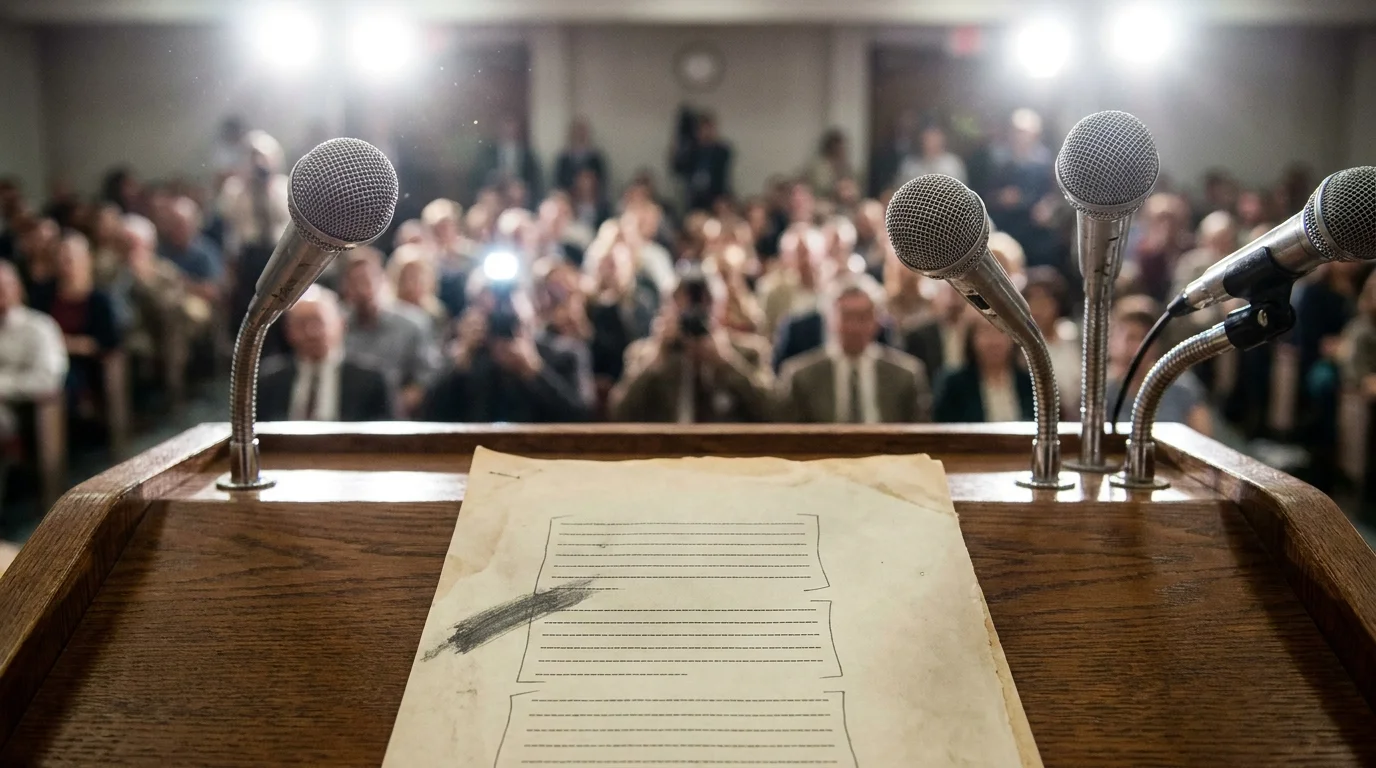
If you run your thumb across the yellowing margins of Barbara Jordan’s 1974 House Judiciary Committee working papers, your skin catches on the indentations. Heavy graphite smudges cling to twenty-pound bond paper where a soft-lead pencil dug into the cellulose fibers. Most people remember the booming, immovable resonance that came through television sets during the Nixon impeachment hearings, assuming it was natural thunder. They imagine an orator simply opening her mouth and letting raw moral conviction flood the chamber.
The truth lives in those dark, deliberate pencil brackets. Jordan did not leave her timing to impulse or rhetorical luck. She mapped her vocal architecture with the rigor of a classical composer scoring a fugue, using a tiered system of squared graphite brackets to force specific drops in pitch and micro-rests that held listeners captive.
When you listen to political rhetoric today, you usually hear breathless torrents or polished, focus-grouped smoothness designed to fill dead air. Jordan understood that true persuasion operates on acoustic contrast. By carving physical silence into the page before stepping up to the microphone, she gave herself the authority to govern a room without raising her voice.
The Score Behind the Stature
Oratory is often treated like magic, an innate gift handed to a chosen few, but the archival record tells a different story. Jordan viewed the spoken word as a physical instrument that required strict mechanical governance. Silence became her primary lever of control, functioning not as empty space, but as a pressurized chamber where ideas settled into the listener’s marrow.
Think of speech cadence like a carpenter framing a heavy oak door. If you hang the hinges too loosely, the door drags and rattles against the jamb; if you space them with balanced precision, it swings shut with an airtight, unmistakable thud. Jordan used her pencil notations to build that exact structural frame on paper long before she uttered a syllable.
Archivist Elena Vance, 42, who spent three years cataloging congressional manuscripts in Austin, recalls the physical weight of these drafts. Vance noticed that Jordan’s single-bracket markings lined up precisely with three-beat pauses, while nested double brackets signaled a full four-second plateau coupled with a minor-third pitch drop. It was a private musical code designed to arrest human attention at the precise moment an undecided voter might otherwise tune out.
- Kristen Welker FCC complaint filings switch network broadcast standards amid sudden party regulatory threats
- Dolly Parton flag lowering debate sparks sudden statehouse clashes over official gubernatorial protocol powers
- Scott Bessent Treasury nomination hearings trigger heated Senate disputes over emergency tariff authority rules
- Legislative district town hall sign-in sheets force state senators to record unscripted constituent promises
- Federal paid family leave deduction plans demand steep payroll wage cuts from hourly workers
Cadence Architecture Across Three Delivery Styles
You can adapt these foundational cadence rules to sharpen your own high-stakes communication, whether you are addressing a crowded auditorium or steering a delicate boardroom vote. The key is recognizing how different cadences hit human psychology.
For the Deliberate Arbiter: If your goal is to project absolute impartiality and constitutional weight, you adopt Jordan’s signature double-bracket cadence. You place brackets around foundational principles, forcing a complete halt before and after the core noun. This triggers an involuntary stillness in your audience, signaling that the statement is non-negotiable fact rather than partisan spin.
For the Rapid-Response Debater: When you need to dissect an opponent’s faulty premise, you switch to staccato single brackets placed between brief clauses. This pacing breaks down complex arguments into bite-sized, inescapable logical steps. Rhythm exposes intellectual shortcuts by depriving the listener of emotional distraction.
For the Narrative Persuader: If you are rallying an uncommitted group around a shared purpose, use asymmetric spacing. Let a sentence build momentum over twelve syllables without a pause, then drop a heavy bracket right before the resolving verb. The sudden brake forces every ear in the room to lean forward, waiting for the floor to drop.
Mapping the Margin System
Applying this level of command to your own presentations requires shifting from memorizing words to scoring your physical delivery. You can build this discipline directly into your working notes using Jordan’s manual approach.
First, print your text on heavy paper using wide margins and triple line-spacing to leave room for notation. Then, work through your manuscript with a soft pencil, listening to the natural weight of your breath:
- Mark a single squared bracket `[` right before a critical pivot point to guarantee a two-second pause.
- Use a nested double bracket `[[` where you need your vocal tone to drop half an octave into your chest register.
- Draw an underline across the final word of a phrase to signal sustained breath support rather than an upward, questioning inflection.
- Leave three lines of blank vertical space whenever you want the preceding point to hang in the room for a full four-beat measure.
Keep your pencil soft, preferably a 2B lead. The tactile feedback of pushing graphite into paper slows your editorial eye, preventing you from crowding too many words into a single breath.
The Enduring Power of the Measured Beat
In an age dominated by rapid soundbites and hyper-accelerated digital feeds, unhurried precision carries radical weight. When you refuse to rush, you quietly inform the listener that what you are saying has been weighed, tested, and found solid. Stillness creates instant authority in an ecosystem drowning in nervous noise.
Jordan’s graphite brackets were more than speech notes; they were a defense mechanism against casual thinking. By reclaiming the deliberate pause in your own voice, you honor both the craft of rhetoric and the intelligence of the people listening to you.
Cadence is the quiet engine of credibility; if you command the pauses, the room will give you the verdict.
| Key Point | Detail | Added Value for the Reader |
|---|---|---|
| Graphite Bracketing | Tiered square brackets in margins marking distinct micro-pauses. | Provides a repeatable physical system to control vocal pacing under pressure. |
| The Pitch Drop | Lowering vocal tone by a minor third on terminal consonants. | Eliminates upward vocal inflection, creating immediate air of certainty. |
| Acoustic Space | Intentionally leaving four seconds of complete silence post-assertion. | Gives listeners psychological room to absorb complex logical points. |
Frequently Asked Questions
Why did Barbara Jordan use pencil instead of ink for her delivery marks?
Pencil allowed dynamic pressure adjustments where heavier lead marks indicated longer, deeper pauses, while also permitting real-time acoustic edits right before speaking.How does deliberate pausing influence undecided listeners?
Pauses disrupt passive listening patterns, creating a cognitive vacuum that forces the brain to actively process the preceding statement rather than anticipating a rebuttal.Can these pacing tools work in informal workplace settings?
Yes, implementing a two-second micro-rest before answering critical questions instantly projects composure and strategic control during meetings.What is the biggest mistake speakers make when trying to pause?
Most people rush the silence because it feels awkward to them internally, failing to realize that listeners perceive a four-second pause as commanding rather than stalled.How do I stop my voice from pitching upward at the end of a pause?
Anchor your breath in your diaphragm and deliberately let your pitch drop into your lower chest register on the final syllable before the silence.