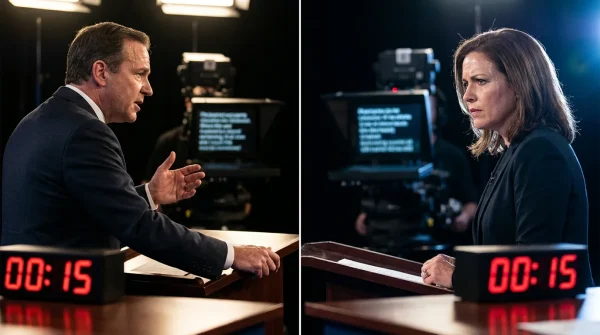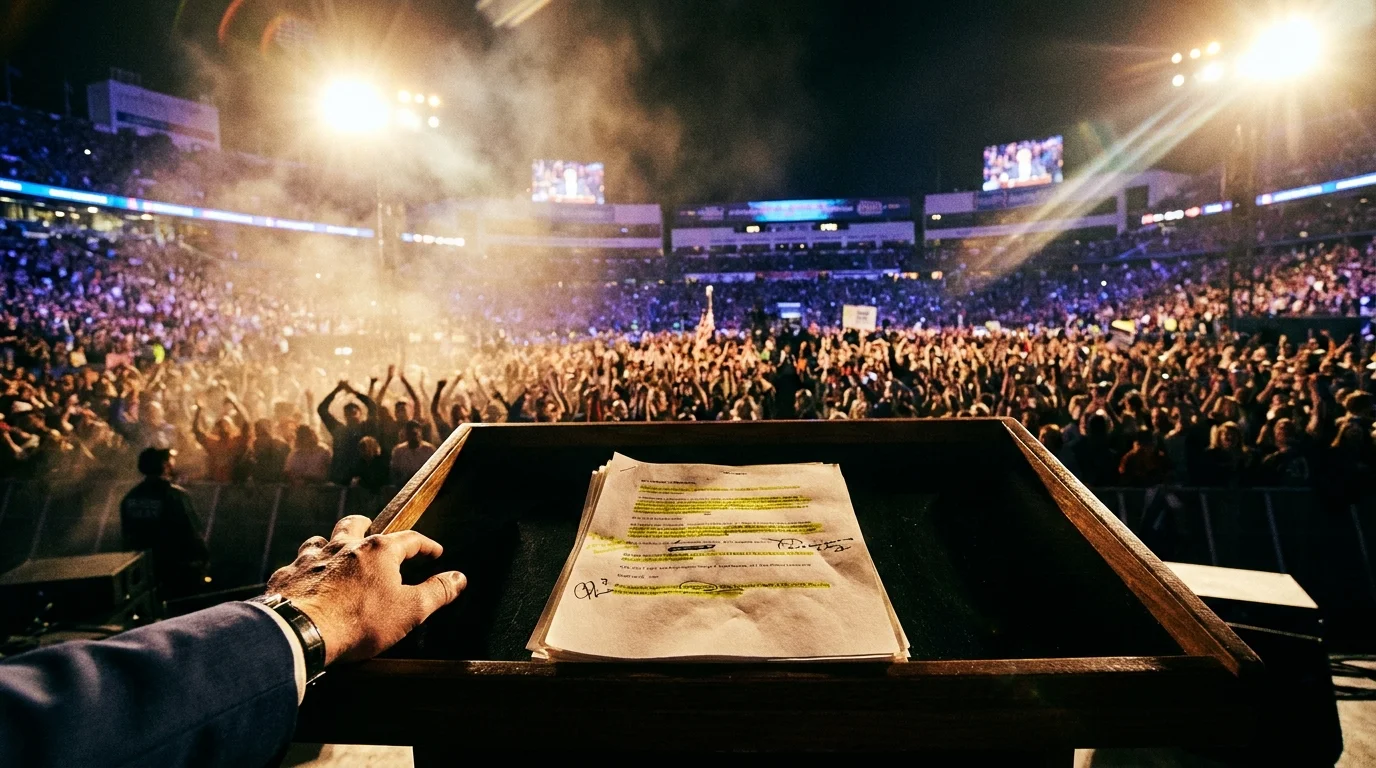
The hall smells of ozone, damp wool coats, and hot tungsten stage lamps. If you stand twenty feet from the podium at an arena rally, the sound is deafening—a rolling thunder of twenty thousand voices bouncing off steel rafters. Yet in the middle of that storm, a single speaker appears entirely unhurried, leaning against the lectern as if sharing a quiet thought over kitchen coffee.
You watch him lift his chin, hold a beat of silence, and let a phrase hang in the room until the air itself seems to tighten. It looks like unvarnished, instinctual charisma. You assume his mind simply works in clean, rhythmic cadences, pulling poetic timing out of thin air while the cameras roll.
The physical reality rests backstage on a rolling flight case. Long before words reach the transparent glass panels flanking the stage, they exist on thick sheets of white cardstock scored with vivid yellow highlighter. What reads as spontaneous soul on television is actually an exacting, mechanical blueprint.
Every pause, every drop in vocal register, and every burst of momentum is plotted onto the page using an intentional typographical shorthand. The secret is not that the speaker avoids structure; it is that the structure is engineered to look entirely invisible.
The Sheet Music Behind the Spoken Word
Most people treat a speech script like an essay to be read aloud. You write complete sentences, arrange neat paragraphs, and trust your instincts to handle the breathing. But reading an essay out loud forces you into a flat, predictable meter that drains energy from the room.
Professional presidential speechwriters treat the prompt screen like an orchestral score. In the Obama-era production suite, the text was broken down into visual measures rather than grammatical rules. Sentences were shattered across multiple lines, isolated so the eye could absorb a thought without scanning ahead and rushing the finish.
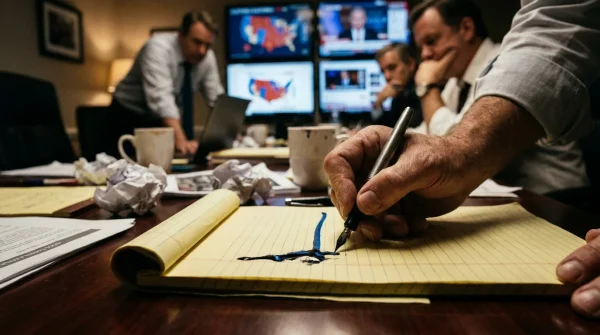
The signature mechanism of this pacing was the forward slash. A single slash meant a split-second comma beat—just enough time for the chin to dip. A double slash, painted in glowing yellow ink across the paper backups and rendered in high-contrast amber on the glass prompt, meant an unyielding two-second freeze. It was an artificial valve designed to let stadium acoustics catch up to the microphone.
When you watch vintage addresses, you are not watching someone think on their feet; you are watching an artist execute carefully calculated sheet music in front of a live room.
- Save America PAC leadership switches official donor guidelines after abrupt executive staff departures
- Florida governor race polling reveals sudden turnout shifts across fast-growing coastal retirement communities
- Pete Hegseth Senate confirmation hearing sparks rapid committee revisions over Pentagon command structures
- Congressional hearing rosters force committee chairmen to yield floor time after sharp gavel strikes
- Clean Water Act rules switch farm runoff oversight sparking cloudy ditch sediment disputes
The Stage Manager’s Hidden Cue Sheet
Marcus Vance, a 46-year-old touring stage technician who managed teleprompter feeds during the 2008 and 2012 campaigns, keeps a binder of original paper backups in his Chicago workshop. He remembers the intense discipline required to keep operators from scrolling too quickly during key rhetorical turns.
“If the operator rolled through the yellow slashes before the candidate took his breath, the entire spell broke,” Vance explains. “The candidate would have to chase the glass, and the second a politician looks like they are chasing text, the illusion of authority evaporates. The slashes were speed bumps for our hands as much as they were breathing marks for his lungs.”
The Typographical Anatomy of Modern Oratory
Understanding how pacing is built into the script reveals why some lines electrify an audience while others fall flat. It comes down to four distinct structural mechanics used behind the scenes.
1. The Breath Slash Notation
Speechwriters do not rely on standard punctuation because commas and periods carry grammatical baggage. Instead, they use typographical slashes to force physiological resets.
A single slash (/) signals a soft pause to swallow or shift weight from one foot to the other. A bold double slash (//) demands complete stillness, forcing a physical reset where the room must sit in utter silence before the resolution arrives.
2. Visual Line-Stagings
Text is never formatted in standard block paragraphs on the glass. A single sentence might be broken across five distinct vertical lines, mimicking the rhythm of blank verse.
This layout prevents the speaker’s eyes from sweeping left to right in a noticeable reading pattern. The eyes stay locked in the center of the glass, giving the impression that the speaker is staring directly into the eyes of a listener in row forty.
3. Weight-Shift Cues and Font Scaling
When an argument builds toward a moral climax, the prompt does not simply tell the speaker to get louder. It alters the typography.
Key operative words are scaled up two point sizes or rendered in bold monochrome blocks. This cues the diaphragm to deliver more air, dropping the vocal pitch into a heavier, more resonant register without sounding like a strain.
Building Your Own Cadence Engine
You do not need a stadium sound system or presidential glass monitors to use this technique. Whether you are leading a boardroom presentation, recording a video, or delivering a wedding toast, scoring your script will instantly remove vocal rush.
Apply these mindful adjustments to your next speaking draft:
- Strip out every standard comma and replace it with a single forward slash to mark where you intend to take a half-breath.
- Insert double slashes (//) right before your most important point, and force yourself to count two silent heartbeats before speaking the next word.
- Break long sentences into individual vertical fragments so your eyes stay centered on your audience instead of tracking across a page.
- Highlight key nouns with yellow ink or bold font weights to remind your voice where the actual emotional weight lands.
- Practice reading only to the slash mark, stopping completely until your eyes drop to the next line.
By mapping out your pauses physically, you eliminate the mental panic of deciding when to breathe under pressure.
The Freedom Inside the Blueprint
We often assume that strict preparation kills authenticity. We romanticize the off-the-cuff remark, imagining that true connection only happens when someone speaks without a safety net. But in high-stakes communication, raw spontaneity often leads to rambling, filler words, and nervous acceleration.
True poise is rarely an accident; it is an act of design. When you take the time to score your cadence, you remove the terrifying guesswork of public speaking. The yellow slash marks do not trap you—they give you permission to be still, to breathe, and to let your message carry the room.
“Pacing is not a gift you are born with; it is the discipline of knowing exactly where the silence belongs.”
| Technique | Visual Notation | Impact on Delivery |
|---|---|---|
| Breath Marker | Single Slash (/) | Creates a natural half-second pause to reset vocal airflow. |
| Acoustic Brake | Double Yellow Slash (//) | Forces a two-second silence to allow key ideas to settle. |
| Vertical Framing | Single-line verse breaks | Eliminates visible eye tracking, maintaining steady eye contact. |
| Diaphragm Anchor | Enlarged bold font weight | Lowers vocal pitch and projects authority naturally. |
Frequently Asked Questions
Why were yellow highlighter marks used instead of standard punctuation?
Standard punctuation is designed for silent reading comprehension, not vocal performance. Yellow highlighter provided maximum visual contrast against white cardstock and stage glare, acting as an unmissable physical speed bump for the speaker.Did the candidate ever deviate from the slash notations on stage?
Yes, but the script served as the home base. If crowd applause ran long, the speaker held at the slash mark until the room settled, ensuring the next point was delivered cleanly into a quiet room.Can I use this notation system for everyday slide presentations?
Absolutely. Adding slashes and breaking your presenter notes into vertical lines will instantly stop you from racing through your slides and help eliminate filler words like ‘um’ and ‘ah.’How long should a double slash pause actually last in real time?
A double slash typically translates to roughly two full seconds. In a quiet room, this feels like an eternity to the speaker, but to the audience, it registers as profound confidence and deliberate thought.Does using formatted prompts make a speaker sound robotic?
The opposite happens when done correctly. Robotic delivery comes from reading full paragraphs; slash notation breaks speech into conversational thought units, restoring the natural melody of human speech.