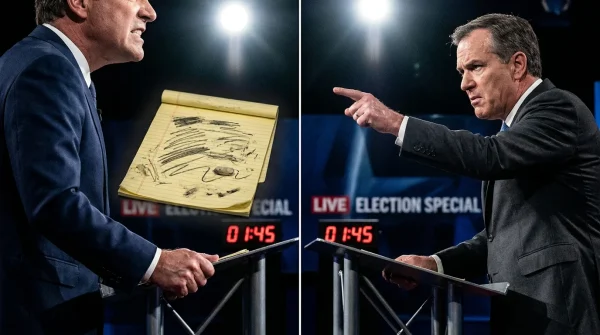
The studio temperature sits at a shivering fifty-eight degrees Fahrenheit, but the moment you step onto the debate riser, it feels like opening the door of an industrial oven. Two dozen blinding overhead tungsten stage lights beat straight down, their harsh golden beams reflecting off the polished wooden lecterns like mirrors. The room smells faintly of ozone, hairspray, and hot metal casing. In this crucible, the human body reacts long before the political mind can formulate a talking point.
You might tune in expecting an intellectual duel over marginal tax rates or foreign trade balances, but the television camera is hunting for something far more primal. As two rival politicians stand eighteen feet apart, the sheer luminescence overhead strips away their media training. Under forty thousand watts of focused illumination, the tiniest twitch of an eyelid or the faintest glaze of perspiration on an upper lip becomes an undeniable broadcast signal.
Television directors understand that voters rarely remember a five-point white paper recited in the second commercial block. Instead, they remember how a candidate looked when the pressure peaked. Tungsten glare exposes physical vulnerability in real time, turning the debate platform into an optical pressure cooker where composure matters far more than rehearsed rhetoric.
The Optical Interrogation: Why Debates Are Won in the Glare
For decades, political strategists treated television lighting as a neutral utility, something designed merely to ensure viewers in living rooms could see who was speaking. That assumption is dead. Modern broadcast rigs function less like portrait studios and more like high-definition interrogation rooms, engineered to measure biological composure under duress.
When light hits human skin from steep sixty-degree angles, it highlights micro-contours that normal room illumination softens. If an orator feels their pulse quicken, blood rushes to the capillaries across the forehead and bridge of the nose. Under warm tungsten lamps—traditionally balanced around 3200 Kelvin—that physiological flush reflects light differently than cool-toned LED panels. Stage heat amplifies biological tells, transforming normal nervous tension into visible signs of distress that viewers register unconsciously within milliseconds.
The polished surface of the podium acts as a secondary spotlight. When a politician grips the edges to steady their shaking fingers, the polished wood bounces harsh downward beams directly back up into their face, illuminating tightened jaw muscles and dry, parting lips. You are not watching a battle of intellects; you are watching two human nervous systems fight against stage conditions calibrated to expose their limits.
- Marist voter turnout models strip low-propensity voters under strict landline caller quotas
- Frank Luntz dial testing enforces sudden speech rewrites using instant voter reaction lines
- Mike Lindell recount escrow funds switch state party audit strategies after missing deposit deadlines
- Curbside ballot drop box slots block creased paper ballots with narrow metal lips
- State legislative delegation breakfasts demand handwritten index cards to flip contested fiscal votes
Greg Vance, a 58-year-old network lighting director who has rigged stages for four presidential election cycles, knows exactly where the psychological fault lines lie. During a walk-through in Columbus, he adjusted the key-to-backlight ratio by less than five percent, altering how shadows fell across the candidates’ brows. “A politician can memorize fifty pages of policy statistics,” Vance once told a junior gaffer while taping down heavy cables behind the riser. “My job is to hang lights that show the country whether that person blinks when the heat hits the bone.”
Reading the Glow: How Light Exposes Three Types of Candidates
Every candidate who steps onto a nationally televised stage brings a distinct physical profile, and the lighting grid treats each of them with ruthless mechanical indifference. Understanding how broadcast lighting interacts with different physical temperaments reveals how optical momentum actually shifts during ninety minutes of live television.
1. The High-Metabolism Fighter
This candidate thrives on kinetic energy, leaning into the microphone, nodding aggressively, and constantly shifting their weight. However, frequent movement breaks the key-light sweet spot. As they dart in and out of the primary beam, the camera’s auto-iris compensates, causing background shadows to pulse and making their physical delivery appear erratic, combative, and unmoored.
2. The Rigid Stoic
To avoid optical traps, some politicians plant their feet, lock their elbows to the podium frame, and barely move their neck. While this keeps them safely inside the lighting designer’s flattering wash, it creates a different failure mode. Under sustained 3200K heat, stationary candidates trap body warmth inside wool suits. Within twenty minutes, the glare creates a shiny sheen across the forehead that heavy stage powder can no longer absorb.
3. The Conversational Operator
The rare debater who masters the stage knows how to use the lighting geometry to their advantage. They hold their gaze directly down the barrel of the primary camera lens, using the reflection in the lectern to soften their jawline while keeping their shoulders slightly dropped. By minimizing rapid head turns toward their opponent, they keep their facial shadows symmetrical and steady.
The Viewer’s Tactical Toolkit: Decoding Stagecraft in Real Time
The next time you watch a primary showdown or a general election debate, look past the practiced soundbites and watch how the stage environment tests the candidates’ physical discipline. You can assess their true control by monitoring a few specific optical markers:
- The Collar Line Glaze: Watch where the shirt collar meets the neck. If fabric begins to darken under hot lamps, the candidate’s core temperature is spiking, indicating elevated adrenaline and stress.
- The Podium Knuckle Grip: Look at the downward bounce light on their hands. White, bloodless knuckles against dark wood reveal an effort to suppress trembling.
- The Eyebrow Crest Shadow: Harsh overhead tungsten casts hard shadows directly into the eye sockets if a candidate tilts their chin downward in defeat or hesitation. A confident speaker keeps their chin elevated just enough to fill those sockets with light.
- Micro-Blinks per Minute: Intense stage lighting dries out the eyes rapidly. A jump from twenty blinks per minute to more than sixty indicates that the candidate’s focus is fracturing under the sensory load.
Beyond the Soundbites: The Power of Seeing Clearly
It is easy to dismiss stage lighting as mere aesthetics, a superficial detail in a process that ought to be about governance and public service. But how leaders behave under physical, unyielding pressure tells you something real about how they manage crisis. A press release can be edited by committee, and a teleprompter speech can be polished over weeks, but ninety minutes trapped under scorching tungsten allows no hiding places.
When you learn to see the debate stage through the eyes of a broadcast technician, the political theater falls away. You begin to notice the discipline required to stand motionless in eighty-degree ambient heat while cameras dissect every breath. True composure is physical mastery under unforgiving scrutiny, and in the high-stakes game of national politics, the lights never lie.
“You cannot spin a bead of sweat running down a candidate’s nose under forty thousand watts of tungsten.”
| Key Point | Detail | Added Value for the Reader |
|---|---|---|
| Color Temperature (3200K) | Warm tungsten spectrum highlights micro-vascular flushing and perspiration. | Helps you spot genuine physiological stress behind rehearsed answers. |
| Steep 60° Overhead Angles | Casts deep shadows beneath brows, nose, and jawline when posture slips. | Reveals when a speaker is losing confidence and ducking eye contact. |
| Lectern Bounce Reflection | Polished wood reflects high-intensity light back onto hands and torso. | Allows you to see physical tension and white-knuckle podium gripping. |
Frequently Asked Questions
Why do presidential debates still use hot tungsten lights instead of cooler LEDs?
While LED fixtures are increasingly common, broadcast networks still rely heavily on tungsten and hybrid high-CRI fixtures because they deliver unparalleled skin-tone accuracy on high-definition camera sensors, preventing candidates from looking washed out or gray.How cold do they keep debate halls to offset the heat?
Production teams routinely drop arena thermostats between 55 and 60 degrees Fahrenheit hours before airtime to cool the physical set and lecterns before the heavy lighting rigs run at full power.Can candidates request custom lighting adjustments?
Campaign representatives participate in strict site surveys and lighting walk-throughs where heights, podium distances, and fill ratios are negotiated down to the inch to prevent either candidate from gaining an optical advantage.Why does podium finish matter so much for broadcast optics?
High-gloss finishes reflect overhead beams directly into camera lenses and up into candidates’ faces, which is why technicians often apply matte sprays or custom wood stains to regulate bounce light.What is the most common visual mistake debaters make under stage lights?
Looking down at their notes for extended periods, which allows overhead lights to cast heavy, unflattering shadows over their eyes, making them appear fatigued or defensive on television screens.