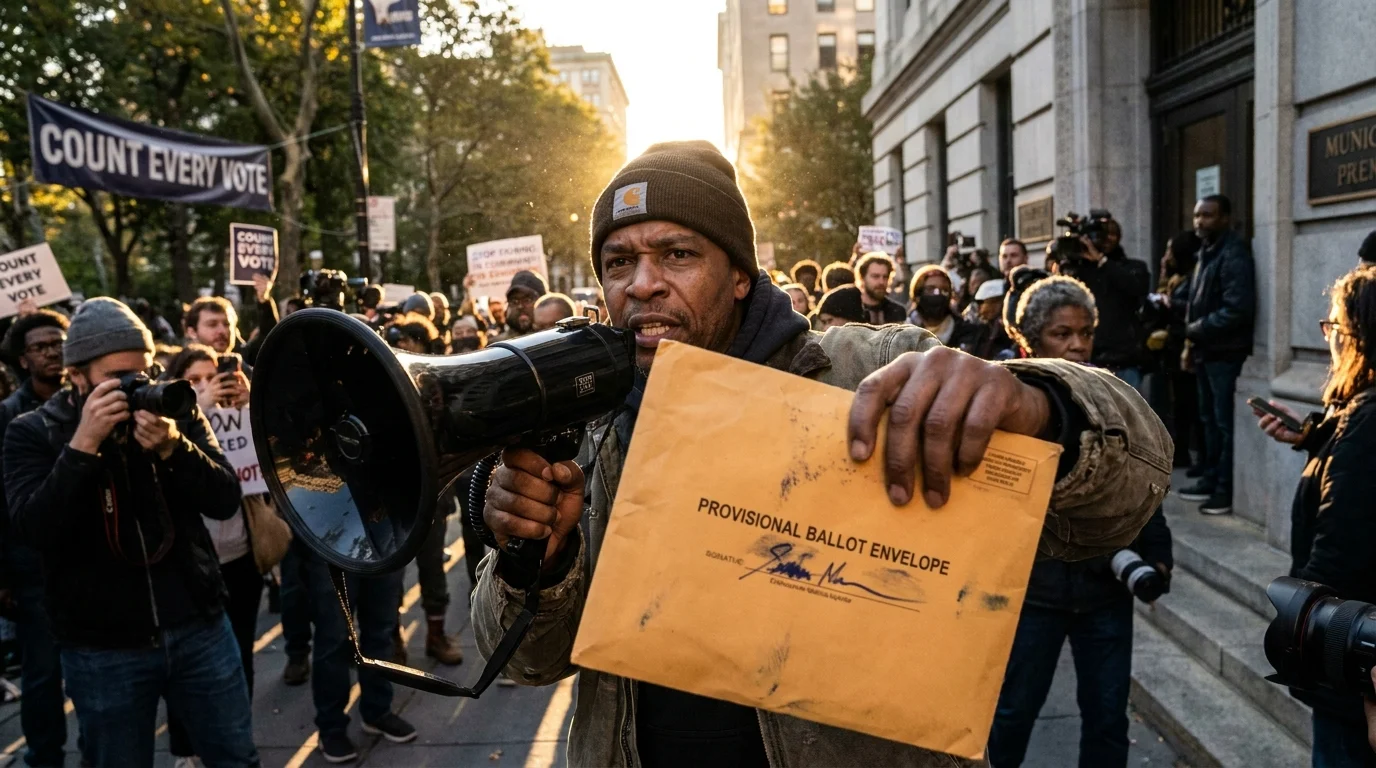
The basement sorting room of any county election warehouse smells of warm paper, dry cardboard dust, and the sharp bite of industrial ozone drifting off high-speed transport belts. Fluorescent tubes hum overhead, casting an unforgiving glare across rows of heavy manila cardstock envelopes stacked like roof shingles. In this sterile assembly line, your ballot does not begin its public life inside a voting machine or on a tally sheet. It begins as a physical package sliding under the high-resolution optical lens of an automated sorting track running at thirty envelopes per second.
You probably remember the exact feeling of filling out that provisional slip: the wobbling plastic clipboard resting against your forearm, the hurried pressure of a line shifting behind you, and the slick drag of a cheap office ballpoint pen against the coarse fiber. You signed your name across the designated line, pressed the self-adhesive flap shut, and handed it across the precinct table, assuming that simple human intent was enough to carry your voice across the finish line.
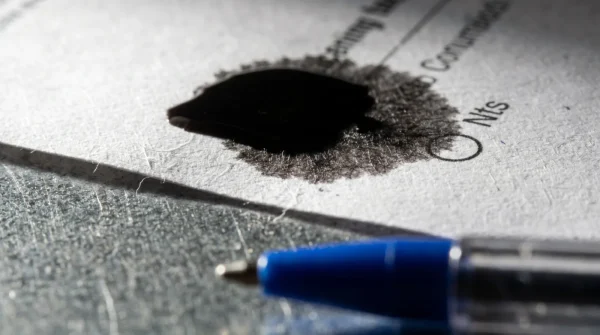
Yet tucked beneath the optics of an envelope scanner, that signature is treated not as an expression of civic will, but as an unforgiving mathematical grid. When the oily blue ballpoint ink smudge on heavy manila cardstock smears across the bounding box line, the camera misinterprets the dragged pigment as an erratic loop or a broken baseline. A stray swipe of ink transforms an otherwise valid signature into an immediate algorithmic anomaly.
Heightened poll-monitoring standards and tightened envelope verification rules have turned outer paper sleeves into the primary battleground of ballot challenges. What feels like an administrative footnote is quietly sifting out valid votes long before any bipartisan canvassing board ever unfolds the paper inside.
The Optical Trap: Why Mechanical Verification Misreads Your Hand
Modern envelope sorters rely on automated signature verification software configured with razor-thin margins. While you might imagine a human clerk carefully comparing your handwriting against your motor vehicle registration file, the first cut is entirely digital. The scanner captures a grayscale bitmap of the envelope’s signature box, strips out background noise, and runs a vector comparison calculating stroke velocity, line thickness, curvature, and loop geometry.
Most county boards establish an automated rejection threshold between twelve and eighteen percent spatial variance. When a standard ballpoint pen deposits a small blob of unrefined oil paste at the end of a stroke—a physical reality common to every cheap twist pen—that paste takes up to ninety seconds to set on dense manila cardstock. If you inadvertently graze the wet line with the side of your hand or slide the sleeve into the drop slot too quickly, that smudge blooms across the boundary grid.
- C-SPAN archival video leaks expose altered stump speech audio with telltale visual static
- Federal Reserve Act amendments trigger hidden paycheck deductions with paper check processing fees
- Iowa precinct caucuses demand standing headcounts that trap exhausted voters in cold gymnasiums
- Federalist Society debates resurfaced forgotten nineteenth century judicial oaths using dusty leatherbound transcripts
- Zoning maps dictate modern housing shortages based on outdated redlining
The computer cannot distinguish between a voter’s natural tremor and an oily smear trailing across the registration border. Scanners flag the resulting blur as an unverified stroke, pushing the ballot straight into the manual challenge bin where partisan observers stand ready to contest baseline deviations.
The Canvassing Table: A Clerk’s Perspective on the Micro-Flaw
Elena Vance, 52, a veteran county canvassing board reviewer in Pennsylvania, has spent hundreds of hours under the bright LED desk lamps of post-election adjudication rooms. Her job is to examine challenged provisional outer sleeves alongside two party representatives before the envelopes can be unsealed and fed into tabulators.
"People think signatures get rejected because someone forged a name, but almost every envelope we pull from the quarantine stack comes down to ink mechanics," Elena explains, leaning over a magnifying loupe. "Someone holds their sleeve with a damp thumb on a rainy afternoon, or they sign with a rolling ballpoint that leaves heavy paste puddles. When that paste smears just a quarter-inch outside the black boundary box, the sorting scanner reads the envelope as corrupted. By the time it reaches our table, election observers are arguing over whether that smear represents intentional voter alteration or signature fraud."
Anatomy of Envelope Rejection: The Hidden Pressure Points
Voters run into friction not because their legal standing is in question, but because the physical interface of a provisional envelope is notoriously unforgiving. Understanding how these mechanical errors occur allows you to protect your ballot from being diverted into administrative limbo.
The Paste Smear and Stroke Width Disruption
Traditional ballpoint pens use high-viscosity oil pastes that sit atop the cardstock rather than soaking immediately into the wood pulp. When stacked in precinct bins under the weight of dozens of other ballots, pressure creates contact transfer. The resulting line thickness swells beyond the five-point scanner tolerance, instantly triggering a mismatch flag in county databases.
Boundary Box Bleed and Registration Marks
Provisional envelopes feature small corner alignment markers and bounding boxes that tell sorting cameras where to crop the image. If a flourish on your signature or a smeared ink trail crosses those registration lines, the automated crop captures the border itself as part of your signature, wildly distorting the vector calculation.
The Moisture Gradient
Voters often hold provisional packets in their hands for twenty to forty minutes while standing in precinct lines or waiting for poll workers to cross-reference poll books. Natural skin oils and humidity soften the surface sizing of manila paper, turning smooth cardstock into an absorbent sponge that wicks cheap ballpoint ink into feathery, unrecognizable shapes.
The Precision Ballot: A Tactical Guide to Protecting Your Vote
Securing your vote requires treating the envelope signature with the same physical care you would give a legal deed. Small, intentional adjustments eliminate the mechanical errors that trip sorting algorithms.
- Choose Archival Pigment Over Ballpoint Paste: When possible, sign official sleeves using a fast-drying, water-based pigment liner or gel pen with a 0.5mm tip. Pigment bonds directly to wood fibers and resists surface smearing.
- Respect the Boundary Safe Zone: Keep all loops, tails, and flourishes at least a quarter-inch inside the printed rectangular signature box to prevent registration line overlap.
- Allow a Thirty-Second Set Window: Do not fold, seal, or stack the envelope the instant you lift the pen. Give the pigment thirty seconds to dry under the room air before sliding it into secrecy sleeves or collection boxes.
- Keep the Sleeve Surface Dry: Rest your wrist on a clean scrap of paper or keep your hand elevated off the cardstock while writing to avoid transferring moisture or body oils to the scan area.
Tactical Toolkit for Envelope Verification
- Ideal Pen Choice: Black or dark blue 0.5mm pigmented micro-point rollerball.
- Drying Rest Time: 30 seconds minimum before insertion or handling.
- Signature Margin: 0.25 inches of clear space inside all four bounding box edges.
- Acceptable Variance Threshold: Under 15% deviation from your motor vehicle bureau file.
Reclaiming Agency in the Margins
We often think of democratic participation as a purely abstract, high-minded ideal. We focus on national debates, platform shifts, and campaign rhetoric, forgetting that every single vote is anchored to an uncompromisingly physical object. That heavy manila cardstock envelope is a bridge between your intent and the institutional record.
When you understand the exact physical demands of automated sorting systems, the mundane task of signing an envelope transforms into a deliberate act of precision. Taking control of small details guarantees that your political voice is never silenced by a spot of misplaced ink.
"A clean ballot is not just about choosing a candidate; it is about leaving zero room for an automated camera to misinterpret your existence."
| Key Point | Detail | Added Value for the Reader |
|---|---|---|
| Ink Chemistry | Oil paste ballpoints smear easily on dense manila cardstock under sorting pressure. | Swapping to fast-drying pigment pens prevents optical non-match rejections. |
| Scanner Margins | Automated sorting profiles flag signatures showing over 15% line-thickness distortion. | Keeping handwriting within boundary boxes protects against algorithmic disqualification. |
| Adjudication Rules | Heightened poll monitoring allows party observers to challenge smudged provisional outer sleeves. | Understanding physical ballot integrity ensures your vote survives administrative audits. |
Frequently Asked Questions
Can an election board reject my provisional ballot solely for a pen smear?
An automated scanner will divert your smudged envelope to a challenge pile if the ink distorting the signature pushes it past the county variance limit. While election workers review these manually, partisan monitors can challenge ambiguous smudges, resulting in potential rejection if you do not complete a signature cure process.What is the best type of pen to sign a provisional ballot sleeve with?
Use a standard black or dark blue quick-drying pigmented fine-point pen (0.5mm). Avoid oil-based twist ballpoints that leave ink globs, as well as ultra-wet liquid rollerballs that bleed through coarse cardstock.How do automated signature sorters compare my handwriting?
Sorting machines extract a high-contrast digital scan of your signature and compare its stroke paths, vector loops, and baseline geometry against your voter registration or driver’s license file using an algorithm tuned to flag variances above 12 to 18 percent.What should I do if I accidentally smear my signature at the polling place?
Do not cross it out or try to write over it. Immediately notify the poll worker or precinct judge and request a fresh provisional envelope packet so the mistake can be spoiled and voided properly.How can I confirm my provisional envelope was accepted and counted?
Most states provide an online provisional ballot tracker or a county clerk hotline where you can enter your receipt identification number to verify that your envelope passed verification and was tallied.