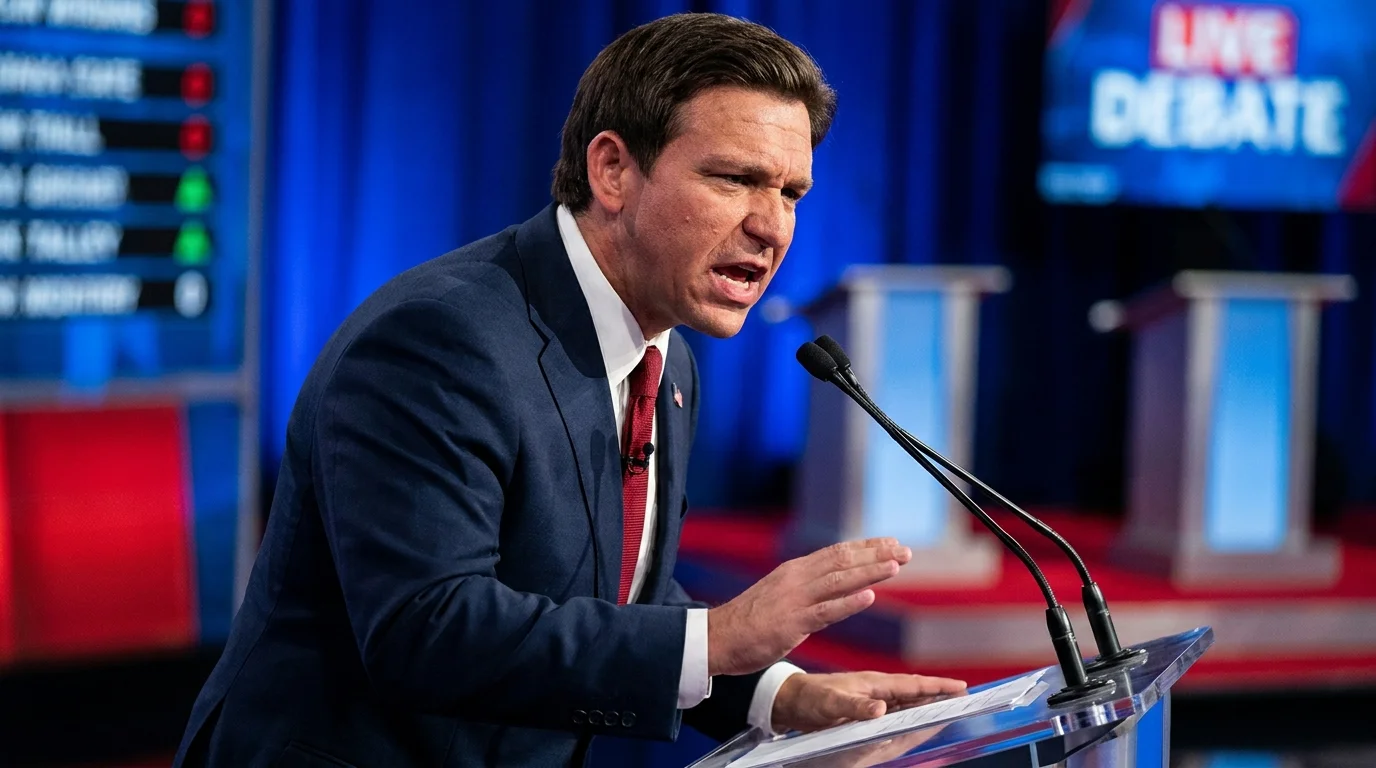
The studio air carries the flat, chilled smell of over-conditioned air and floor wax, held cold enough to keep stage makeup from running under forty thousand watts of broadcast illumination. Two lecterns stand twelve feet apart on a dark acrylic riser, their surfaces wiped free of dust and fingerprints just minutes before the red tally light flickers on. You watch the split-screen framing on your television at home, where everything looks tidy, measured, and rehearsed down to the angle of each candidate’s necktie.
Then the moderator pivots toward the budget deficit, and the rehearsed silence collapses completely.
For fifteen seconds, the air in the soundstage changes. It begins with an unscripted rebuttal on statutory retirement formulas, followed by an ill-timed admission that certain baseline benefits require dynamic structural revision. The camera stays fixed on the podium, but you can see the immediate physiological shift: pupils widening, the stuttering inhalation of a speaker who realizes they just crossed an invisible electric fence, and the predatory lean of their opponent moving in for the kill. In television control rooms across Washington and Philadelphia, the live reaction dials held by focus group swing voters do not merely dip—they drop like lead sinkers tossed off an ocean pier.
Within ninety seconds of that single sentence leaving the microphone, ad buyers in the wings were already reaching for their mobile phones under the dim glow of backstage monitors. What felt like an intellectual debate over ledger columns to the candidate was instantly understood by campaign managers as a lethal liability, turning tomorrow morning’s entire planned media schedule into scrap paper before the second commercial break even aired.
The Load-Bearing Beam: Why Entitlement Rhetoric Snaps Political Armor
Modern campaigns run like pressurized hydraulic systems. Every talking point is filtered through focus groups, smoothed over by policy fellows, and polished until it reflects no sharp edges. Yet political consultants refer to retirement entitlements as the third rail for a precise mechanical reason: they are not abstract budget debates, but the load-bearing beams of your household budget.
When a candidate brings up changing eligibility thresholds or modifying indexing math, the kitchen table reality strikes with immediate ferocity. It is not an ideological fight over balance sheets; it is your mother’s prescription drug allowance, your grandfather’s heating oil check, and the three decades of steady payroll deductions you watch disappear from every paystub. The moment a nominee treats that social contract as an adjustable spreadsheet cell, the voter’s emotional response ceases to be partisan—it becomes protective instinct.
- New Hampshire primaries crush frontrunner war chests through direct living room voter scrutiny
- Senate agriculture drafts secretly trade rural nutrition subsidies for Southern crop baselines
- Kroger grocery aisles face sudden consumer boycotts over automated digital price tags
- Mexico border trade shifts force party leaders into sudden protectionist platform pivots
- Postal worker routes prompt immediate community backlash over rural mail delays
Marcus Vance, a forty-four-year-old independent media strategist based in Phoenix, spent the evening monitoring twenty-four live voter dials while tracking overnight broadcast inventory. His desk was littered with cold coffee cups and printouts of targeted cable buys across three swing counties when that specific exchange flared on screen. Vance watched the dial-test graph register an immediate forty-point plunge among non-affiliated voters over age fifty-two—a demographic his candidate needed to carry by at least four points to survive November. Before the debate resumed from the first station break, Vance had personally executed emergency cancellations on six figures of planned television ads, substituting them with rapid-response defense clips cut from an iPhone in the green room hallway.
Dissecting the Shockwave: How Different Coalitions React to the Break
A sudden slip on entitlement safety nets does not reverberate uniformly across the electorate. Depending on where you stand economically and geographically, the fifteen-second clash carries an entirely different resonance.
For the Fixed-Income Household: The threat is immediate, existential, and non-negotiable. When national figures float cost-of-living adjustments tied to chained inflation metrics, they hear an immediate reduction in grocery buying power. Partisan loyalty evaporates instantly under this scrutiny, replaced by a defensive posture that punishes any politician daring to touch existing solvency guarantees.
For the Swing-Suburban Breadwinner: This demographic evaluates the dispute through the lens of dual obligation. These voters are balancing child care costs on one side and assisting aging parents on the other. If federal support systems for elder care or retirement weaken, that unpaid labor and financial stress collapses squarely onto their shoulders, triggering rapid defection away from candidates perceived as fiscally reckless with human safety nets.
For the Younger Payroll Contributor: Cynicism often masks genuine concern here. While younger voters frequently report doubt that these trust funds will exist when their own hair turns silver, watching candidates squabble on live television confirms their suspicion that their monthly deductions are financing current political gridlock rather than an enduring collective savings account.
Mindful Observation: How to Read the Next Debate Clash
You do not have to fall prey to the post-debate spin cycles engineered by cable networks and party spokespeople. Watching these high-stakes clashes with an analytical eye reveals the real political damage long before the weekend polls confirm it.
Keep these practical observation points in your sights during the next live televised broadcast:
- Watch the nonverbal recovery: When a speaker makes a mistake on sensitive benefit policy, notice if they immediately drop their chin or look toward their campaign box off-camera. The loss of eye contact with the moderator tells you they know they stepped into a trap.
- Track the opponent’s pivot speed: Effective debaters do not answer the broader question once an opponent stumbles; they immediately freeze the topic on the slip, repeating the exact phrasing back to the audience to anchor the mistake in your memory.
- Observe the rapid ad substitution: Watch local evening news broadcasts forty-eight hours after a debate. If positive biographical spots disappear and are abruptly replaced by defensive, direct-to-camera explanations of past voting records, you know the campaign’s internal polling registered catastrophic movement.
- Monitor the statutory language: When politicians use euphemisms like ‘modernizing solvency frameworks’ or ‘means-tested structural adjustments’, translate them directly to kitchen table realities. They are discussing the timing and amount of your monthly benefit checks.
The Bigger Picture: Reclaiming Your Stake in the Social Contract
Behind the harsh television lights, the frantic hand gestures, and the multi-million-dollar ad cancellations lies a simple, reassuring truth: public pushback still carries raw power. The panic that swept through that battleground debate studio did not originate from high-priced consultants or elite think tanks. It was generated entirely by everyday people looking at their screens, recognizing a direct threat to their family’s security, and registering instant, unwavering refusal.
When you understand the exact mechanisms behind these televised skirmishes, the political noise loses power over you. You stop seeing a debate as theatrical entertainment and begin recognizing it as a public negotiation where you hold the deciding vote. The frantic scrambling in backroom campaign suites proves that when it comes to the basic guarantees of your working life, Washington remains fundamentally terrified of your voice.
The fastest way to puncture a politician’s practiced facade is to force them to explain an unearned ledger cut to the person who spent forty years paying for it.
| Key Point | Detail | Added Value for the Reader |
|---|---|---|
| The Fifteen-Second Slip | Candidate acknowledged structural revisions to baseline benefit eligibility. | Reveals how unscripted moments expose unvetted legislative priorities. |
| The Focus-Dial Collapse | Swing voter sentiment dropped forty points below baseline in real time. | Demonstrates that voters reject entitlement restructuring regardless of party. |
| The Media Buy Pivot | Campaign war rooms pulled hundreds of thousands in broadcast ads mid-debate. | Shows the direct link between debate performance and rapid campaign resource allocation. |
| Household Ledger Reality | Entitlements function as personal assets rather than abstract budget items. | Reframes federal budget debates into practical terms of monthly household security. |
Frequently Asked Questions
Why do entitlement discussions cause such immediate panic in political campaigns?
Social Security and Medicare are viewed by voters as earned insurance paid for through decades of labor, not government charity. Any threat to their stability directly disrupts the personal financial plans of millions of swing voters, making it the most politically dangerous topic on any debate stage.What is a live voter dial test, and how does it influence political strategy?
Selected groups of undecided voters hold hand-held dials to rate their real-time reaction to candidate statements second by second. When dial lines plunge sharply, campaign managers realize immediately that an argument has failed, prompting urgent strategic pivots before the debate even concludes.How quickly can a campaign replace an ad buy after a disastrous debate moment?
Thanks to modern digital traffic systems, campaign buyers can cancel or replace regional television spots within a few hours. If a debate moment proves toxic, existing positive spots are often yanked overnight to prevent waste and mitigate polling fallout.What euphemisms should I listen for when politicians discuss benefit cuts?
Pay close attention to terms such as ‘stabilizing solvency’, ‘indexing structural adjustments’, ‘dynamic retirement age indexing’, and ‘modernizing safety frameworks’. These phrases almost universally refer to reducing future benefit payout schedules or delaying access.How can ordinary voters verify what was actually proposed during a debate clash?
Bypass campaign press releases and examine the official legislative text of committee budget resolutions. Reviewing the Congressional Budget Office (CBO) score of disputed bills provides an impartial assessment of how proposed statutory changes affect household benefits.