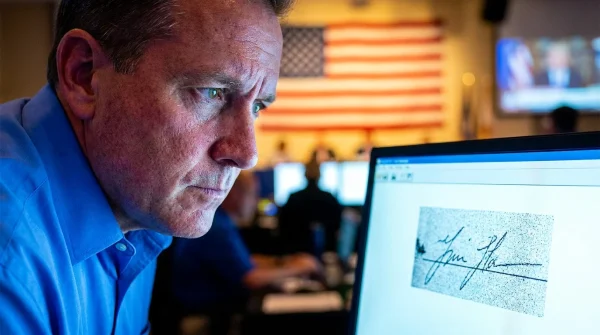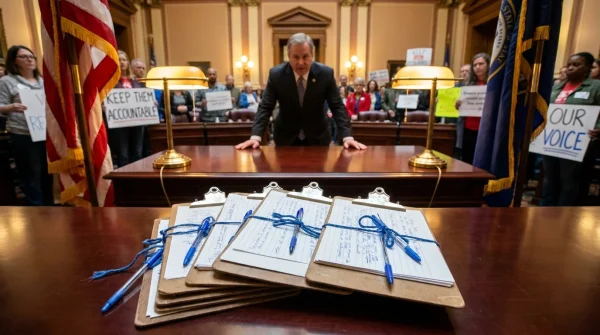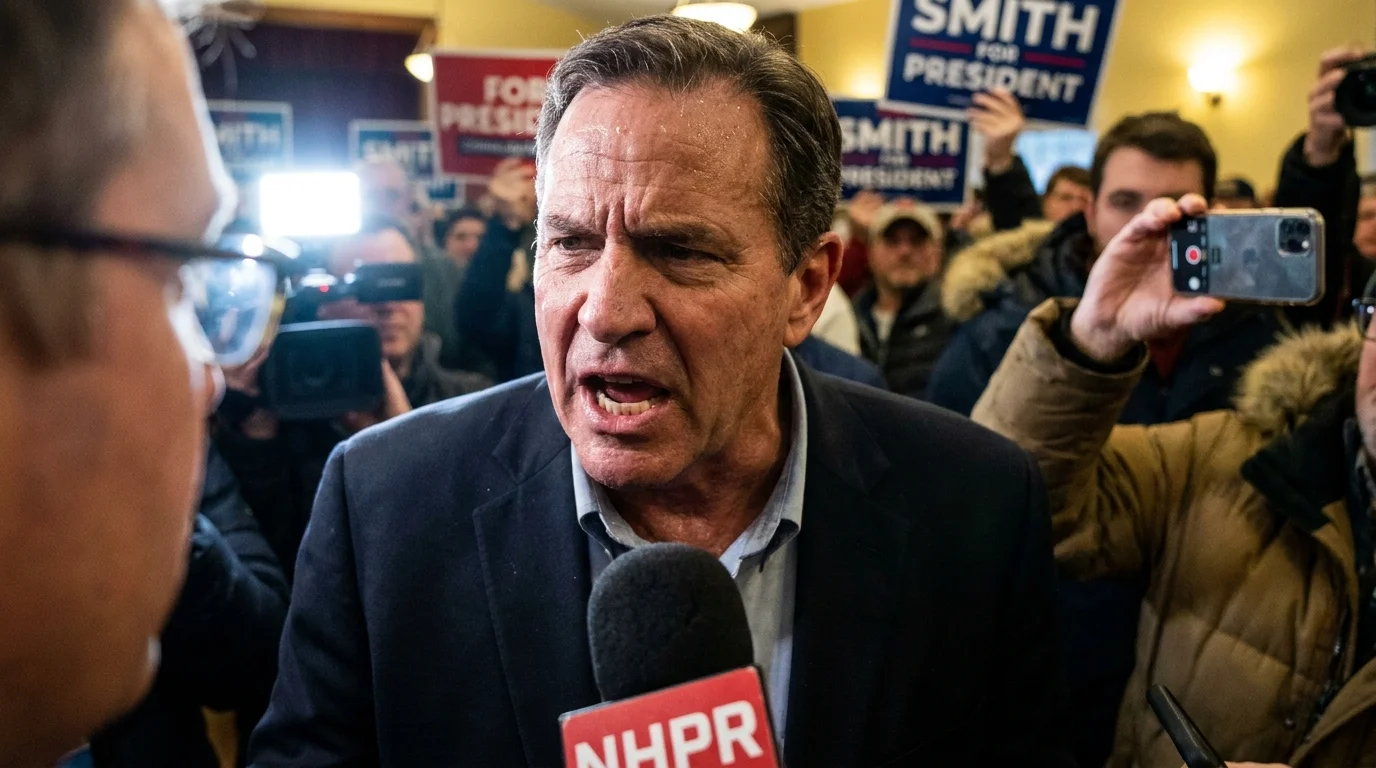
The gravel crunches under slush in a snowbanked driveway off Route 101, where exhaust plumes drift white and thick into the sub-twenty-degree dusk. Inside a drafty Methodist church basement smelling of damp wool coats, burnt drip coffee, and lemon-scented floor wax, sixty wooden folding chairs scrape across linoleum. There are no teleprompters here, no theatrical stadium lighting rigs, and no digital filters to polish the fatigue out of a national candidate’s hollow cheekbones.
You might imagine modern presidential campaigns are won inside gleaming broadcast studios or through algorithmic ad buys plotted by data scientists in northern Virginia. Yet when a candidate steps through that side door, shedding a wet down parka to stand level with retired lineworkers, municipal clerks, and public school teachers, the glossy million-dollar airwaves suddenly dissolve into irrelevance. The room offers nowhere to hide, forcing unfiltered human contact across folding tables.
A voter sitting three feet away in a worn flannel jacket does not care about national cable panel commentary or polished twenty-point polling leads. They care that the candidate hesitated before answering a hyper-specific question about rural ambulance districts or municipal property tax assessments. In this state, politics is not consumed as entertainment through a glowing screen; it is felt as a physical, unvarnished transaction where eye contact and conversational pauses carry more weight than an eight-figure Super PAC war chest.
The Friction Engine: Why Big Money Stalls in Small Rooms
For decades, political strategists have treated the early primary calendar as an engineering problem that could be brute-forced with liquidity. If a campaign raises forty million dollars in a single quarter, the conventional playbook dictates blanketing Boston network affiliates, flooding suburban mailboxes with four-color cardstock, and dominating digital feeds with micro-targeted thirty-second spots. Yet when that multi-million-dollar machine meets the granite hills, it hits a peculiar hydraulic resistance.
Think of it as forcing a high-speed speedboat into an iced-over mountain canal. The very bulk and velocity of a national campaign turn into fatal liabilities in an environment built strictly for low-wake, hand-crafted navigation. New Hampshire voters possess an institutional muscle memory passed down through town warrants and open-floor debates; they do not view a candidate as real until they have personally pressed them on a second or third follow-up question in a neighbor’s living room.
This creates what seasoned organizers call the living-room veto. A slickly produced television spot can establish basic name recognition, but it cannot survive the skepticism of a voter who watched that same frontrunner stammer when asked about local aquifer protection. What national consultants view as a quaint historical quirk is actually an uncompromising quality-control filter designed to break candidates who rely on teleprompter cadence rather than native policy fluency.
- Senate agriculture drafts secretly trade rural nutrition subsidies for Southern crop baselines
- Kroger grocery aisles face sudden consumer boycotts over automated digital price tags
- Mexico border trade shifts force party leaders into sudden protectionist platform pivots
- Postal worker routes prompt immediate community backlash over rural mail delays
- Congressional spending rescissions trigger fierce bipartisan clashes across Capitol Hill
Consider Sarah Lin, a fifty-four-year-old municipal tax collector from Merrimack County who has attended thirty-two candidate house parties across four election cycles. Lin keeps a battered spiral notebook in her glove compartment, filled with handwritten margins tracking whether contenders actually answered her inquiries about local road maintenance grants or retreated into generic national talking points. During the last cycle, she watched a heavily favored frontrunner with fifty million dollars in cash reserves freeze for six painful seconds when asked to explain an obscure heating-oil subsidy clause. Lin shared that moment with her precinct committee before dawn the next day, puncturing the frontrunner’s regional momentum long before the first television ad finished airing.
The Anatomy of Granite State Voter Archetypes
To understand why this gauntlet routinely dismantles frontrunners while breathing oxygen into cash-strapped underdogs, you must examine the specific friction points across different corners of the state. Each community operates with its own distinct standard for measuring authenticity, testing outsiders through unique cultural pressure gauges.
The coastal towns along Rockingham County bring an intense focus on infrastructural resilience and maritime commerce. Voters here are often policy pragmatists who read legislative fine print before breakfast; they will cross-examine a candidate on federal dredging permits with the precision of a courtroom attorney. If an aspiring leader attempts to pivot to a sweeping ideological slogan, the room cools instantly, viewing the evasion as an insult to their civic literacy.
Move north toward the Upper Valley and the North Country, and the dynamic pivots from legalistic examination to rugged self-reliance. In small community halls heated by cast-iron woodstoves, the audience values emotional temperament and personal humility above polished pedigree. Voters want to know whether a candidate understands the anxiety of a four-mile drive to the nearest pharmacy on unplowed backroads, and they judge character by how comfortably a city-bred politician handles a freezing draft without checking their watch.
Then there is the commuter belt in southern Hillsborough County, where suburban transplants balance Boston professional ties with fierce New England independence. These voters are fiscal hawks who have deliberately chosen a state without personal income or general sales taxes. They view any federal proposal through the ruthless lens of household utility, weighing promises against the quiet levies that squeeze middle-class budgets. You cannot appease this demographic with soaring speeches about national renewal; you must show them the balance sheet.
Mindful Observation: How to Read the Primary Gauntlet
Whether you are analyzing national trendlines from your kitchen table or watching live returns roll in on a frozen Tuesday night, learning to read these early retail signals will transform how you understand American power dynamics. The real race is never captured in the topline national horse-race tracking polls; it reveals itself in the micro-behaviors that unfold in town halls long before ballots are dropped into wooden boxes.
Watch the candidate’s peripheral vision during public exchanges. A speaker who relies on scripted memorization will constantly seek their field director or campaign manager in the back corner of the room whenever a local citizen interrupts their cadence. Authentic communicators, by contrast, drop their shoulders, plant their boots firmly on the floorboards, and lock eyes directly with the person holding the microphone.
Pay close attention to how a campaign handles unscripted question-and-answer sessions in small venues. When a frontrunner begins restricting press access or limiting citizen questions to pre-screened index cards, it is an unmistakable signal that their internal polling is cratering under retail pressure. The moment a campaign retreats into defensive security cordons, the state’s civic fabric actively rejects them.
- Track local newspaper endorsements from legacy weeklies rather than national cable roundups to gauge authentic grassroots enthusiasm.
- Observe crowd density in overflow municipal parking lots forty-five minutes before an event begins, rather than relying on curated social media photos.
- Listen for whether voters introduce candidates by their first names or their titles, an understated barometer of perceived accessibility.
- Watch how contenders respond when interrupted by crying infants or clattering coffee urns; genuine adaptability cannot be rehearsed in a green room.
The Human Anchor in an Automated Political Age
In an era dominated by synthetic media, algorithmic content feeds, and billionaire-backed political action committees, the New Hampshire primary serves as an essential constitutional counterbalance. It preserves an endangered democratic ritual: the radical act of an ordinary citizen standing twelve inches away from the most powerful individuals on earth, demanding unscripted answers to real-world problems.
When a national candidate is forced to sit on a low stage under buzzing fluorescent tubes, answering for the cost of prescription insulin or rural bridge repairs, the vast architecture of modern campaign spending temporarily collapses. In that quiet room, wealth cannot buy immunity from scrutiny. The freezing church basements and town halls do not simply test political stamina; they protect the fundamental American premise that before anyone earns the right to govern a nation, they must first look their neighbors in the eye and listen.
The loudest microphone in the world will always sound tinny when it echoes inside an empty, unheated hall where people are waiting for the truth.
| Primary Pressure Point | Traditional Frontrunner Trap | The Retail Voter Reality |
|---|---|---|
| Ad Spend Allocation | Pouring millions into saturated television markets | Voters disregard broadcast spots in favor of direct house-party interactions |
| Policy Presentation | Reciting high-altitude national talking points | Demands hyper-local accountability regarding municipal and county impacts |
| Event Architecture | Staging cordoned rallies with pre-screened questions | Open-floor formats where unscripted pushback exposes canned rehearsed lines |
Frequently Asked Questions About the New Hampshire Primary
Why does New Hampshire hold such outsized influence compared to larger states?
By state statute, New Hampshire must hold its primary at least seven days before any similar contest. Its small geographical footprint forces candidates to campaign face-to-face, providing an early real-world stress test that winnows down national fields before high-cost media markets take over on Super Tuesday.Can high campaign spending overcome poor retail performance in the state?
Historically, massive war chests fail to guarantee victory here. Candidates who spend tens of millions on broadcast advertising frequently place behind underfunded contenders who spend months holding town halls in local diners and high school gymnasiums.How do independent voters shape the outcome of the primary?
Undeclared voters represent the largest voting bloc in the state and are permitted to choose either party’s ballot on primary day. This creates an unpredictable dynamic that rewards candidates with broad crossover appeal over rigid ideological partisans.What is the living-room veto in early primary states?
It refers to the informal power of local civic leaders and everyday citizens to derail a frontrunner’s momentum simply by sharing their direct, unimpressed observations with neighbors and local networks after hosting or attending small-scale domestic gatherings.Why do national campaigns struggle to script retail events here?
Granite State voters expect direct, unscripted Q&A periods lasting an hour or more. Any attempt to use scripted index cards or prevent follow-up questions is widely viewed as a lack of respect, quickly generating negative local press coverage.