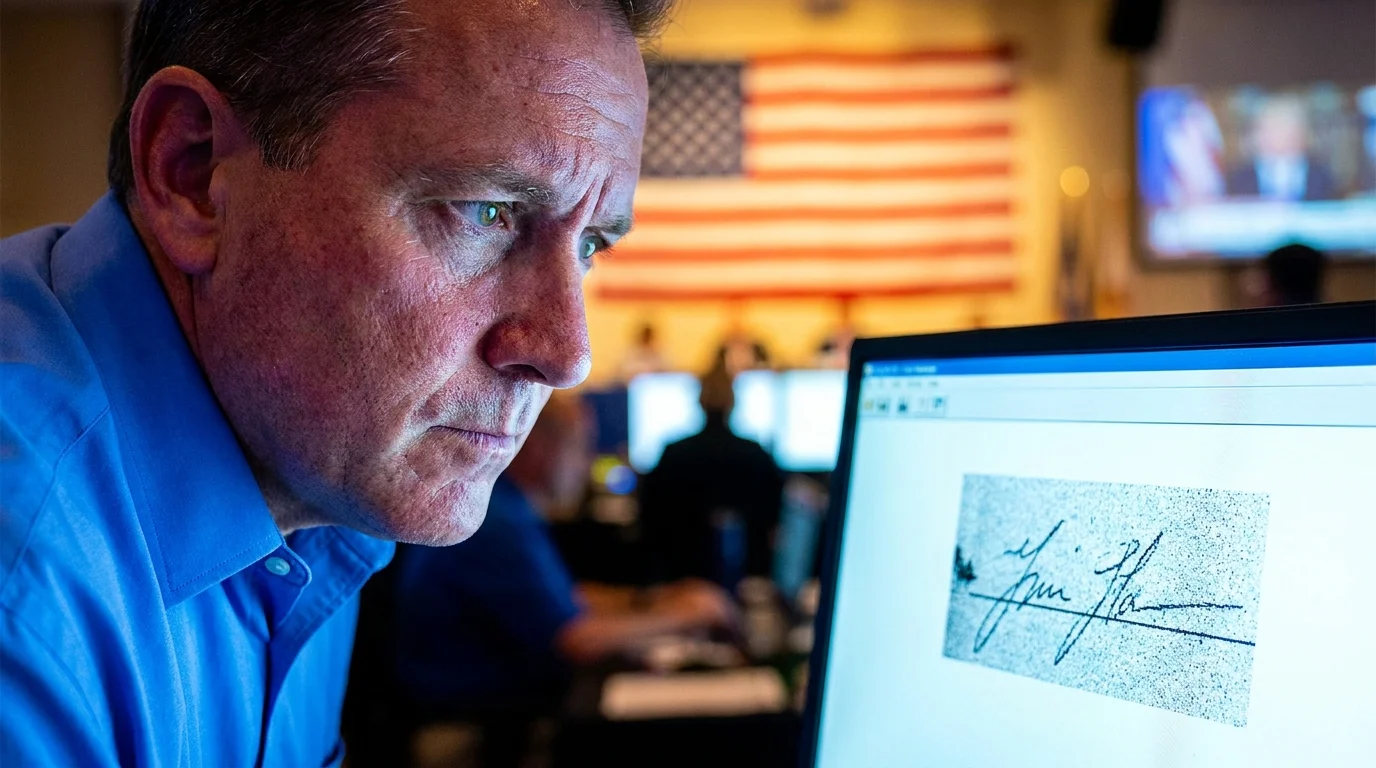
The basement room of the county elections warehouse hums with the dry warmth of industrial cooling fans and the rhythmic clack of high-speed sorting trays. Under the cold glare of strip lighting, rows of temporary election workers sit before heavy desktop monitors, staring at split-screen image captures. On the left sits the baseline signature from your motor vehicle file—captured years ago with the broad, fluid pressure of an electronic stylus. On the right sits the envelope you dropped into a blue collection box three days ago.
Viewed through an automated optical recognition camera, your everyday signature looks startlingly foreign. Grainy pixelated signature displays on backlit desktop monitors render thin, hesitant strokes as broken gray static rather than solid lines. The machine’s sensor, programmed to measure pixel density and contour match within strict mathematical parameters, does not see your identity; it sees an algorithmically unacceptable drop in line weight.
You likely walked away from your kitchen counter feeling confident that your civic duty was complete. You licked the seal, signed your name across the designated line, and slipped the return envelope into the mail stream. Yet right now, your envelope sits in a gray plastic tote marked for manual review, all because the delicate tip of your favorite pen failed a mechanical test designed for high-contrast industrial sorting.
The Ghost in the Lens: How Optical Scanners Read Your Hand (H2)
We tend to think of our personal signature as an unmistakable mark of human intent, as distinct and reliable as a fingerprint pressed into warm wax. In modern ballot processing, however, your handwriting is transformed into a binary vector map long before any human eye glances at your name. Optical recognition scanning cameras measure stroke geometry, edge continuity, and black-to-white pixel ratios at speeds exceeding two thousand envelopes per hour.
When an automated lens passes over faint or hairline strokes—typical of micro-fine rolling ball pens or light pressure on slick envelope stock—the image sensor fails to capture the continuous line. The machine’s logic interprets gaps in optical continuity not as a light touch, but as an irregular deviation from your baseline file. What you intended as an elegant, rapid signature registers to the optical processing engine as an anomalous, broken trace.
This mechanical disconnect has turned routine envelope processing into a central point of administrative friction across the country. Automated signature matching systems face growing judicial review in state and federal courts, where election integrity audits scrutinize the precise error rates and optical thresholds that trigger automatic ballot rejections.
- Media market ad reservation sheets trap campaign managers into forfeiting local airtime
- Contract with America pledge cards sparked modern congressional gridlock across glossy laminate tables
- FEC Form 3X disbursement ledgers expose dark PAC spending through telltale payroll splits
- Corporate Transparency Act registry rules strip small LLC owners of private asset shields
- Federal judge injunction orders trigger fierce executive branch clashes across five border states
The Clerk’s Screen: A View from the Verification Line
Marcus Vance, a 54-year-old county tabulations supervisor with twelve years of election administration experience in suburban Ohio, spends weeks every autumn watching these machine discrepancies play out in real time. "People assume their ballot gets rejected because an election worker doubts their politics," Marcus explains while clicking through a queue of flagged images. "The truth is far simpler and much more frustrating. A voter uses a 0.38mm fine blue gel pen on an envelope with recycled paper fibers, the ink soaks inward instead of sitting on the surface, and the camera sensor reads the signature as a cluster of faint dots. The machine spits it out, and the clock on the voter’s curing window starts ticking."
Signature Profiles: How Ink, Paper, and Motion Interact (H2)
Understanding why ballots get flagged requires looking at how different writing habits interact with the high-speed camera sensors mounted inside election sorting rigs. Your physical signature naturally shifts over time, but the physical medium you choose dictates whether the machine accepts that drift or flags it as an error.
The Rapid Fine-Point Writer
Voters who favor precision Japanese gel pens or micro-rollerballs often produce clean, tight letterforms that look immaculate to the naked eye. However, on porous envelope paper, these fine inks disperse into microscopic valleys, reducing contrast. When the camera captures the envelope under high-speed motion blur, faint lines drop below the machine’s contrast threshold, triggering an automated match failure.
The Stylus-File Disconnect
Most baseline voter files rely on digitized signatures captured at the Department of Motor Vehicles on low-resolution resistive touchpads. These digital signatures naturally feature thickened, blocky stroke weights caused by blunt plastic styluses. If your physical envelope signature is sharp and delicate, the optical software flags a structural mismatch in stroke weight and velocity contours.
The Kitchen-Table Signer
Signing a document while standing at a counter, resting on a textured tabletop, or using a fading pen creates irregular pressure drops across the signature arc. While a human reviewer readily recognizes the fluid motion of your hand, automated software flags these sudden pressure breaks as potential tracing or forgery artifacts.
Mindful Steps to Protect Your Vote: The Ballot Toolkit (H2)
Navigating the mechanics of modern voting does not require changing who you are; it simply means outsmarting the physical limitations of the sorting camera. A few deliberate adjustments at your desk ensure your ballot passes through high-speed automation without a single hitch.
- Choose a medium-point black ballpoint pen: An oil-based 1.0mm black ballpoint creates bold, light-absorbing lines that sit firmly on the paper surface without feathering, delivering maximum contrast for optical sensors.
- Sign on a firm, flat surface: Place a smooth notepad underneath your ballot envelope to ensure consistent pen pressure and eliminate the stroke jitter caused by rough wood or granite textures.
- Track your envelope immediately: Log into your state or county voter tracking portal within forty-eight hours of mailing your envelope to confirm its status has moved from ‘received’ to ‘accepted’.
- Know your local cure deadline: Most states provide a formal ‘signature cure’ window lasting between three and eight days after an election, allowing you to resolve an optical mismatch by submitting a quick verification form.
If you receive a notification stating your signature could not be verified, treat it as an administrative speed bump rather than a personal challenge. Acting within the cure window preserves your voice, requiring only a simple digital confirmation or a signed affirmation form returned to your local registrar.
The Reassurance of Intentional Action (H2)
When election administration shifts toward high-speed automation, the smallest physical details—the drag of a ballpoint, the density of an ink line, the timing of a mail drop—take on unexpected weight. Taking an extra moment at your kitchen table to use the right pen and verify your mark restores human intentionality to an increasingly mechanized process.
By understanding how the camera lens reads your paper signature, you remove chance from the equation. Your ballot moves smoothly through the sorting trays, clear of flags and technical delays, standing exactly as you intended: counted, secure, and unmistakably yours.
"The ballot envelope is not just a piece of paper; it is a physical bridge between a citizen’s intent and an automated system that demands absolute optical clarity."
| Verification Variable | Mechanical Vulnerability | Added Value for the Reader |
|---|---|---|
| Ink Formulation | Faint gel or light blue inks fail sensor optical density checks | Use bold black oil-based ink to ensure unbroken line recognition |
| Baseline Discrepancy | DMV touchpads create thick lines that conflict with fine pens | Match the natural boldness of digital DMV signature files |
| Curing Window | Unresolved optical flags discard ballots after statutory deadlines | Track status online to resolve machine flags within 48 to 72 hours |
Frequently Asked Questions
Why did my state flag my signature if I signed the ballot myself?
Automated optical verification scanners assess pixel contrast and stroke continuity rather than human intent. A light pen stroke, a worn ballpoint, or writing on an uneven surface can make genuine handwriting fall below the scanner’s mathematical match threshold.What is the best pen to use on a mail-in ballot envelope?
A standard 1.0mm medium-point black ballpoint pen using oil-based ink provides the highest optical contrast and will not bleed through porous envelope paper, making it ideal for high-speed scanners.How long do I have to fix a signature mismatch issue?
The curing window depends on state law, typically ranging from three days to two weeks following an election. Your local election office is legally required to notify you by mail, email, or phone if your ballot requires curing.Can election workers automatically throw away my flagged ballot?
No. Automated software only flags envelopes for secondary review. In nearly all jurisdictions, bipartisan teams of human election workers review flagged envelopes before issuing a cure notice to the voter.Does signing with blue ink cause automated scanner rejection?
While dark blue ink is generally accepted, light blue or pale turquoise inks often lack sufficient optical density under high-speed camera lighting, leading to preventable automated match flags.