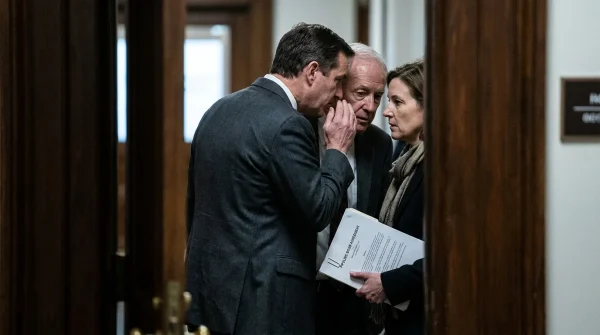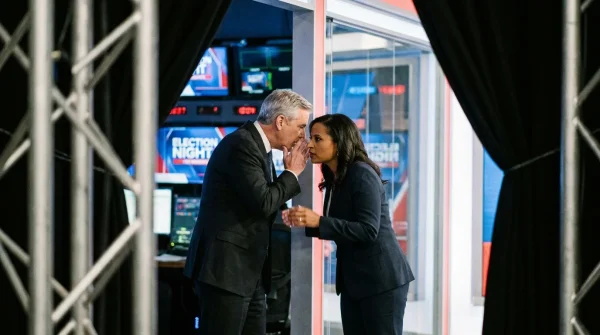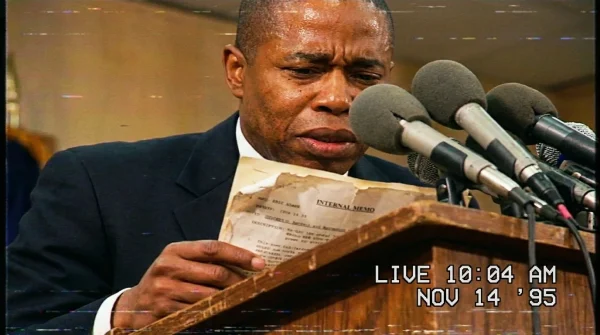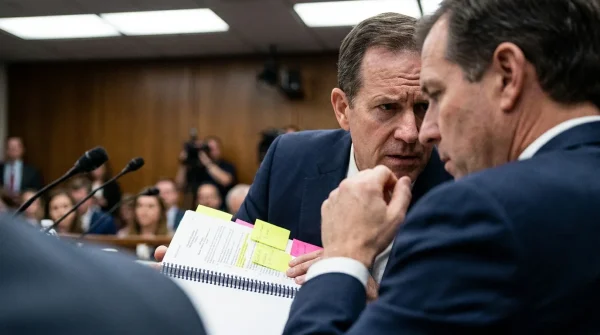
The living room stays dark except for the flickering blue wash of your television screen. It is past nine on a Tuesday evening, and the room smells faintly of cooled mint tea and radiator dust. With the volume turned down low to keep from waking the house, your eyes naturally pull downward, drawn away from the candidate’s moving lips toward the solid band of bright color anchored at the base of the display.
You see yellow text against a deep crimson ribbon, pulsing with urgency. Flip the input channel across the dial, and that identical speaker, holding that exact hand gesture mid-sentence, sits perched above an electric blue banner declaring an entirely different reality. The lower third text does not merely accompany the spoken broadcast; it quietly dictates how your nervous system absorbs the room.
Most viewers treat those lower banners as humble transcripts, a courtesy running along the carpet of the screen for anyone checking in between commercial breaks. Yet in the high-stakes theater of modern primary debates, that strip of digital real estate does the heavy lifting long before an analyst clears their throat at the desk.
The Prism of the Lower Third
Think of the lower banner not as a caption, but as a polarized pane of glass sliding across an open window. When raw light strikes an uncalibrated prism, it splits along predictable wavelengths, bending warmth one way and cool shadow another. A sixty-second spoken defense of public ledger spending leaves a podium as neutral sound waves, yet the instant it hits network production switchers, it fractures into two contradictory moral universes.
When a candidate stumbles over an obscure agency abbreviation while outlining a manufacturing subsidy, one control room perceives an infrastructural milestone, while the rival booth catches a bureaucratic collapse. Words become visual packaging that frames whether you should feel guarded caution or sudden vindication before you have even heard the full clause resolve.
Consider Marcus Vance, a 38-year-old chyron operator who spent six election cycles tucked inside an auxiliary production truck outside national debate venues. His job was not to interpret macroeconomics, but to synthesize forty spoken words into a seven-word punchline in under twelve seconds, working off preset network narrative guides. Marcus often describes the gig as breathing through a pillow; by the time the control room director shouts a revision into his headset, the collective impression of four million suburban voters has already set like cooling plaster.
- Cul-de-sac density mandates spark furious partisan splits across fast-growing sunbelt suburbs
- Voter registration portal outages trigger sudden national swing state legal battles
- White House communications playbooks deploy staged counter-leaks to derail senior staff resignation demands
- Supreme Court nationwide injunctions freeze dozens of state infrastructure permits without warning
- Automaker emissions coalitions confront White House mandates risking massive federal contract cancellations
The Soundbite Split: One Sentence, Two Realities
To grasp how deeply this mechanics shapes perception, trace what happens to an identical four-second soundbite uttered during an industrial trade exchange: “We reallocated eight billion dollars from dormant regional transport grants directly into municipal battery storage pilots.”
Notice what happens when that single factual statement passes through competing editorial engines:
The Growth Ledger Frame
On the green or blue banner, the crawl reads: HISTORIC CLEAN ENERGY INVESTMENT TARGETS LOCAL JOBS. By using affirmative industrial terminology, the text guides your attention toward local utility improvements and future-focused wage potential. You are nudged to overlook the redirected money and celebrate the capital deployment.
The Administrative Rupture Frame
Flick the remote control over one slot, and the crimson ribbon reads: MASSIVE TRANSIT DEFICIT: UNVETTED PILOTS SIPHON COMMUTER FUNDS. The exact same financial transfer is no longer a strategic redeployment; it is presented as administrative abandonment. The viewer in this lane feels an immediate spike of grievance regarding delayed commuter rails and unproven state experiments, all while staring at the very same suited figure on stage.
Neither chyron explicitly fabricates a statistical figure, yet each engineers an emotional verdict. Selective context alters memory before your cognitive defenses even recognize an argument is taking place.
Reclaiming Your Screen: The Mindful Deconstruction
Breaking free from this visual nudge does not require turning off the news entirely. It asks for a deliberate, sensory reset in how you position your attention during live political broadcasts.
The next time debate coverage starts to quicken your pulse, run through this grounding sequence:
- Kill the lower screen: Place a folded newspaper, a slip of cardstock, or a strip of painter’s tape across the bottom three inches of your monitor for ten minutes.
- Listen for verbs: Strip away adjectives and track only the hard actions announced by the speaker—what was signed, what was funded, and what was canceled.
- Monitor the crawl delay: Watch the precise second a chyron updates; notice whether the network changed the banner to highlight policy or to amplify interpersonal awkwardness.
- Cross-verify transcripts raw: Wait twenty minutes after the broadcast closes and read the unformatted stenographer log on public domain archives without network commentary.
Your Tactical Toolkit for Live Coverage:
- Visual Occlusion: High-tack blue painter’s tape (safe for television bezels, zero residue).
- Speed Verification: C-SPAN raw feed mobile stream (broadcasts without commercial chyrons or network anchors).
- Context Window: 15 minutes of silence following a debate before checking digital roundups or social feeds.
The Clear View Behind the Glow
Stepping back from the crawl changes the texture of civic engagement. When you recognize that the bottom of the screen is an active editorial sales pitch rather than a public utility, the ambient anxiety of election season begins to lose its grip. You stop taking the emotional temperature of a graphics department miles away and start listening to the actual rhythm of the debate floor.
There is a profound, quiet dignity in refusing to let a red or blue ribbon tell you what to feel about a spoken thought. By watching the person instead of the caption, you return to the basic, human work of democratic judgment—patient, attentive, and entirely your own.
“The caption on the screen is never an innocent mirror; it is the frame that decides which parts of the painting you are allowed to see.”
| Key Point | Detail | Added Value for the Reader |
|---|---|---|
| Banner Velocity | Lower thirds rotate every 8 to 15 seconds during live broadcast debates. | Helps you identify when network producers are manufacturing urgency during dull policy exchanges. |
| Lexical Priming | Adjectives like ‘Embattled’ or ‘Landmark’ precede factual event summaries. | Alerts your brain to filter out emotional cues before assessing the actual speaker’s performance. |
| Visual Occlusion | Covering the lower strip redirects focus to micro-expressions and spoken cadence. | Restores raw observational clarity, letting you evaluate candidate confidence without editorial mediation. |
Frequently Asked Questions
Are debate chyrons written in advance of the broadcast?
Production teams prepare dozens of topical templates based on anticipated talking points, though live operators modify phrasing within seconds as exchanges unfold on stage.Why do networks use high-contrast colors like bright red and vivid yellow?
These primary shades instinctively capture peripheral vision, ensuring your gaze returns to the television screen even if you are glancing down at your phone.Does watching debates on C-SPAN really make a difference?
Yes. C-SPAN relies on fixed wide-angle cameras and eliminates bottom banners, allowing you to witness podium body language without editorial guidance.How can I spot emotionally loaded language in a news banner?
Look for verbs and descriptors that carry moral value, such as ‘scrambles,’ ‘doubles down,’ ‘triumphs,’ or ‘evades,’ rather than plain procedural verbs like ‘states’ or ‘proposes.’Does chyron framing genuinely sway undecided voters?
Studies in visual communication show that casual or uncommitted viewers remember the concise on-screen summary far longer than the nuanced spoken details of a candidate’s response.