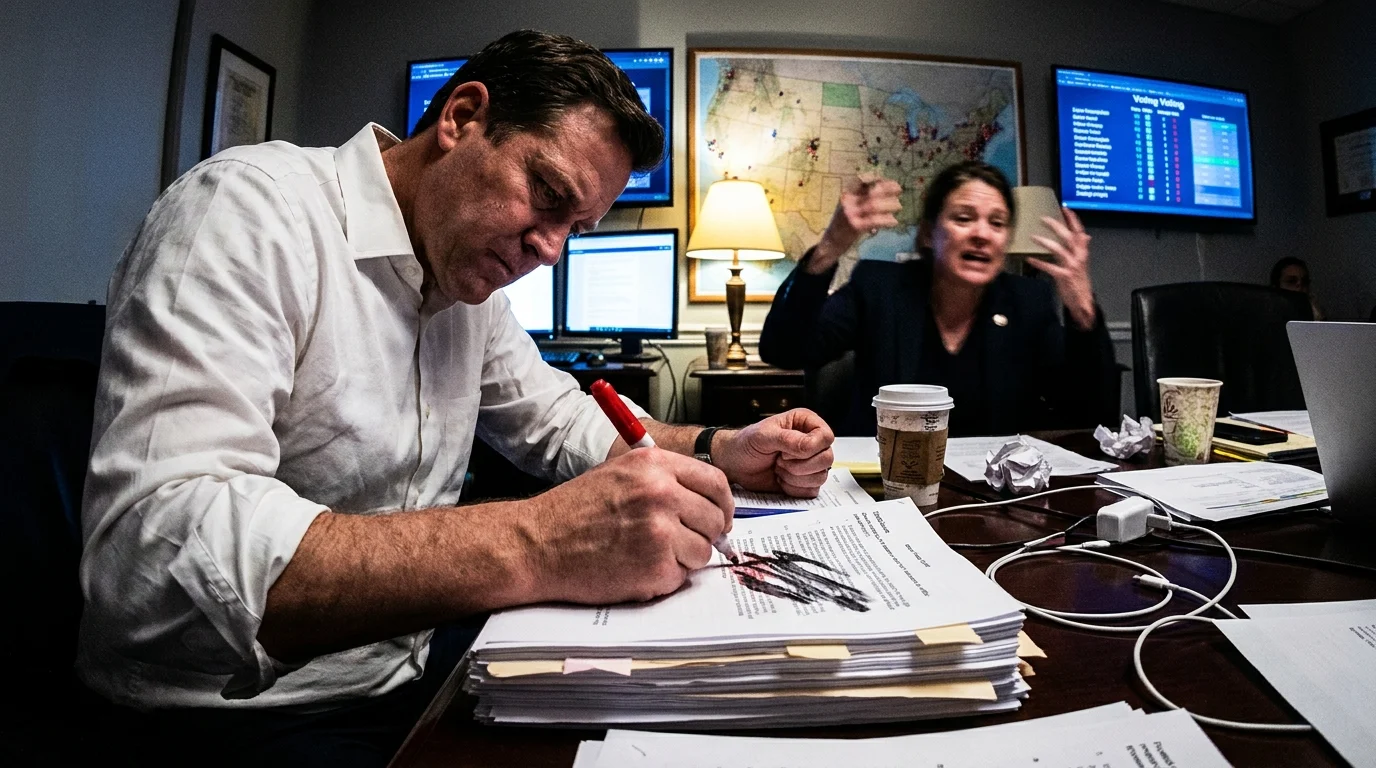
Past midnight in the basement corridors of the Russell Senate Office Building, the air smells of burned cafeteria roast and cooling printer toner. Outside, cable news anchors dissect theatrical press conferences delivered from the grand rotunda steps, convinced that a party line majority can steer national law by raw willpower alone. Inside room S-133, the fluorescent lights buzz with a cold, relentless hum that strips away every trace of partisan rhetoric.
You are watching the true machinery of American governance, and it does not operate on fiery floor speeches or viral town halls. Instead, it runs on three-ring binders bound in cracked black leather, dog-eared copies of Riddick’s Senate Procedure, and the quiet, dry cadence of nonpartisan staff attorneys. While lawmakers promise sweeping social transformations across prime-time screens, those very promises are being surgically excised line by line behind heavy mahogany doors.
The ritual unfolds in an atmosphere of forced hush, where exhausted committee counsels balance paper coffee cups on their knees while defending months of legislative packaging. When the clock slips past 2:00 AM, the cameras are dark and the galleries are locked. Yet this is precisely when the fate of your household budget, your healthcare out-of-pocket limits, and your workplace regulations are determined—not by an elected senator, but by a career parliamentarian armed with a red pencil and an uncompromising procedural standard.
The Byrd Rule Scalpel and the Illusion of Majority Will
Most voters assume that securing fifty-one votes in the Senate grants an incoming administration the unchecked leverage to reshape the country. You might watch a sweeping reconciliation package advance, assuming that every bold policy rider attached to the omnibus spending vehicle will automatically become federal law. But reconciliation is not a blank check; it is a fragile, tightly guarded procedural exception designed strictly for budgetary arithmetic.
Think of the Senate parliamentarian not as an ideological referee, but as a building inspector tapping structural timber to check for dry rot. Under Section 313 of the Congressional Budget Act—widely known as the Byrd Rule—any provision that does not produce a direct, more than incidental change in federal revenues or outlays is declared procedurally extraneous legislation. If an amendment fails that clinical financial test, the parliamentarian orders it stripped from the text before the bill ever reaches the floor for final enrollment.
What feels like an act of partisan sabotage during late-night markups is actually an unforgiving institutional filter. While leadership aides frantically claim their pet riders will reduce national debt, the parliamentarian strips away creative accounting and demands undeniable proof from the nonpartisan Congressional Budget Office. If the primary purpose of a clause is regulatory control or social engineering, the budgetary impact is ruled merely incidental, and the provision dies in the dark without a single roll-call vote.
Marcus Vance, a forty-four-year-old former senior legislative director who spent twelve years navigating Senate finance markups, remembers the exact silence that fell over room S-133 during the 2021 reconciliation fights. Vance watched his committee’s signature minimum-wage expansion—a centerpiece promised to millions of blue-collar workers—disintegrate in less than four minutes of dry, statutory interrogation. The parliamentarian listened without blinking, opened an annotated ledger from 1985, noted that the proposal altered private wage mandates rather than federal ledger balance, and issued a one-sentence judgment that no press release could overturn.
- Trump rally teleprompter departures target undecided swing voters through unscripted loyalty tests
- Pete Hegseth confirmation shifts Senate defense posture amid sudden conservative party fractures
- John Fetterman splits party ranks after challenging Senate leadership on federal border policies
- Trump $5,000 checks proposal sparks intense congressional spending battles across divided factions
- Voter registration address mismatches freeze provisional ballots across crowded swing state precincts
The Anatomy of Confidential Procedural Disqualifications
During these confidential late-night ‘Byrd bath’ sessions, committee counsels sit across from the parliamentarian’s team to endure rapid-fire challenge rounds. Each contested section undergoes an administrative post-mortem, sorted into categories of vulnerability that dictate what survives into dawn.
The Mere Regulatory Condition: Lawmakers often attempt to disguise aggressive industry mandates as revenue measures by attaching token federal grant funding to strict behavioral rules. The parliamentarian routinely disqualifies these riders because the behavioral mandate—whether requiring private corporations to shift labor standards or demanding states alter local licensing laws—outweighs the modest grant appropriations attached to it.
The Pure Private Sector Mandate: When a policy primarily governs relationships between private citizens and commercial entities, it immediately triggers the Byrd Rule’s fatal tripwire. Federal budget reconciliation cannot be used to dictate private commercial contracts, even when those contracts affect massive national industries like private health insurance networks or commercial pharmacy benefit managers.
The Out-of-Jurisdiction Rider: An amendment may carry genuine, measurable fiscal weight, but if the text touches subject matter outside the authorizing committee’s strict charter, the parliamentarian strikes it without hesitation. A finance committee cannot smuggle environmental policy changes into a tax package, regardless of how neatly the accounting projections align.
The Long-Term Deficit Trap: Under Title III guidelines, no reconciliation bill can increase the federal deficit beyond the designated budget window, which typically spans ten calendar years. Partisan staffers routinely attempt fiscal acrobatics—such as sudden sunset dates or delayed phase-ins—to hide out-year shortfalls, only to see the parliamentarian expose the accounting gimmick and toss the amendment wholesale.
How to Track Procedural Cuts Before the Morning News Cycles
You do not have to wait for spin doctors to explain why major campaign promises vanished from a spending package overnight. Tracking the movement of these secret markups requires paying attention to the procedural breadcrumbs buried in federal databases rather than cable commentary.
Watch the timing of committee markup adjournments. When negotiations stretch past midnight and recess without an updated floor draft, leadership is almost certainly battling an adverse Byrd Rule challenge. Take these mindful, deliberate steps to trace the cuts yourself:
- Cross-reference official CBO cost scores: Search the Congressional Budget Office repository for newly published baseline scores on the specific title you care about, paying strict attention to whether revenue effects are marked as direct or secondary.
- Audit the Congressional Record for point-of-order strikes: Look for moments when an entire paragraph disappears between committee report filings and the formal floor substitute text, marked cryptically by bracketed omissions.
- Read Congressional Research Service (CRS) precedent memorandums: Search public CRS reports on reconciliation precedents; they document the exact historical rulings the parliamentarian relies upon to deny current policy amendments.
- Monitor committee jurisdictional referrals: Confirm which Senate committee originally drafted the provision to determine whether an out-of-jurisdiction challenge can survive procedural scrutiny.
Keep a clear diagnostic toolkit on your desk when an omnibus bill moves: track the ten-year deficit impact window, watch for the formal sustained point of order invocation, and review the CBO score date against the hour of markup adjournment.
The Power Found in Institutional Restraint
Watching your preferred policy riders fall to procedural objections can feel deeply disillusioning, especially when an issue directly touches your family’s economic stability. You are repeatedly told that simple majorities govern the republic, only to watch sweeping initiatives stall against the quiet ruling of an unelected official reading century-old rulebooks under basement desk lamps.
Yet understanding this hidden reality gives you a significant advantage. It frees you from the emotional volatility of political theater, allowing you to see past inflated campaign slogans and recognize the true structural boundaries of legislative authority. The parliamentarian’s red pen is not a breakdown of democracy; it is the enduring institutional friction designed to prevent temporary majorities from rewriting permanent social contracts through procedural shortcuts.
When you learn to separate raw political messaging from true budgetary mechanics, you stop investing hope in legislative maneuvers designed to fail for the cameras. You begin to demand durable, bipartisan lawmaking that can survive the open floor, rather than banking on midnight riders that quietly dissolve before the morning sun hits the Capitol dome.
“Procedural integrity is the only firewall that keeps a legislative body from becoming an auction house for temporary political passions.”
| Key Procedural Point | Technical Parliamentary Detail | Direct Reader Value |
|---|---|---|
| The Byrd Rule Threshold | Enforces Section 313 of the 1974 Congressional Budget Act against non-budgetary policy text. | Tells you immediately whether a promised social program can legally pass with fifty-one votes. |
| Incidental Fiscal Impact | Disqualifies proposals where spending changes are purely secondary to regulatory mandates. | Saves you from false expectations when politicians claim regulatory overhauls fit in budget bills. |
| Confidential Markup Sessions | Staff-level legal arguments held in S-133 before public floor amendments are brought forward. | Explains why headline-grabbing policies quietly disappear from legislation without public floor debates. |
| Point of Order Enforcement | Requires sixty votes to waive an sustained parliamentary objection on reconciliation text. | Reveals why a unified partisan majority can still fail to pass its signature platform items. |
Frequently Asked Questions
Can the Vice President simply overrule the Senate parliamentarian’s decision?
While the presiding officer technically holds the constitutional authority to issue a contrary ruling, doing so breaks established Senate precedent and risks unraveling institutional protections that both parties rely on when in the minority.Why are parliamentarian markup sessions conducted behind closed doors?
These meetings involve sensitive legal arguments between committee counsels and nonpartisan staff over statutory interpretation, requiring candid analysis free from cable news grandstanding.What happens to a bill after a policy rider is Byrd-ruled out?
The bill remains alive, but the offending paragraphs are stripped from the legislative text, forcing leadership to either adjust the funding formula or advance the policy as standalone regular legislation.How does the Congressional Budget Office influence these secret rulings?
The parliamentarian relies directly on formal CBO accounting models to verify whether a provision creates genuine, non-incidental shifts in federal revenue or programmatic spending.Why don’t majorities rewrite the Byrd Rule to pass their agendas faster?
Rewriting or eliminating the Byrd Rule would effectively abolish the reconciliation fast-track process altogether, leaving future budget bills vulnerable to an ordinary, insurmountable sixty-vote filibuster.