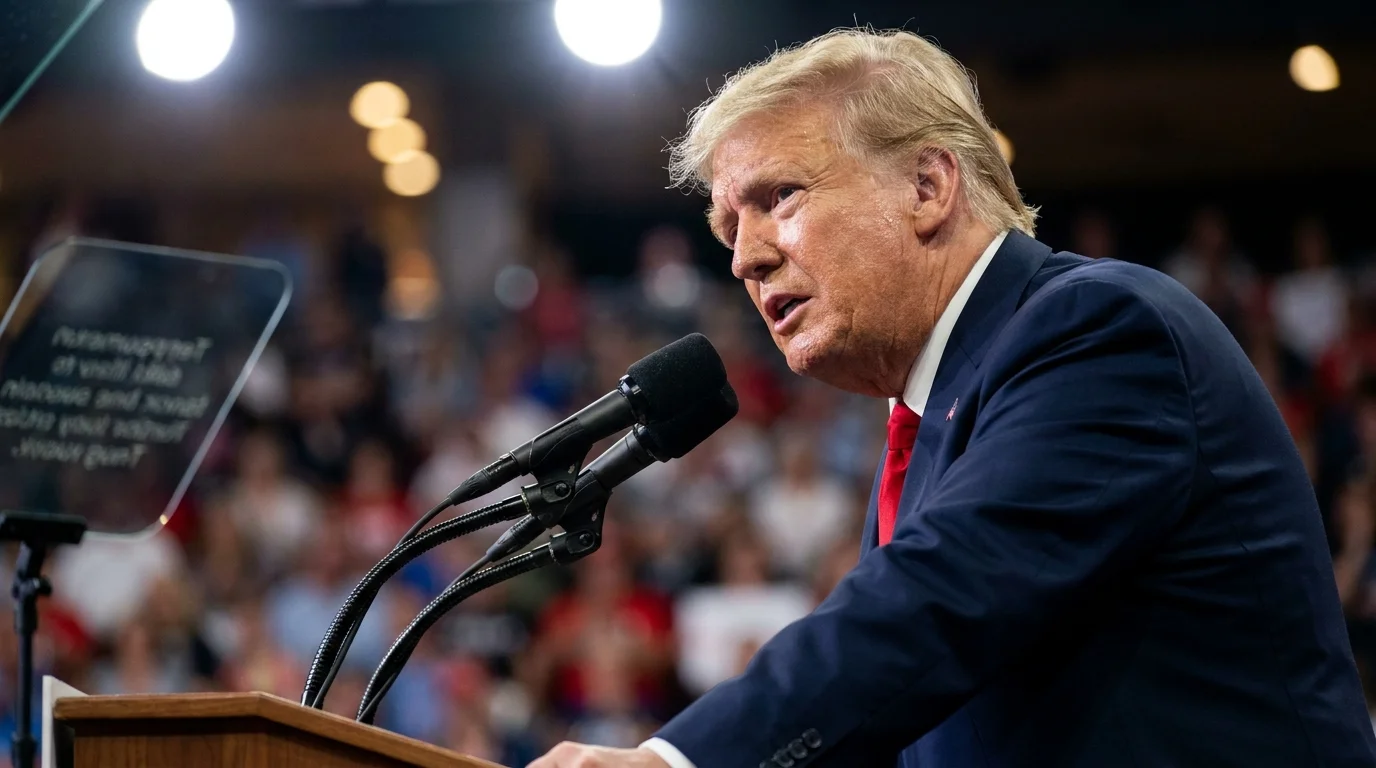
The hum of an arena sound system carries a low vibration that settles directly in your sternum before the first word is ever spoken. Out on the floor, the heavy air carries the sharp tang of hot popcorn, wet pavement from late-autumn rain outside, and the faint metallic burn of diesel exhaust from generator trucks humming behind the loading dock. You stand in the bleachers where the lights wash everything in hyper-real glare, watching the two upright glass teleprompter paddles flank the wooden podium like silent sentries.
For forty minutes, those transparent panes cast green, scrolling text into the air, feeding predictable phrases about trade deficits and manufacturing zones. Then his shoulders drop three inches, his chin angles sharply forty-five degrees to the right, and he stops reading altogether. You can hear the exact fraction of a second when the scripted rhythm fractures, replaced by a slower, conversational growl that sounds less like a stump speech and more like an uninvited neighbor leaning over your backyard fence.
What feels like a spontaneous digression is actually where the real work begins. When the prepared text goes dark, you are no longer watching an address; you are being drawn into a calibrated loyalty test designed specifically to eliminate your neutral ground.
The Illusion of the Off-Ramp
Most political observers assume that undecided voters crave polished white papers and calculated policy moderation. Yet when an arena crowd watches a speaker step away from the monitors, the psychological contract changes instantly. The scripted remarks offer an intellectual framework, but the unscripted diversion operates like a velvet rope, daring the listener to decide whether they belong inside the room or out in the cold.
The metaphor here is not an open door, but an airlock. By presenting an unfiltered, raw observation—often framed around grievance, cultural skepticism, or institutional distrust—the rhetoric strips away comfortable neutrality. You are forced to answer an implicit question: Do you laugh along with the joke, or are you part of the group being ridiculed?
Marcus Vance, a 44-year-old audio technician and independent rhetoric researcher based in Ohio, spent eight months cataloging the precise second markers where podium eyes lose contact with teleprompter glass. In his field logs, Vance tracked how decibel fluctuations drop right before an unscripted pivot, creating a conspiratorial intimacy across fifty thousand square feet of concrete. As Vance noted during a late-night recording session in a Grand Rapids exhibition hall, the off-prompter moments bypass policy scrutiny entirely by mimicking the cadence of someone finally telling you a dangerous secret they were ordered to keep quiet.
- Pete Hegseth confirmation shifts Senate defense posture amid sudden conservative party fractures
- John Fetterman splits party ranks after challenging Senate leadership on federal border policies
- Trump $5,000 checks proposal sparks intense congressional spending battles across divided factions
- Voter registration address mismatches freeze provisional ballots across crowded swing state precincts
- SALT deduction cap rollback slashes suburban property tax refunds across high-income districts
Decoding the Three Audiences in the Crosshairs
Not every swing voter responds to the same friction point. The off-script detour uses specific variations depending on who sits in the quiet middle of the battleground map.
For the suburban pragmatist who leans conservative on taxes but recoils from chaos, the departure takes the shape of weary common sense. The speaker mocks formal decorum, framing institutional rules as absurd red tape designed to protect incompetent insiders. By presenting basic bureaucratic functioning as comic ineptitude, the performance converts discomfort into pragmatic permission.
For the cross-pressured trade unionist, the diversion pivots to blunt economic betrayal. The script might cite national employment percentages, but the unscripted aside zeros in on local mill closures, naming foreign competitors with stinging street-corner shorthand. It forces a stark binary: you either stand with the people in high-visibility vests who drink from thermoses, or you side with globalist executives who have never turned a wrench.
For the exhausted, cynical non-voter who rarely tracks legislative updates, the tactic is conversational rebellion. The abrupt departures break the fourth wall of modern media production. When a speaker openly criticizes the teleprompter itself—complaining about the font size or mocking the speechwriters—it validates the voter’s own belief that official politics is entirely scripted garbage.
The Field Guide to Deconstructing the Pivot
You do not need an advanced degree in linguistic analysis to spot when an off-script detour is setting a snare. Look for specific physical and tonal adjustments that signal the transition from messaging to pressure.
- Watch the chin line: A steady, robotic glance from left to right signals prompter tracking; a fixed, downwards gaze aimed at the front row signals an unscripted provocation.
- Listen for the vocal register drop: Scripted text is delivered at high pitch and fast tempo, while loyalty tests slow to a low, syncopated baritone.
- Note the exclusionary pronoun shift: The transition from collective terms like ‘our country’ to hard dividers like ‘they’ and ‘us’ marks the immediate construction of a rhetorical wall.
- Track the self-referential laughter: The speaker pauses, smirks, and invites the audience to enjoy a shared, forbidden taboo before completing the sentence.
Tactical observation requires simple discipline: timing, distance, and baseline tracking. When an aside begins, clock the duration on your watch. Any riff extending past the three-minute mark is rarely an accident; it is a battle-tested focus-group theme unleashed without the protective padding of a communications director’s edit.
Reclaiming Your Autonomy from the Spectacle
When you learn to see the architectural scaffolding behind spontaneous speech, the emotional leverage vanishes. You stop reacting to the outrage or the humor of the moment and start recognizing the machinery designed to corner your judgment. That realization does not require cynicism; it simply restores your independence in a voting booth where everyone is trying to bully you into early surrender.
Real political agency lives in the deliberate pause. When a stadium erupts in laughter or anger at an unscripted crack, your strength lies in taking a quiet breath, stepping mentally back from the roar, and analyzing whether you are being offered genuine representation or merely an invitation to pick a side in someone else’s war.
The sharpest hook in political theater is always disguised as an accidental slip of the tongue.
| Key Point | Detail | Added Value for the Reader |
|---|---|---|
| Prompter Abandonment | Speaker breaks rhythmic eye contact with glass screens to address lower-tier bleachers directly. | Allows you to separate vetted party platforms from psychological pressure campaigns. |
| Binary Loyalty Framing | Replaces policy nuance with sharp ‘us versus them’ linguistic categories during ad-lib segments. | Protects your independent judgment from being emotionally stampeded into an artificial camp. |
| Intimacy Mimicry | Microphone technique changes from broadcast volume to a conspiratorial, living-room cadence. | Helps you recognize when personal relatability is being manufactured to bypass critical logic. |
Frequently Asked Questions
Are teleprompter departures truly unscripted?
While some riffs are spontaneous responses to crowd reactions, most departures are rehearsed modular themes that have been tested repeatedly in smaller rooms to gauge visceral response.Why do undecided voters respond to informal rhetoric over policy facts?
Voters often evaluate authenticity over programmatic detail; raw speech patterns signal confidence and human connection, making the speaker feel less like a manufactured product.How does an off-script rant force fence-sitters to take a stand?
By introducing a culturally polarizing statement, the rhetoric destroys middle ground, demanding that you either embrace the taboo along with the crowd or accept being cast out as an opponent.Can speechwriters prepare for spontaneous rally divergences?
Modern campaign speechwriters intentionally build ‘white space’ or brief bullet points into prompter scripts, providing landing strips for planned tangents before resuming the formal text.What is the best way to fact-check an ad-libbed claim?
Isolate the specific empirical statement from the surrounding comedic or emotional framing, and verify the raw numbers through non-partisan legislative or economic databases.