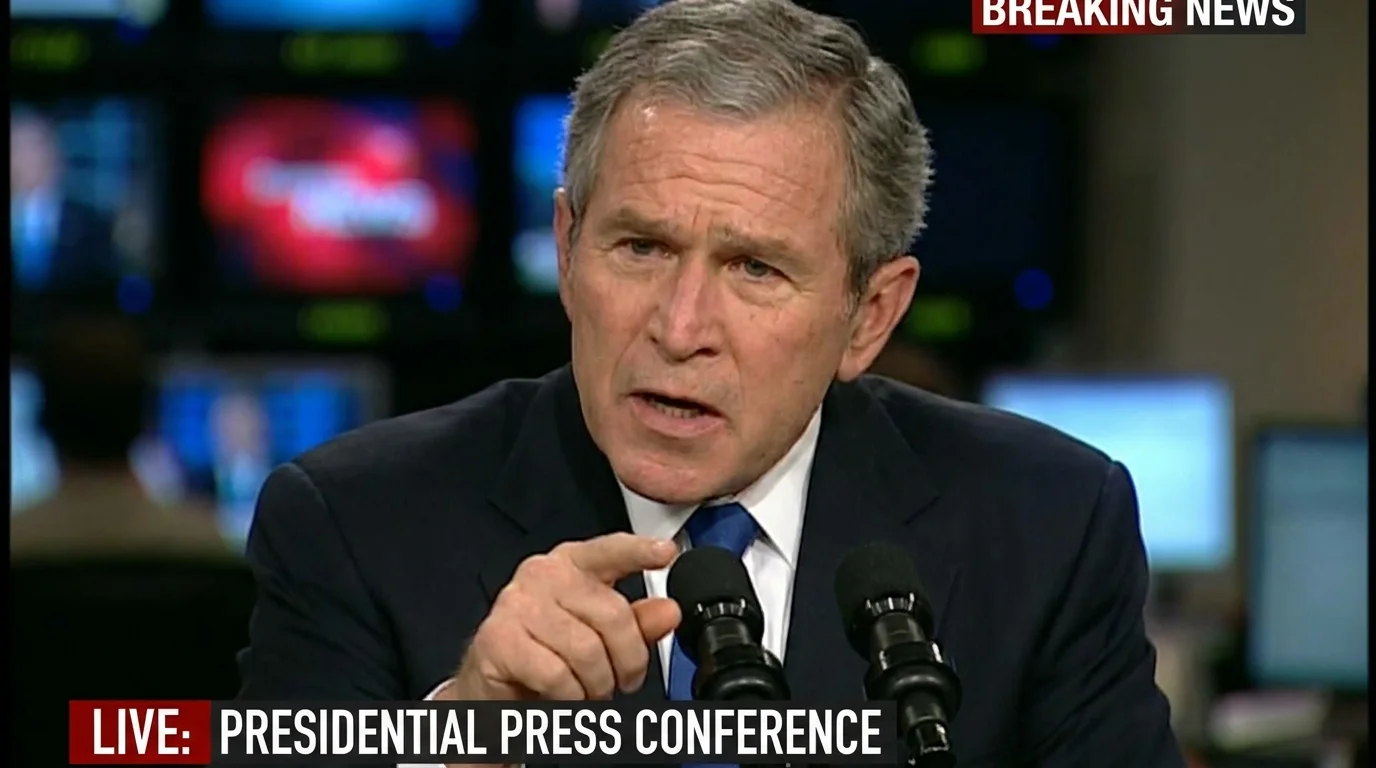
The muted glare of an airport gate television paints the carpet pale blue while rain streaks the tarmac outside. In your hand, a smartphone vibrates with a breaking push alert citing former President George W. Bush’s latest public remarks on democratic resilience and civic duty. A passenger two seats down glances up from their own phone, where the exact same speech has just arrived under a fiercely contradictory banner.
One feed frames the speech as a dignified moral defense of bedrock democratic institutions against rising domestic volatility. The other brands those identical phrases as the self-serving rhetoric of an entrenched establishment defending an obsolete political order. The speaker, the setting, and the recorded transcript are identical, yet you and the person beside you are effectively living in two incompatible worlds.
This is not a casual disagreement among friends over tax policy or executive power. It is the mechanics of an engineered reality split, where invisible distribution engines dissect a single moment into distinct ideological products before the sound waves even settle in the room.
The Two-Way Mirror: How Algorithms Fracture the Same Spoken Word
Imagine standing before a plate glass window expecting to look out onto the street, only to discover it functions as a two-way mirror reflecting your pre-existing anxieties back into your eyes. When an elder statesman like George W. Bush speaks, his words are rarely ingested as a whole speech. Instead, they act as raw ore mined by recommendation engines trained to extract emotional voltage.
Rather than providing a civic square where citizens evaluate an argument on its merits, the machine isolates hyper-specific thirty-second soundbites designed to confirm whatever baseline assumptions keep your thumb scrolling. For one audience, algorithms spotlight his warnings against nativism and institutional erosion, framing him as an elder statesman lending rare bipartisan weight. For another, the system cuts straight to grievances over historical foreign interventions, framing his critiques as out-of-touch posturing from a discredited establishment.
The speech ceases to exist as a unified message. It becomes an optical illusion where both sides believe they possess the full, unvarnished truth, entirely unaware that the other half of the room is looking at a fundamentally different clip reel.
- Federal wage mandates trigger frantic eleventh-hour corporate scrambles following emergency midnight appellate stays
- Treasury compliance algorithms freeze routine campaign contributions after misidentifying standard voter wire transfers
- Automated redistricting software splits historic voting coalitions into fractured quadrants before midterm elections
- Osama bin Laden declassified files expose secret courier networks behind unreleased intelligence dossiers
- Suburban swing voters freeze national campaign strategies over multi-family housing zoning mandates
Elena Vance, a 42-year-old algorithmic data auditor based outside Denver, tracks these divergent data streams using parallel digital profile clusters. When the former president’s recent remarks began trending, Elena watched her monitoring tools register the bifurcation in real time. Within forty-seven seconds of publication, the mirror accounts split the transcript across two divergent narrative tracks, serving starkly opposed emotional interpretations to accounts that sat only three demographic steps apart.
Two Speeches, One Podium: Mapping the Partisan Feeds
To grasp why your neighbor views the same public statement through a completely different lens, you have to examine the distinct curation layers operating behind the scenes. Each ecosystem optimizes for a specific emotional payoff.
The Institutional Restorationist Feed: Here, the delivery is edited to emphasize gravitas and traditional norms. The pull quotes highlight calls for decency, defense of constitutional checks and balances, and the preservation of global alliances. If you inhabit this loop, the remarks feel like common-sense reassurance from a bygone era of political stability.
In this curated reality, dissent is framed as radicalism, and any structural criticism of the 2000s political consensus is scrubbed in favor of nostalgia for decorum and steady institutional authority.
The Populist Counter-Offensive Feed: On this side of the screen, the framing flips completely. Bush’s statements are cut alongside reminders of the Iraq War, industrial manufacturing decline, and the financial crisis of 2008. The system highlights his calls for moderation as coded attacks on working-class self-determination.
Every sentence from the former president is processed as evidence that traditional party elites will always close ranks against grassroots challengers, cementing an unbreakable fortress of grievance that repels outside perspective.
Sanitizing Your Information Diet: A Calm, Minimalist Method
Stepping off the algorithmic carousel does not require abandoning the news altogether. It requires treating public statements the same way an archivist treats raw parchment: inspecting the original artifact before someone hands you an annotated copy.
Run a weekly routine to break algorithmic calcification:
- Bypass third-party video snippets and read the unedited, full-length transcript published directly by the hosting university, archive, or non-partisan repository.
- Search out the specific primary source video without commentary tracks or overlay graphics to observe raw cadence, pauses, and audience reactions firsthand.
- Purge cached engagement signals by using incognito browsing sessions or dedicated RSS readers stripped of personalized behavioral tracking.
- Cross-reference coverage across two non-aligned regional newspapers rather than national cable aggregator accounts.
Adopt a simple rule of thumb: whenever a headline uses emotionally charged adjectives to tell you how to feel about a political figure’s speech, pause for five minutes. Look up the verbatim sentence in the official record. You will routinely find that the surrounding three sentences soften, complicate, or entirely reshape the outrage being marketed to your screen.
Reclaiming Shared Ground Beyond the Filter Bubble
The danger of algorithmic realities is not that citizens disagree on the remedies for national problems. Disagreement is the lifeblood of representative government. The actual danger is that citizens are no longer disagreeing about the same reality.
When a single speech by George W. Bush produces two mutually exclusive versions of history, the shared civic floor gives way beneath our feet. Reclaiming your footing begins when you refuse to accept algorithmic summaries as your primary window into the world. By reaching directly for the source material, you reclaim your own judgment—and deny the machine its easiest prize: your unexamined reaction.
The digital town square no longer distributes common facts; it sells personalized reflections disguised as news.
| Key Point | Detail | Added Value for the Reader |
|---|---|---|
| Algorithmic Fracturing | Algorithms isolate emotionally charged soundbites from the same speech, tailoring clips to opposing biases. | Recognize why your peers form conflicting interpretations from the identical public event. |
| Emotional Saliency Bias | Feeds prioritize high-arousal content (nostalgia or outrage) over dry, balanced policy analysis. | Neutralize digital rage by spotting the underlying emotional bait before reacting. |
| Direct Source Verification | Full transcripts and raw footage bypass the selective clipping used by curated social platforms. | Restores independent assessment and shields your perspective from algorithmic spin. |
Frequently Asked Questions
Why do speeches by former presidents spark such sharp algorithmic division?
Former presidents hold strong historical associations. Algorithms easily leverage their image to trigger immediate, high-arousal reactions like institutional trust or lingering political resentment.How can I find the raw transcript of a major political address?
Turn to public repositories like the American Presidency Project at UC Santa Barbara, official foundation archives, or C-SPAN’s raw video library instead of social media feeds.Does switching platforms prevent algorithmic bias?
No. Nearly every major platform uses behavioral optimization models designed to maximize attention, meaning different apps simply feed you variations of the same polarized framing.What is the best immediate step when a political quote angers me?
Wait five minutes, search for the complete sentence within the full speech transcript, and read the entire paragraph surrounding the quotation.Can two contradictory news accounts both be factually correct?
Yes. Outlets often report real quotes while omitting context, leading two audiences to draw entirely incompatible conclusions from identical source facts.