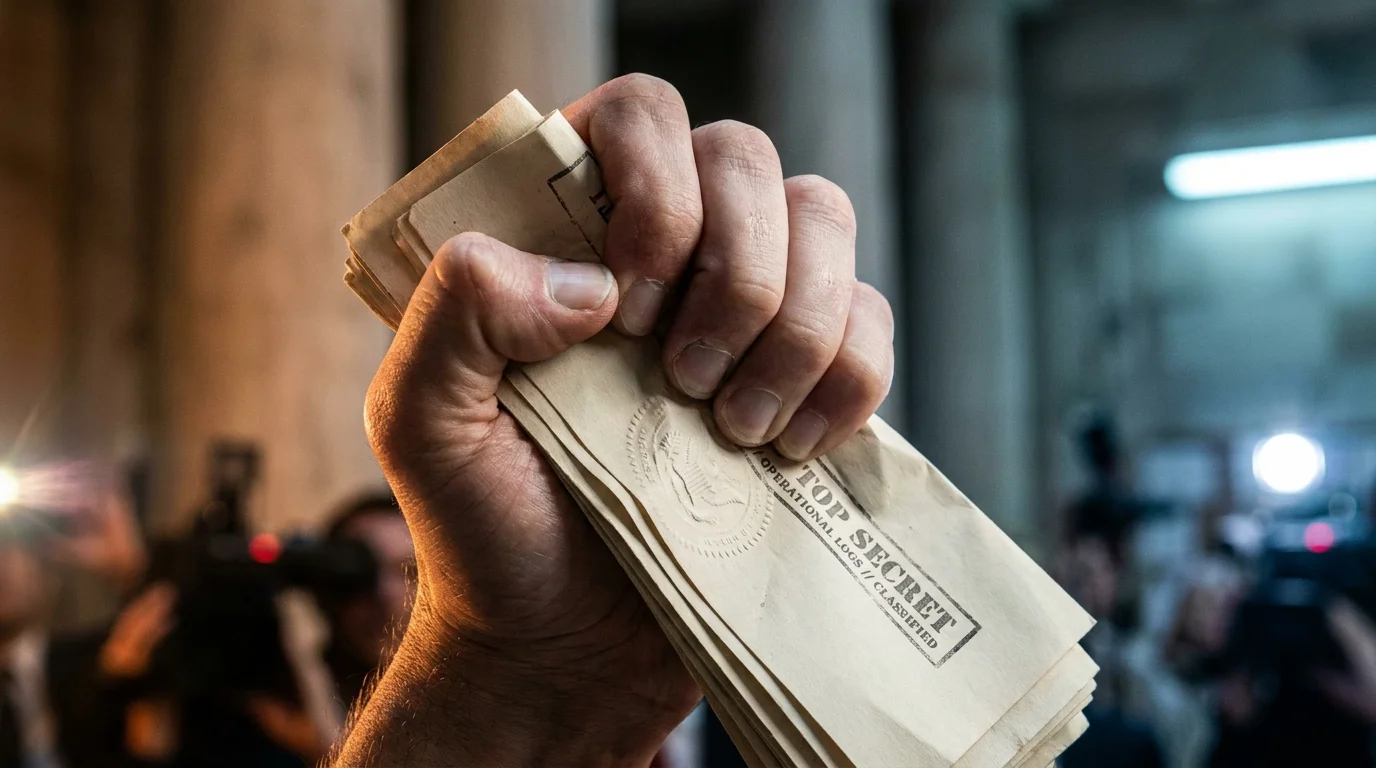
Step inside an archive facility after hours, and the first thing you notice is the sharp tang of acidic paper slowly breaking down under low-humidity air. Fluorescent tubes hum with a faint, hollow frequency overhead, vibrating against rows of steel shelving that stretch into darkness. You might picture modern counterterrorism through the cold lens of thermal drone feeds and clean satellite telemetry. But the actual machinery of human hunting smells like water-damaged cardboard, hand-scrawled cipher pads, and cheap thermal fax printouts taped into leather logbooks.
For more than a decade, the public accepted a crisp, cinematic script of how the safehouse in Abbottabad was pinpointed. You were told a single cell phone intercept cracked the mystery wide open, creating an unbroken chain of causality that ended on a moonless night in May 2011. Yet when you peel back the gray redaction tape on newly unsealed military intelligence dossiers, that tidy narrative fractures into something far messier, slower, and profoundly human.
The files reveal that the critical breakthrough did not happen inside an air-conditioned operations center listening to satellite relays. Instead, it was pieced together through a grueling, decade-long audit of human messengers who carried thumb drives inside hollowed-out car batteries, traveling along rutted highways between Peshawar, Rawalpindi, and the Himalayan foothills. **Real tradecraft moves at foot speed**, leaving faint paper bruises across forgotten transit manifests that Washington spent years trying to reconcile.
The Living Relay: Rethinking the Architecture of Concealment
To understand what these declassified dossiers actually show, you have to discard the myth of digital omniscience. When an adversary completely unplugs from the global grid, your billion-dollar signals satellites are reduced to deaf ears staring down at silent rooftops. The target operated not as a rogue general barking orders over radio waves, but as a deliberate recluse breathing through a pillow—muffling every whisper before it could leave the courtyard walls.
His communication network functioned exactly like an old mountain bucket brigade. **Information moved through physical weight**, transferred from hand to hand across hundreds of miles of public transit. A courier would take a micro-SD card, wrap it in foil, and tuck it behind the dashboard of an unregistered passenger van. He would ride three bus routes, buy a ticket in cash under a false name, and slip the drive to a second courier inside a crowded fruit market without exchanging a single spoken sentence. By the time a single instruction reached a cell commander, it had changed hands five times over three weeks.
The newly unsealed logs reveal that the official timeline released to the press was compressed for public consumption. Military planners were not tracking a fresh, urgent trail in late 2010; they were reconciling conflicting reports that had gathered dust inside inter-agency folders since 2004. The delay was not caused by a lack of raw data, but by the staggering difficulty of tracking men who simply chose never to touch a keyboard.
- Suburban swing voters freeze national campaign strategies over multi-family housing zoning mandates
- Eric Adams memos expose aggressive press deflection strategies against federal corruption charges
- Supreme Court rulings freeze regional pipeline projects leaving municipal budgets stranded
- Ron DeSantis mandates fuel boardroom revolts across Wall Street financial firms
- White House orders bypass congressional oversight to strip veteran agency directors
Marcus Vance, a 47-year-old former tactical signals intercept analyst who now conducts independent intelligence auditing, spent fourteen months cross-referencing transit stamps from Bagram detention intake forms against the unsealed courier dossiers. In a quiet, drafty library annex in Arlington, he mapped the coordinates of three distinct safehouses that were raided years before Abbottabad, discovering that field operators had flagged the Abbottabad courier’s alias as early as 2006. The warning had been dismissed because analysts at headquarters were searching for active electromagnetic signatures rather than silent walking paths.
The Anatomy of the Shadow Route: Three Operational Rings
The declassified records divide the clandestine logistics into three distinct concentric rings. Understanding these layers dismantles the illusion that this evasion network was an improvised miracle; it was an industrial protocol designed to exploit institutional blind spots.
The first tier was the Courier Perimeter, staffed by individuals chosen specifically for their mundane, unmemorable lives. They did not carry weapons, possess radical digital footprints, or associate with known regional brokers. They drove modest family sedans, held routine vendor permits, and paid local municipal bribes on time. **The perfect spy looks boring**, blending into morning traffic while carrying encrypted strategic directives wrapped in grocery receipts.
The second tier was the Dead Drop Corridor. Messengers never delivered materials directly to the compound’s gate. Instead, they used third-party exchange depots: open-air lumberyards, auto repair garages, and municipal transit stops where packages could sit inside unmonitored locker boxes or beneath discarded vehicle floorboards for days before being collected. This created a built-in temporal firewall. If an intercept team arrested a courier at the drop point, the safehouse inhabitants had forty-eight hours of pure silence to pack and vanish before anyone knew the chain had snapped.
The third tier was the Redacted Interior. Unsealed compound supply manifests expose the absolute physical isolation enforced behind those concrete walls. The inhabitants burned their own trash down to fine ash in steel barrels, never placed a single bag at the curb, and relied on internal livestock and rooftop garden plots to minimize retail interaction. They treated human visibility as a fatal leak, constructing an analog bubble that baffled electronic surveillance until human observers finally spotted children playing inside a walled compound where no children were registered to live.
Dissecting Unsealed Records: A Field Guide to Archival Truth
When you sit down to examine declassified dossiers yourself, the official story will tempt you to look only at the operational raid summaries. That is a mistake. The truth lives in the bureaucratic friction—the logistical invoices, field transit manifests, and after-action corrections that officials never intended to release to the Sunday morning talk shows.
To pull meaningful insight from raw FOIA releases, adopt the mindset of an auditor looking for administrative panic. **Look for the chronological breaks**, where days or weeks vanish between tactical log entries without an operational explanation. Those pauses mark the exact moments when institutional assumptions collapsed and commanders were forced to rewrite their strategies on the fly.
- Track physical custody receipts: Cross-reference the serial numbers on seized media against regional chain-of-custody transfer logs to see where evidence lingered before reaching central analysis desks.
- Map the geographical cutouts: Note the towns where couriers changed transit modes; these transition hubs reveal which local transportation routes were considered safe from checkpoint sweeps.
- Compare conflicting date stamps: Match unsealed military patrol journals against later congressional briefing timelines to spot where the official retrospective narrative smoothed over field-level hesitation.
- Scrutinize redaction patterns: Pay attention to what remains blacked out. Names are routinely concealed for safety, but large black blocks over dates and times suggest an operational sequence that conflicts with public testimony.
Keep your research workspace minimal and grounded. Rely on a clean PDF markup tool that preserves raw page metadata, an offline spreadsheet for building strict chronological timelines, and a high-resolution regional road atlas printed before 2010 to cross-reference routes that have since been renamed or paved over.
The Lingering Weight of the Missing Pages
When you finish walking through hundreds of pages of unredacted transit logs, the lingering feeling is not triumph, but a quiet, unsettling sobriety. The official narrative handed to the public was built like a straight line, clean and reassuring in its mechanical perfection. The unsealed reality, however, looks like a tangled root system buried under hard soil, showing an intelligence community that spent years groping in the dark against an adversary who defeated high-tech surveillance simply by turning off the power switch.
Understanding this historical disconnect matters because the same institutional instincts shape modern policy today. Governments instinctively tell stories of digital supremacy, clean algorithmic answers, and effortless control. But the ground truth—whether in the back alleys of northern Pakistan or inside your own local regulatory systems—is always decided by friction, human error, and quiet moments that never make the evening news. When you learn to read between the black ink of declassified files, you stop taking clean headlines at face value and start looking for the quiet human runners who actually move the pieces.
True tradecraft is not found in high-orbit optics, but in the patience of a courier willing to walk three days to deliver a single sentence.
| Key Point | Declassified Detail | Added Value for the Reader |
|---|---|---|
| The Courier Network | Relied entirely on physical micro-SD relays and hand-carried paper ledgers, bypassing all regional cellular towers. | Reveals how absolute digital silence neutralizes multi-billion-dollar signals intelligence apparatuses. |
| Timeline Compression | The target was identified through archival cross-referencing of 2004 files, not sudden real-time satellite intercepts. | Exposes the reality that modern intelligence breakthroughs depend on deep clerical audits rather than cinematic tactical breakthroughs. |
| Compound Operational Isolation | Internal waste incineration and zero municipal footprint shielded the Abbottabad location from conventional urban surveillance for years. | Demonstrates the mechanics of physical counter-surveillance and how low-tech isolation blinds predictive tracking software. |
Frequently Asked Questions
What are the newly unsealed courier dossiers?
They are declassified military intelligence logs, field interrogation transcripts, and operational transit manifests documenting how human couriers bypassed digital surveillance networks between 2002 and 2011.Why does the unsealed timeline differ from the original raid narrative?
The public story compressed months of archival ledger audits and contradictory field reports into an urgent, linear chain of events to maintain public confidence and operational security.How did couriers avoid detection for nearly a decade?
They practiced absolute digital hygiene, moving encrypted memory cards along regional bus routes and utilizing public market dead drops rather than transmitting data over phone or internet networks.What role did digital surveillance play in locating the Abbottabad compound?
Signals intelligence was largely ineffective until human couriers were physically tracked to the perimeter through boots-on-the-ground surveillance and vehicle identification.Where can independent researchers access these declassified records?
Declassified tranches are available through the Director of National Intelligence public reading rooms, the National Security Archive at George Washington University, and targeted FOIA repositories.