The studio floor smells of industrial floor sealant, hot quartz lamps, and stale gaffer tape. As you watch the broadcast crew hustle out of frame, the stage lights click to full intensity, washing over two dark wooden podiums that look strikingly balanced from your living room couch. You assume the two figures walking out will meet on identical terms, framed neatly against matching blue backdrops under the cool wash of auditorium air conditioning.
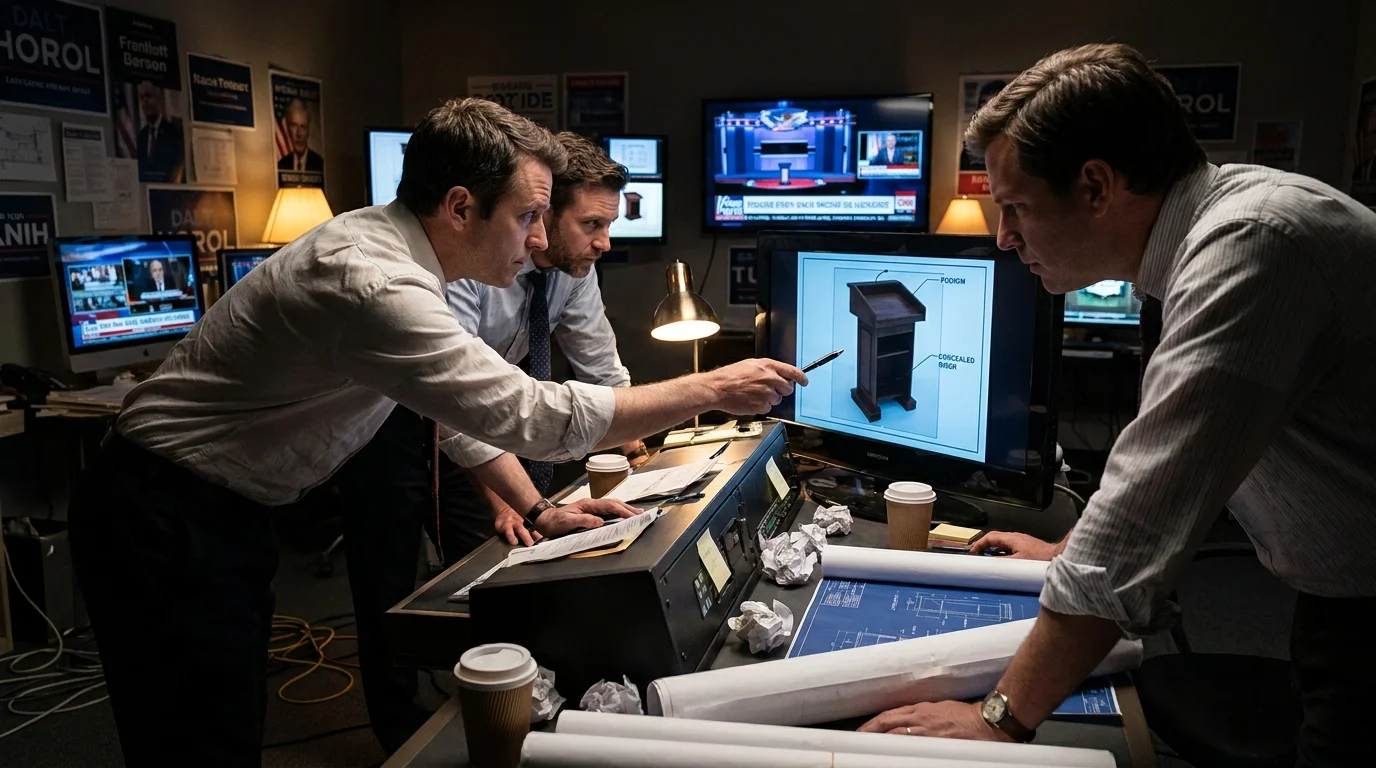
Step behind the perimeter of camera tracks, however, and the architecture tells an entirely different story. Tucked behind the recessed, plush-carpeted base of one lectern sits a custom plywood box—a duckboard riser painted matte black to swallow any stray studio reflection. The candidate stepping onto that block does not simply gain four inches of stature; they surrender their natural posture.
Their shins press hard against the hidden interior shelf of the lectern shell. Because television networks build these monolithic furniture pieces to match the taller candidate’s torso, the shorter debater must anchor their heels to the wooden riser while **fighting a relentless upward gaze**. To look the moderators in the face, their chin must lift, stretching their neck muscles tight while the camera lens catches them from an angle that feels subtly strained, almost defensive.
The Optical Horizon: Television’s Greatest Staging Illusion
Debates are not civic forums; they are television shows built around strict optical engineering. When network producers sit down with campaign representatives months before the first debate, they do not just negotiate timer chimes and rebuttal minutes. They argue over millimeter measurements of podium breastplates and stage riser steps.
The central illusion of the debate broadcast relies on the split screen. Television demands visual symmetry, requiring both faces to occupy the exact same horizontal grid line on your monitor screen. When one candidate stands six-foot-two and the other barely touches five-foot-seven, television creates an artificial equality by **propping the shorter participant upward** on custom wooden carpentry.
Yet physics refuses to sign a candidate agreement. When you elevate someone on a duckboard behind a podium built forty-eight inches high, the proportions distort. Their hands cannot rest comfortably along the edges of the wooden rim without pushing their shoulders toward their ears. If they lower their hands to the hidden interior shelf, their arms disappear completely behind the lumbering wooden barricade, making them look like a disembodied head floating above polished veneer.
- Bill Clinton convention speech drafts enforce calculated crowd pauses through bold marginal bracket notations
- Republican convention platform rules switch sudden delegate voting thresholds following grassroots floor revolts
- Trump Iran strategy searches expose deep voter anxiety across sudden Middle East defense realignments
- Trump interest rate demands spark emergency Senate pushback over central bank independence protections
- Optical scan ballot bubbles demand dark black ballpoint ink over smudged gel pens
Elena Ramos, a 52-year-old veteran broadcast production designer who has drawn stage plots for three presidential cycles, knows how quickly these small carpentry choices alter a race. She recalls an October debate where staff spent nearly four hours adjusting an oak riser by three-quarters of an inch. "If that box is half an inch too tall, their elbows flare out like wings," Ramos explains. "If it is half an inch too short, the podium swallows their chest and they spend ninety minutes talking to the ceiling."
Adjustment Layers: How Staging Battles Shape the Shot
Campaign managers treat podium schematics with the intensity of military logistics. Every adjustment layer is calibrated to camouflage physical vulnerabilities or neutralize an opponent’s natural stage presence.
For the taller candidate, the objective is downward stabilization. They often fight against tall podiums that cramp their posture, preferring a lower rim that allows them to lean forward comfortably, projecting physical dominance across the stage gap. If the lectern sits too high, they lose the ability to deploy subtle, commanding hand gestures over the rim, trapped behind an impenetrable wooden slab.
For the challenger standing on the riser, **every movement carries spatial peril**. They cannot pace; they cannot shift their weight naturally from heel to toe without risking an awkward stumble off the edge of a three-foot-wide wooden platform hidden inside the podium cavity. They must remain completely stationary, anchored like a statue while projecting effortless ease under thousands of watts of hot illumination.
Then comes the lens problem. Production directors position primary tracking cameras thirty-five to fifty feet back into the auditorium darkness, fitting them with telephoto zoom lenses. These long focal lengths compress the physical space between the lecterns, making rival candidates look as though they stand shoulder-to-shoulder, even when an eight-foot chasm separates them on stage. That telephoto compression also flattens perspective, turning that slightly upward eyeline into what can look like a confrontational glare.
Decoding the Split Screen: A Viewer’s Tactical Toolkit
Once you understand how the stage floor is rigged, the entire debate experience transforms. You stop listening purely to polished soundbites and start reading the structural discomfort broadcast through the glass.
To see through the visual stagecraft on debate night, watch for the telltale signs of physical strain engineered by the set itself:
- The Collarbone Gap: Watch the space between the top edge of the wooden rim and the candidate’s tie or necklace. If the wood cuts straight across the lower throat, they are fighting the furniture.
- The Parallax Tilt: Notice whether a candidate looks directly into the lens or slightly above the camera hood. An eyeline angled upward signals they are perched on a riser trying to clear a towering rim.
- The Elbow Anchor: Pay close attention when someone plants both elbows firmly onto the lectern wings. That posture usually means their feet are locked on a narrow platform, using upper-body tension to maintain balance.
- The Disappearing Forearm: When a candidate’s hands vanish completely behind the wood during an emotional point, the podium has effectively erased their nonverbal communication.
Next time you tune in, keep these technical baseline numbers in mind to judge the staging fairness yourself:
A standard network lectern stands 44 to 48 inches high from stage carpet to breastplate rim. Stage duckboards range from 2 to 7 inches in height, constructed from heavy three-quarter-inch plywood topped with sound-dampening neoprene. Broadcast cameras operate with focal lengths between 85mm and 135mm equivalent to compress field depth. The distance between lectern centers is locked at precisely 8 to 10 feet to preserve split-screen parity.
Reclaiming Your Perspective in the Optical Arena
Recognizing the hidden mechanics of the stage frees you from the emotional traps crafted by television production crews. You realize that what looks like fatigue, aloofness, or stiff hesitation is often nothing more than a person trying not to step off a small wooden box while staring across an intimidating ridge of stained lumber.
When you spot the upward strain of an eyeline or the awkward resting angle of an arm, the spell breaks. The debate ceases to be a pristine arena of equals and reveals itself for what it truly is: **a tightly negotiated optical compromise**. Watching with that clear, mechanical eye lets you judge the human beneath the lighting, unswayed by the invisible architecture designed to tilt your view.
"The moment a candidate has to fight the height of their own lectern, the audience stops hearing their ideas and starts judging their physical tension."
| Key Point | Detail | Added Value for the Reader |
|---|---|---|
| Podium Height | Standard 44 to 48 inches from carpet to rim | Shows whether furniture was sized for one specific torso |
| Hidden Duckboard | 2 to 7-inch custom-built wooden step box | Explains why shorter candidates often look static and rigid |
| Focal Compression | Long telephoto lenses (85mm–135mm) | Reveals how stage space is flattened to force visual parity |
| Eyeline Angle | Upward pitch toward moderators and cameras | Helps distinguish between genuine arrogance and optical strain |
Frequently Asked Questions
Are presidential candidates allowed to bring their own step stools on stage?
No individual furniture is brought freely onto the stage by campaigns. All risers, footboards, and platforms must be negotiated in advance and built or approved directly by the host network production crew.Why do debate stages use massive wooden lecterns instead of open microphones?
Solid wooden podiums hide messy technical equipment, note pads, timer countdown screens, and candidate risers, ensuring the camera frame remains clean and completely free of stage clutter.How do camera operators equalize candidate height on split screens?
Operators adjust their pedestal heights and lens framing individually, placing both candidates' eye levels across the exact same horizontal guide line on broadcast control room monitors.Do lectern dimensions favor taller debaters naturally?
Taller debaters generally enjoy a relaxed upper-body posture, as their forearms rest naturally over standard 46-inch rims without requiring elevated footboards that limit foot movement.Can candidates see the hidden timer clocks inside the lectern?
Yes, most modern lectern rims conceal small digital screens showing green, yellow, and red countdown lights visible only from the candidate's vantage point behind the rim.