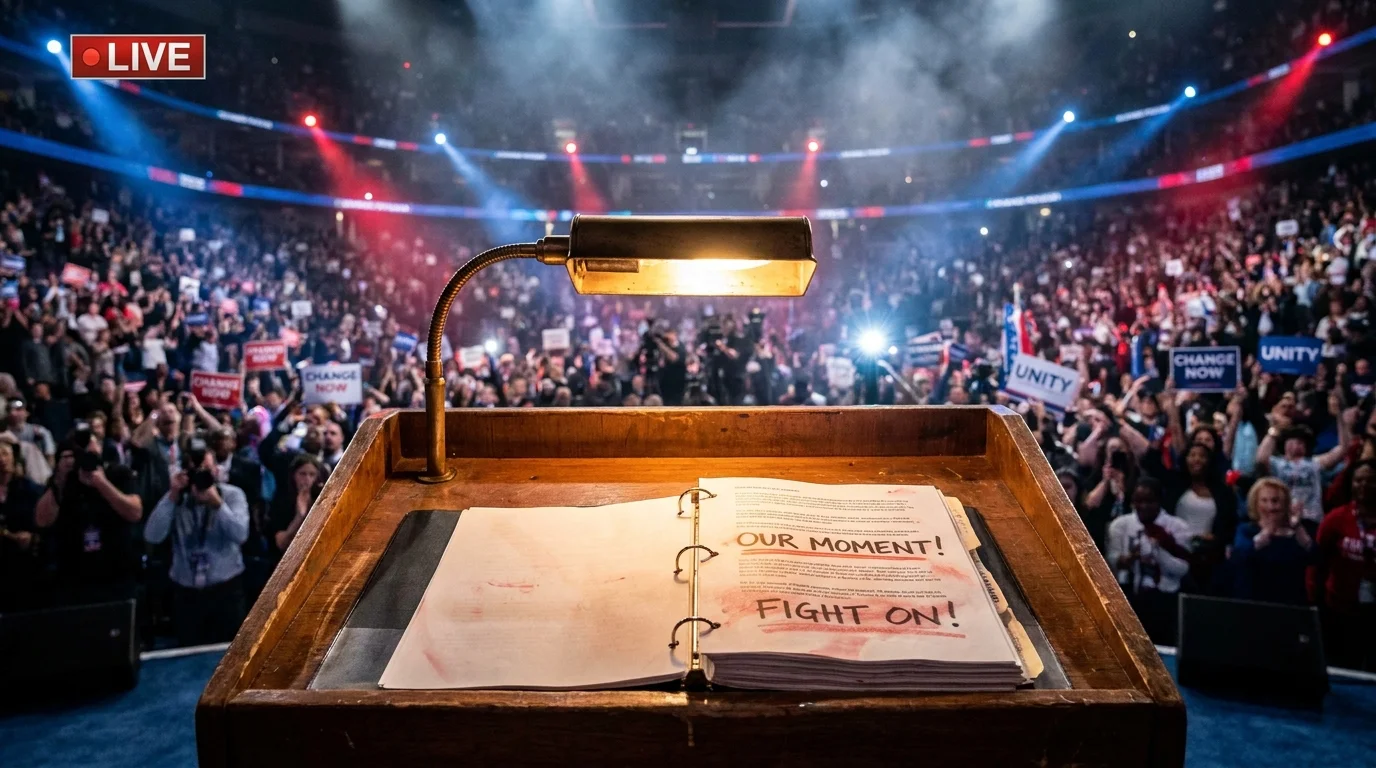
The air inside the sports arena smells of stale popcorn, warm cable insulation, and cold air conditioning pouring from steel rafters forty feet above. Ten thousand delegates roar beneath the glare of xenon follow-spots, wave printed placards, and watch the man at the microphone tilt his chin. To your eyes on a living-room screen, he appears to be surfing raw acoustic electricity, catching waves of mass adoration on pure, untamed instinct. You imagine a master storyteller speaking off the cuff, letting emotion pull the cadence straight out of his chest.
Look closer at the lectern surface, hidden behind the tinted teleprompter glass and the dark wooden lip. Rested flat on the shelf sits a black three-ring binder with matte heavy-stock sheets, scarred by heavy red grease pencil brackets. Those marks do not suggest words; they govern the silence between them. What spectators mistake for charismatic surrender is a rigid acoustic machine operating under millisecond timing.
When Bill Clinton stepped up to redefine modern national party conventions, the illusion of easy intimacy masked an exacting engineering feat. Every throat-clearing hesitation, every tilted grin, and every sweeping rhetorical crest was mapped onto paper with typographical rigor. If you want to understand how crowds are actually moved, you have to peel back the myth of the natural orator and look at the ink.
The Architecture of the Acoustic Dam
We tend to treat speech as a river, assuming that greater power comes from pouring more volume into the channel. In truth, persuasive speech works like a heavy hydraulic dam. The speaker does not win people over by talking over their reactions; they win by cutting the current and forcing the reservoir to back up behind closed teeth.
Convention drafts from that era reveal that party speechwriters never left applause to chance. When an audience begins to register a sharp political contrast, their instinct is to surge forward with sound. If you keep speaking while they cheer, your ideas drown under their own momentum. Marginal brackets marked as [WAIT – 6 SEC] or thick double slashes ordered the speaker to stop cold, drop the chin, and breathe through the nose until the room exhausted its immediate reflex.
Consider Michael Sheehan, the veteran speech coach who spent decades drilling governors and nominees in basement hotel ballrooms before they ever tasted prime-time television. During late-night revisions in 1992, Sheehan sat with twenty-something aides armed with grease markers and stopwatch displays, pacing out draft lines like musical measures. He knew that an undisciplined speaker treats applause like an interruption, rushing to squeeze in the next syllable. Sheehan taught his pupils that silence is an active weapon; by carving out dead air on the page with grease pencil, he gave politicians permission to stand motionless and let the hall burn its fuel.
- Republican convention platform rules switch sudden delegate voting thresholds following grassroots floor revolts
- Trump Iran strategy searches expose deep voter anxiety across sudden Middle East defense realignments
- Trump interest rate demands spark emergency Senate pushback over central bank independence protections
- Optical scan ballot bubbles demand dark black ballpoint ink over smudged gel pens
- Direct-mail carrier route flyers trap low-propensity households behind glossy oversaturated cardstock mailers
The Three Typographical Cues of Mass Influence
The paper drafts that guided those hallmark addresses were not standard manuscripts; they resembled orchestra conductor scores layered with visual boundaries. Each symbol served as a physical brake on the speaker’s pulse.
The Six-Second Hold Bracket was the primary line of defense. Represented in the margins by bold, squared brackets surrounding a punchline, this cue demanded an absolute freeze. When you step before a crowd and hit an ideological nerve, the room needs six seconds to gather its voice, crest, and recede. Breaking this hold at second three signals panic, making the speaker look defensive or hurried.
The Staccato Slash Line cut across sentences to break natural conversational clauses into deliberate hammer blows. Instead of delivering a flowing policy explanation, the markings forced the speaker to bite off cadence syllable by syllable. It kept the speaker from tumbling forward down their own rhetorical slope.
The Low-Register Pitch Reset served as an acoustic reset button. Noted often by downward arrows or underlined whispers, these marginal tags told the speaker to drop their vocal octave immediately after an applause burst. Following a deafening roar, dropping your vocal pitch forces the entire room to quiet down just to hear you resume.
Persuasion Choreography for Everyday Rooms
You do not need an arena of delegates waving state banners to use the discipline of the grease pencil. Whether you are addressing an uneasy board of directors or pitching an idea to your neighbors, the urge to rush into quiet rooms remains your biggest vulnerability. Persuasive control comes from accepting that silence feels twice as long to the speaker as it does to the listener.
To anchor your delivery without relying on panic-fueled adrenaline, build these mechanical safeguards directly into your physical notes:
- Enlarge your font to eighteen points and leave generous margins for physical cues rather than just words.
- Draw visible block brackets around your core assertions to command yourself to pause and let the claim land.
- Place your weight equally on both heels during pauses so your body does not translate nervous tension into rocking.
- Count three quiet, deliberate nasal breaths before responding to any unprompted audience reaction.
The Tactical Speaker Toolkit relies on specific structural rules: keep your applause baseline at 5.5 to 7.2 seconds before secondary decay, maintain a spoken rate of 125 to 140 words per minute during narrative setups, enforce a three-line-per-inch maximum on your page to keep your eyes grounded, and use crimson grease pencil that stays visible under harsh, glare-heavy stage lights.
The Space Between the Words
True rhetorical command is never about monopolizing every second of clean air. When you master the deliberate pause, you give your listeners something rare: the space to process their own conviction. A speech is not a monologue delivered at an audience; it is a structured rhythm of breathing together.
Those greasy red marks on vintage podium binders were never signs of insecurity or lack of talent. They were tools of profound self-restraint. By learning to stop talking when everyone expects more noise, you step outside the scramble of defense and claim the quiet authority of someone who already knows how the sentence ends.
The most persuasive word on any podium is the absolute silence that forces the listener to lean in.
| Key Point | Detail | Added Value for the Reader |
|---|---|---|
| Bracket Notations | Forced 6-second physical pause marks in grease pencil. | Prevents you from stepping on your own applause or punchline. |
| Acoustic Dam | Holding silence until the audience volume crests. | Transforms passive crowds into active participants in the rhythm. |
| Pitch Drop Reset | Dropping down an octave after high-energy applause bursts. | Commands immediate silence without straining your voice or shouting. |
Frequently Asked Questions
Why were grease pencils used instead of standard pens on podium drafts? Standard pen ink is thin and difficult to catch under blinding television spotlights. Red grease pencil wax creates thick, non-reflective boundaries that the speaker can register instantly through peripheral vision without breaking eye contact with the audience.
Why is six seconds considered the ideal pause window? Human crowd dynamics require roughly two seconds to spread across a room, two seconds to hit peak collective volume, and two seconds to decay. Intervening before six seconds cuts off the audience’s emotional release.
How do bracket notations differ from normal teleprompter cues? Teleprompters scroll automatically based on voice tracking, which often tempts speakers to keep talking to keep the screen moving. Paper binders with bracket notations act as physical stop signs that override the prompter’s forward crawl.
Can these pause structures work in small business meetings? Yes. In smaller rooms, reducing the bracketed pause to two or three seconds after an important metric gives decision-makers time to absorb the data instead of feeling rushed into an objection.
Doesn’t scripting pauses make a speaker sound robotic? The paradox of rhetoric is that unscripted speakers rush when nervous, which sounds erratic. Mechanically enforced pauses give you the physical composure and breath control that audiences interpret as natural confidence.