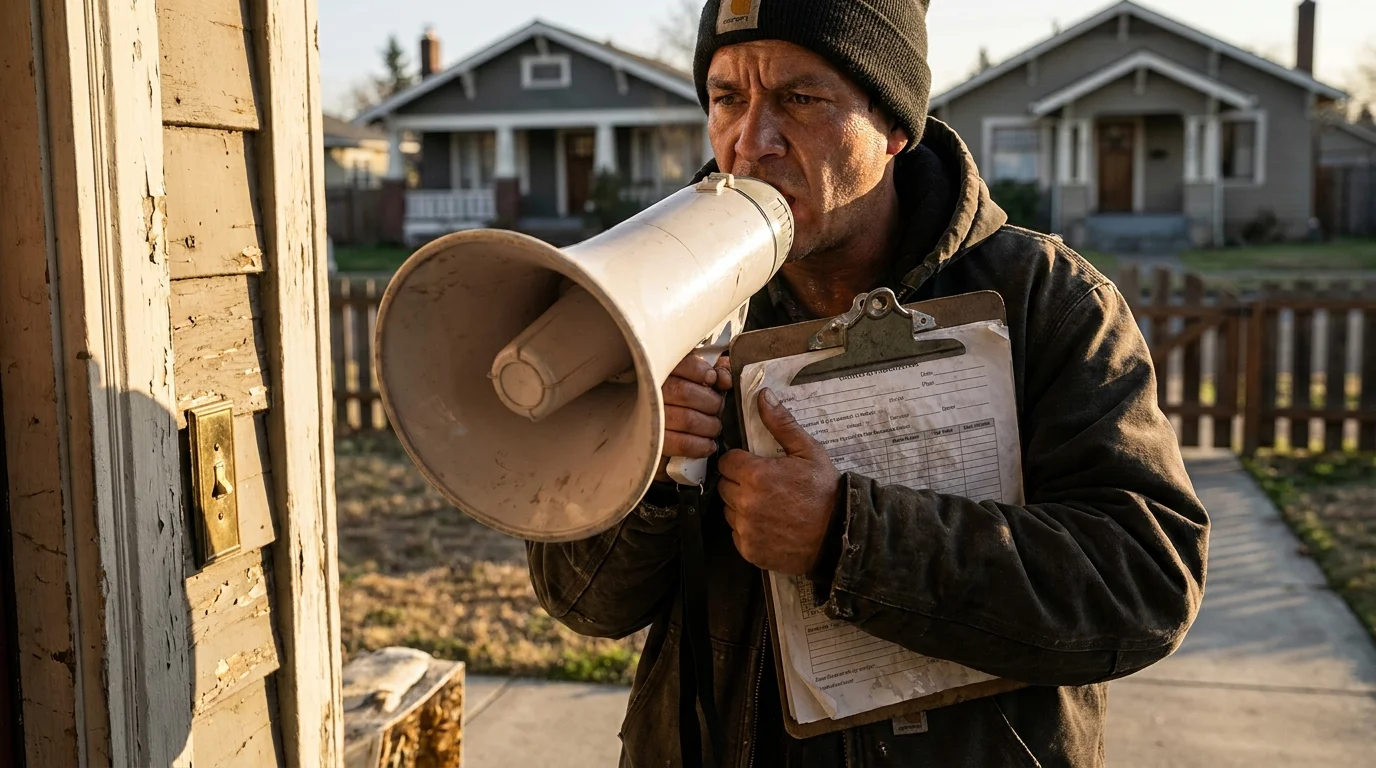
The wet gravel crunches under worn sneakers as the morning mist hangs over a quiet subdivision cul-de-sac. A stiff breeze rattles through overgrown maple branches, sending a shower of cold droplets down onto a plastic clipboard clamping rain-speckled paper walking sheets beside a tarnished brass doorbell. You stand on a cracked concrete porch, checking the glowing screen of a smartphone running on fifteen percent battery while a dog barks behind closed blinds.
Most people assume political campaigns work like neighborhood block parties, casting a wide net across every welcome mat in town. The prevailing myth suggests that enthusiastic volunteers simply wander up and down asphalt lanes, distributing pamphlets to anyone willing to crack open their storm door. Every footstep across your lawn is actually calculated by cold, predictive math long before anyone taps your doorbell.
When that volunteer stands outside your entryway clutching a clipboard, they are not guessing whether you care about the upcoming race. They are standing there because a quiet algorithmic engine ran millions of calculations through an analytical voter file, scoring your household on civic propensity, magazine subscriptions, and retail habits, eventually deciding that your split-level house is the single most valuable four minutes of their afternoon.
The Invisible Math Behind the Welcome Mat
Modern campaigns do not knock on doors to convince partisans or beg disengaged cynics; they operate on predictive voter scores that treat your front walkway like prime commercial real estate. Think of these scoring models not as a list of names, but as an invisible topography map where every household has an elevation score. Field directors spend their limited volunteer hours navigating strictly along the ridge lines, skipping the deep partisan valleys entirely.
Instead of guessing who might change their mind, analytics firms ingest billions of commercial and public data points to build unified profiles. Consumer habits reveal partisan leanings with startling clarity, linking everything from your automotive loan history to your favorite outdoor gear brand back to your municipal voting frequency. If a model assigns your household an 82 on turnout likelihood but a 48 on candidate preference, your porch light instantly becomes a magnet for field operations.
- Federalist No. 10 pamphlets sparked modern factional voting across yellowed colonial newsprint
- FEC candidate search tools expose deceptive super PAC shell names within minutes
- Energy Policy Act tax credits strip homeowners with unexpected heat pump installation clauses
- Strait of Hormuz shipping corridors stop commercial tanker passage triggering urgent Capitol Hill showdowns
- White House ballroom construction spending derails local district budgets amid sudden voter backlash
Elena Ruiz, a 28-year-old regional field director running competitive suburban legislative races in Bucks County, Pennsylvania, spends her dawn hours drinking lukewarm gas station coffee while staring at these dynamic voter spreadsheets. She knows that sending a tired volunteer up three flights of brick steps to the wrong address wastes precious campaign capital. Last cycle, Elena watched her precinct turnout jump by four net points simply by filtering out hyper-partisans and directing canvassers strictly to split-ticket suburban parents whose predictive scores shifted after local school board redistricting.
The Scoring Breakdown: How Your Porch Gets Ranked
Voter models separate suburban streets into distinct operational tiers, ensuring volunteers never spend valuable breath on the wrong conversation.
The Persuasion Window: The High-Stakes 40-60 Tier
This is the golden corridor of modern field strategy. Households landing between forty and sixty on candidate preference models represent true independent thinkers or conflicted partisans. If your profile places you here, expect multiple knocks, customized literature addressing local infrastructure or taxation, and volunteers trained to listen rather than recite rigid talking points.
The Mobilization Lane: The Reluctant Partisan
These addresses belong to voters who align closely with a candidate on paper but routinely skip midterms or off-year municipal contests. Volunteers skip the persuasion scripts entirely here, focusing instead on polling location hours, mail-in ballot deadlines, and personal voting plans to guarantee the ballot actually lands in the drop box.
The Silent Passes: The Solidified Fringe
Homes scoring above eighty-five or below fifteen are virtually invisible to walking apps. Even if your neighbor spends twenty minutes pruning their hydrangeas on Saturday morning, a trained canvasser will walk briskly past their driveway without making eye contact, husbanding energy for the undecided resident down the street.
Mindful Canvassing: The Tactical Field Protocol
Understanding how canvassers are deployed allows you to decode every knock at your door during campaign season. Field organizers follow a precise, minimalist routine designed to maximize human connection in high-value neighborhoods:
- Verify the turf assignment: Organizers synchronize offline mapping caches at 8:30 AM to capture overnight scoring updates.
- Audit porch signals: Canvassers scan for yard signs, work trucks, and home improvement projects before knocking to contextualize scripted questions.
- Execute the two-minute contact: Volunteers step back three paces from the threshold to establish non-threatening body language and respect personal boundaries.
- Log qualitative disposition: Responses are logged into handheld software within thirty seconds of leaving the driveway, updating the central predictive model instantly.
The tactical toolkit relies on specific operational metrics: canvassers aim for 25 attempts per hour, a strict 20% contact rate, and conversations capped at 180 seconds unless a persuasion score triggers an extended qualitative debrief.
The Bigger Picture: Reclaiming the Human Interaction
When you see a field worker navigating your neighborhood with a stack of rain-slicked papers, you are witnessing the intersection of massive algorithmic processing and fragile human democracy. While proprietary models curate the route, the actual exchange on your front steps remains surprisingly grounded: two neighbors discussing community concerns face-to-face. Understanding the unseen digital architecture behind that knock removes the mystery, giving you total agency to engage on your own terms.
The predictive model merely builds the bridge to the front steps; the human conversation determines whether anyone crosses it.
| Key Point | Detail | Added Value for the Reader |
|---|---|---|
| Predictive Scores | Combines commercial data, voting frequency, and polling regressions. | Explains why some houses get knocked three times while neighbors are skipped. |
| Turf Optimization | Walking routes generated dynamically to target 40-60 persuasion windows. | Reveals how campaign field operations maximize limited volunteer hours. |
| Data Refresh Loops | Canvasser notes sync back to analytical models within minutes of contact. | Demonstrates how doorstep answers reshape campaign messaging in real time. |
Frequently Asked Questions
How did a political campaign get my home address and cell number?
Voter registration rolls are public records, which analytical data vendors merge with consumer marketing databases, credit bureau files, and subscription histories to compile contact sheets.Does putting up a yard sign stop canvassers from knocking?
Often it does the opposite. If your registered scoring profile contradicts your yard sign, field models may flag your address for an exploratory persuasion visit.Why do canvassers ask specific questions about local issues?
Your answers serve as live data points that calibrate precinct-level algorithms, updating how resources and mail pieces are distributed across your legislative district.Can I ask a volunteer to remove me from their walking list?
Yes. Politeness works best: asking the volunteer to mark your household disposition as ‘Do Not Walk’ or ‘Refused’ logs an immediate flag in their mobile software.Do weather conditions change which doors get knocked?
Rain and extreme heat narrow target lists to hyper-dense clusters, forcing organizers to prioritize only the top five percent of high-value swing voters on a street.