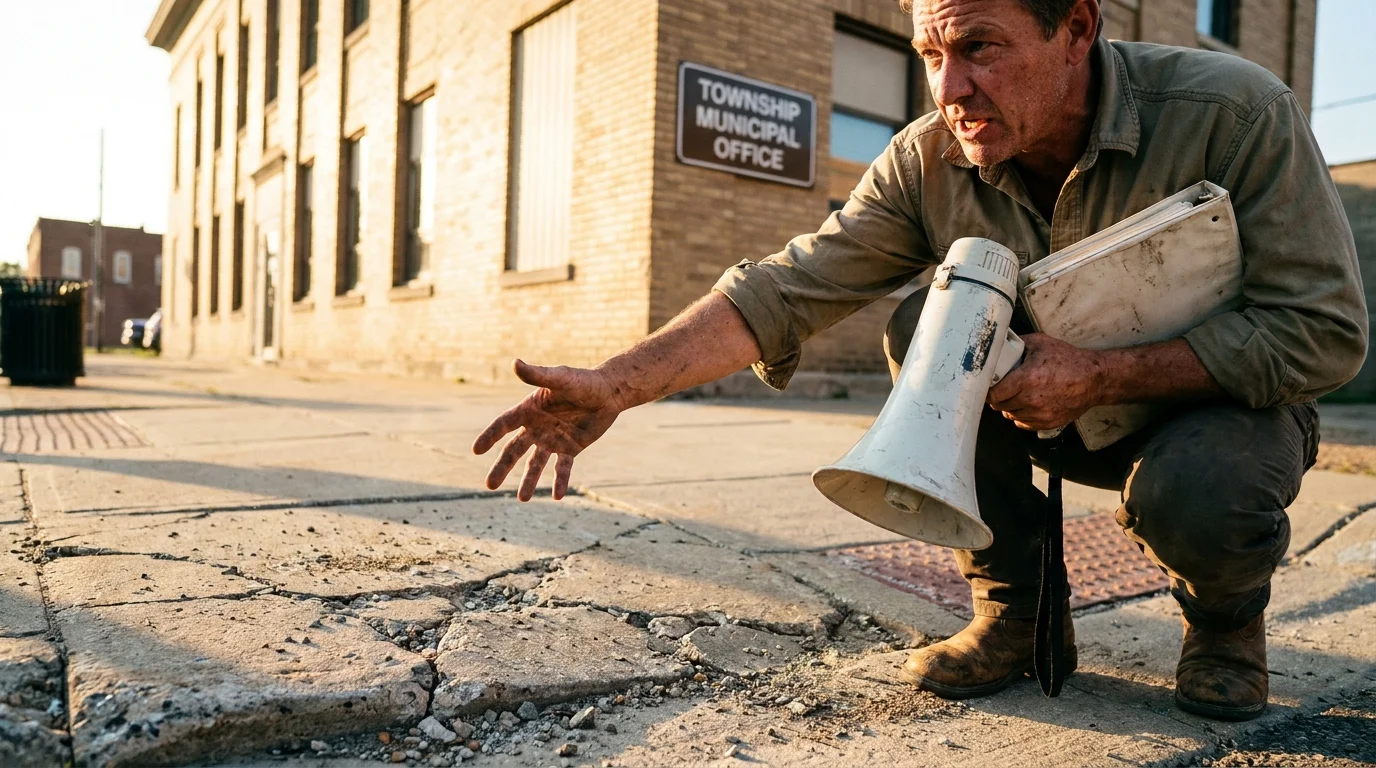
You can tell how brittle a town’s finances are by walking down its Main Street and watching where the spray paint lands. When neon orange chalk marks a spiderwebbed, sun-bleached concrete sidewalk slab right at the corner of an intersection, it looks like simple municipal upkeep. The chalk line cuts across gray stone that has buckled under thirty winters of road salt, sitting directly adjacent to a fresh stretch of gravel where the crosswalk meets the gutter.
You might assume Washington paid for that neon chalk mark. When federal infrastructure bills pass with ceremonial pens and triumphant press releases, the public expectation is straightforward: federal rules arrive with federal checks. You imagine an endless reservoir of national transit funding smoothing out every municipal edge, ensuring that modern, tactile yellow curb ramps appear magically without bruising the local balance sheet.
The physical reality hits much harder. In rural county seats and quiet townships across the country, those bright accessibility ramps are not arriving on the back of generous federal grants. Instead, they land directly on the kitchen table property bill in the form of special municipal assessments, quiet millage recalculations, and drained maintenance reserves.
The Ledger Gravity: When Washington Rules Hit County Dirt
To understand why your town’s road maintenance fund is bleeding out, you have to treat the federal regulatory pipeline like a gravity well. When federal agencies enforce Americans with Disabilities Act curb ramp standards during road maintenance, the mandate moves downhill unimpeded until it hits the bottom rung of local government: the township supervisor and the property owner.
The common misconception is that accessibility mandates are elective municipal improvements scheduled at leisure. Under Title II of the ADA and Department of Justice regulations governing public right-of-ways, any time a municipality performs an asphalt mill and overlay, that resurfacing constitutes an “alteration” under 28 CFR § 35.151(i). The moment the asphalt roller touches the street, the clock starts ticking: the county must bring every intersecting curb ramp up to current federal slope, width, and tactile dome specifications, regardless of whether there is federal money attached to the project.
If the county commissioners lack the discretionary capital to hire specialized concrete contractors for every corner, they face an impossible choice: cancel scheduled street repaving entirely, or balance the books by issuing sudden localized property assessments against the adjacent parcel owners.
- Marist College battleground surveys trap nervous campaign pollsters behind crinkled paper ballots
- FHFA mortgage loan fees switch suburban closing costs onto crisp cashier checks
- Kennedy Center federal funding disputes trigger fierce midnight Capitol Hill spending roll calls
- United States midterm election precincts reveal rapid suburban voter flips across scratched voting screens
- Military operation authorization votes expose sharp candidate rifts under glaring studio spotlight heat
The Superintendent’s Dilemma
Consider Marcus Higgins, 54, a highway superintendent serving an agricultural county of barely eighteen thousand residents in eastern Ohio. Last autumn, Marcus sat in an unheated municipal garage with a stack of contractor bids spread across his desk, watching the cost of poured-in-place concrete ramps consume sixty percent of his annual chip-seal budget. “We had eight miles of failing farm-to-market roads that needed fresh oil and stone before the freeze,” Marcus explained, pointing toward a cracked concrete sidewalk slab outside his shop door. “Instead, federal compliance guidelines forced us to divert $340,000 into fourteen intersection corners in town. The state didn’t give us an extra dime. We had to notify forty-two downtown homeowners that their sidewalk frontage was out of compliance, billing them directly for the concrete forms.”
Where the Ledger Fractures: Three Realities of the Ramp Mandate
The impact of this regulatory squeeze does not land evenly across your community. It fractures along hyper-local lines, quietly transforming civic planning into a defensive accounting exercise.
For the Township Homeowner
If your deed includes street frontage, municipal codes in many rural jurisdictions designate the sidewalk as private maintenance property, even while the public retains right-of-way access. When the county resurfaces your street, you might receive a formal notification demanding that your corner parcel be brought into ADA compliance within ninety calendar days. A replacement ramp that once cost a few hundred dollars now requires engineered slope certifications, specialized detectable warning pavers, and certified grading contractors, turning a simple maintenance task into a multi-thousand-dollar personal liability.
For the Daily Commuter
You may not live on a corner, but you pay for it with your car’s suspension. When county commissioners realize that resurfacing a secondary road triggers compulsory corner reconstruction that can run upwards of $12,000 per ramp, they stop repaving. They switch from structural asphalt overlays to cold-patch fills and loose chip seals, purely to evade the statutory definition of an “alteration.” You end up driving on deteriorating, potholed arterial roads because your county cannot afford the mandatory concrete compliance work tied to proper asphalt paving.
For the County Commissioner
Local officials are caught between legal liability and municipal bankruptcy. Advocacy groups and federal oversight bodies can initiate devastating compliance audits or civil rights lawsuits if a county’s formal ADA Transition Plan fails to demonstrate continuous, measurable progress. Facing the threat of frozen state transit aid or catastrophic federal court consent decrees, local boards have no choice but to draft emergency assessment ordinances, pushing compliance debt down to the property ledger.
Auditing Your Local Curb Mandate
You do not have to wait for an unexpected line-item adjustment on your winter tax bill to understand what your local government is facing. A careful review of your municipal ledger can tell you where the next concrete assessment will strike.
- Request the public Capital Improvement Plan (CIP) and look specifically for the line item marked “Pedestrian Infrastructure Compliance” or “ADA Transition Reserves.”
- Check whether your township categorizes upcoming road projects as “preventative maintenance” or “structural alterations.” If the road is classified as an alteration, ask your township supervisor if ramp construction costs are being drawn from the general fund or assessed against abutting property deeds.
- Review local public hearing minutes for Title II compliance updates; federal enforcement schedules typically impose strict three- to five-year remediation milestones on sub-recipients of federal highway safety distributions.
- Examine the local sidewalk ordinance to verify whether your municipality uses “front-foot assessment rules,” which shift the financial burden of corner reconstruction directly onto adjacent deed holders.
By engaging directly with the township budget review process, you strip away the bureaucratic jargon and reveal the mechanical costs driving local tax decisions.
The Unvarnished Public Balance
Universal accessibility is an essential principle of modern civic design. Navigating a public street in a wheelchair, pushing a stroller, or walking with an unsteady gait should not require negotiating a crumbling obstacle course. The challenge is not the standard itself, but the quiet dishonesty of how it is financed.
When higher levels of government mandate gold-standard engineering without providing the concrete to pour it, they do not eliminate the financial burden; they merely camouflage it. Real civic awareness begins when you look past the fresh yellow tactile domes at the corner and see the municipal ledger underneath—a precarious balance sheet sustained by local taxpayers footing the bill for cracked concrete they never knew they owned.
“Federal mandates without dedicated federal dollars are simply local property tax increases wearing a legal disguise.”
| Key Point | Detail | Added Value for the Reader |
|---|---|---|
| Statutory Trigger | 28 CFR § 35.151(i) defines asphalt milling and resurfacing as a roadway alteration. | Helps you identify which road repairs automatically trigger mandatory concrete costs. |
| Front-Foot Liability | Municipal codes frequently classify corner slabs as adjacent homeowner maintenance obligations. | Allows you to review your property deed before municipal assessment letters arrive. |
| Resurfacing Deficits | Counties often switch to cold patches to dodge regulatory alteration thresholds. | Explains why your local roads remain rough despite approved transit budgets. |
What triggers a mandatory ADA curb ramp replacement?
Under federal law, any street project classified as a structural alteration—such as milling, asphalt overlays, or complete road reconstruction—requires all intersecting pedestrian ramps to meet current slope and accessibility codes immediately.Can my town legally bill me for a public sidewalk corner?
Yes, in many jurisdictions across the United States, municipal ordinances explicitly assign sidewalk maintenance and accessibility upgrades to the adjacent real estate owner under front-foot assessment laws.Why doesn’t the federal infrastructure law cover these expenses?
While major federal grants fund interstate systems and primary transit corridors, small county and rural township roads rarely receive discretionary grant funding, leaving local property taxes to cover the cost of compliance.How much does a single ADA-compliant ramp cost a small municipality?
Depending on grading requirements, utility line relocations, drainage considerations, and detectable warning surfaces, a single certified ramp can cost between $4,000 and $15,000 to construct.Where can I find out if my street is scheduled for mandatory curb reconstruction?
You can review your county or municipality’s public ADA Transition Plan and Capital Improvement Schedule, typically maintained by the county engineer or public works director.