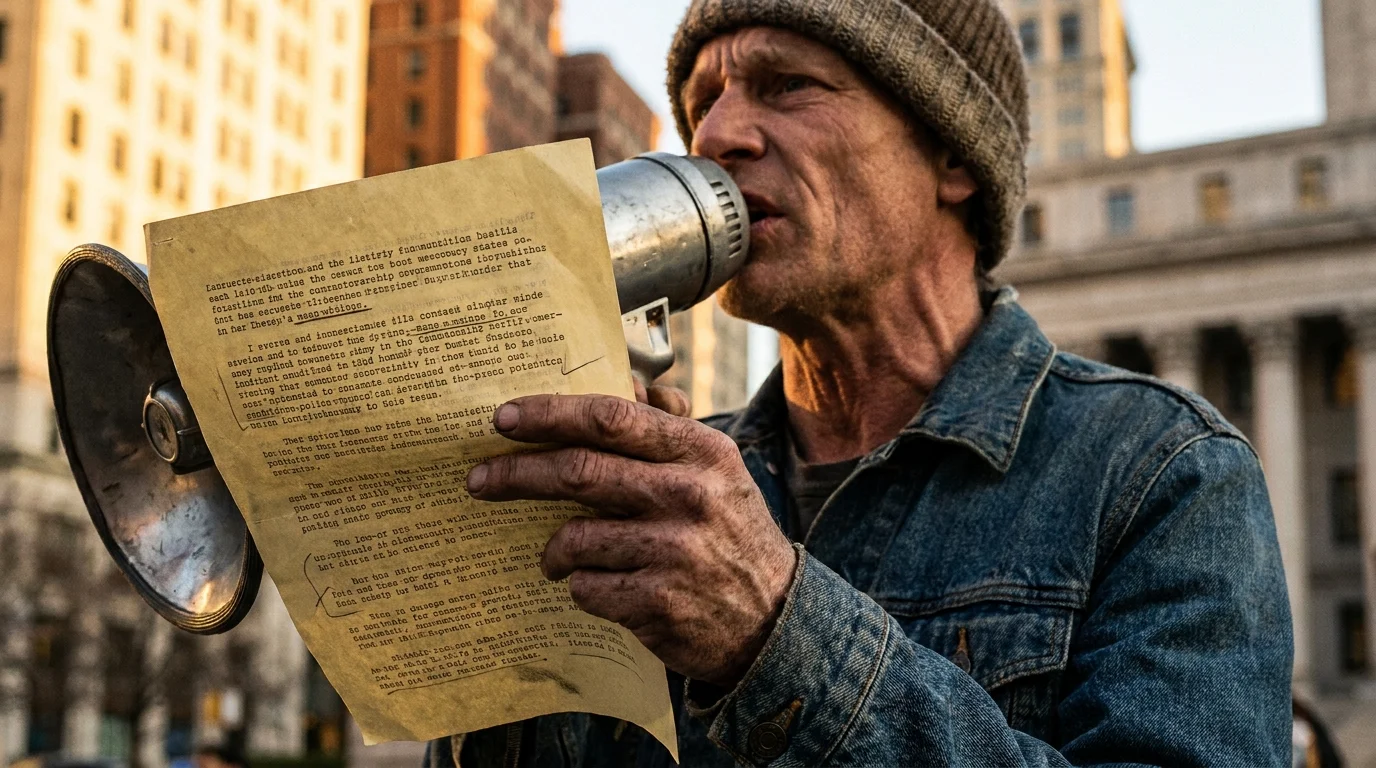
Hold a sheet of twenty-pound rag bond paper to the light, and you can still see the physical depression left by the lead. The typescript is dense, stamped out by a heavy government-issue Remington, but the real choreography sits between the lines. Thick, graphite strokes slash downward across the margins, followed by deliberate double underlines beneath simple monosyllables like not, now, and men.
You were likely taught that Franklin Delano Roosevelt’s fireside chats were triumphs of pure, natural charisma. History textbooks paint a picture of an effortless storyteller leaning toward a metal grate in the Oval Office, speaking off-the-cuff to a frightened nation huddled around glowing wooden consoles. But when you examine the archival scripts preserved in Hyde Park, that romantic illusion evaporates.
The intimacy was not an accident of personality; it was an exacting piece of acoustic engineering. Every pause, every drop in decibel level, and every deliberate drag of a vowel was plotted on the page to conquer the unforgiving physics of early network radio.
The Mechanical Architecture of a Living Room Chat
In the spring of 1933, broadcast technology was remarkably fragile. The standard carbon and early condenser microphones were notoriously sensitive to high pressure. If a speaker raised his voice in the style of nineteenth-century campaign oratory—bellowing from the diaphragm to reach the back rows of a county fairground—the sound diaphragm would rattle violently against its backplate. The result over the airwaves was a harsh, distorted crackle known as audio clipping.
To solve this, Roosevelt and his aides treated the manuscript not as an essay, but as musical notation. The double underlines did not mean ‘shout for emphasis.’ Instead, they were visual speed bumps instructing the President to drop his pitch, lean back slightly, and allow his vocal cords to loosen. By dropping into a lower register on high-stakes words, he avoided overloading the carbon elements in the mic while letting the natural warmth of his chest resonance carry across the frequency band.
You are looking at a fundamental shift in political rhetoric: the exact moment public persuasion moved from the theatrical balcony into the private living room.
- Congressional constituent office days shift lawmaker votes through coordinated local delegation visits
- James O’Keefe undercover videos spark fierce donor debates over nonprofit investigative tactics
- Lake Ontario shoreline legislation triggers urgent property rights battles over rising water baselines
- Iran president diplomatic outreach forces sudden Washington strategy pivots over frozen trade sanctions
- Federal minimum wage proposals clash over regional living costs versus flat hourly floors
The Control Room Secret from 1933
During the drafting sessions for the first fireside chat on the banking crisis, presidential adviser Samuel Rosenman, then forty-two, sat across from Roosevelt with a mechanical stopwatch resting against his thumb. While Roosevelt smoothed out legalistic jargon into plain phrases, radio technician Ralph Schoolman kept one eye on the needle of the line amplifier.
Schoolman had warned the White House staff that sudden acoustic spikes would blow the fuses of local relay stations in rural markets. Rosenman watched as Roosevelt took a soft No. 2 pencil and scored heavy, double horizontal lines under key verbs. The marks signaled a mandatory two-second breath cycle, forcing the President to pause, lower his chin, and let the broadcast line settle before uttering the next sentence.
Decoding the Script Annotations: Three Layers of Delivery
When you dissect these archival pages, the pencil marks fall into distinct categories, each tailored to solve a specific technical and emotional obstacle.
1. The Pressure Valve (Double Underlines)
Found almost exclusively under short, hard-consonant words. When Roosevelt encountered a phrase like ‘we must act,’ the word act received two thick pencil bars. This reminded him to cut the airflow early, preventing the plosive ‘p’ and ‘t’ sounds from creating a sharp burst of wind against the microphone casing.
2. The Cadence Slits (Single Slashes)
Inserted between clauses where standard grammar would never place a comma. These slashes broke long, formal sentences into bite-sized three-to-five-word pulses. For a tired listener sitting in a quiet kitchen after a twelve-hour workday, this rhythmic pacing matched a resting heart rate, making complex legislative action feel manageable and unhurried.
3. The Decibel Floor (Margin Arrows)
Downward arrows scrawled in the left margin indicated passages where the tone needed to shift from executive briefing to confidential reassurance. These were the moments Roosevelt lowered his volume by nearly half, forcing every family in America to lean slightly closer to their radio set just to catch the conclusion of the thought.
The Fireside Method: Mastering Acoustic Space
Whether you are speaking on a podcast, delivering a boardroom pitch, or recording a video address, the mechanics Roosevelt developed remain the gold standard for high-trust communication. You do not build authority by pushing sound outward; you build it by pulling your audience inward.
- Score your script for breathing: Never rely on grammatical commas to dictate your tempo. Insert visual break marks where your lungs naturally need to reset.
- Drop pitch on critical nouns: When you reach your most important point, resist the instinct to speak louder. Lower your voice by a half-step; the human ear interprets downward pitch shifts as proof of complete emotional control.
- Leave two seconds of clean dead air: Modern digital compressors reward clear space between sentences. A deliberate pause lets your audience process the concept before you introduce new data.
Your delivery improves immediately when you stop treating speech as theater and start treating it as an intimate, physical exchange between two chairs.
The Lasting Geometry of Restraint
The enduring power of Roosevelt’s addresses did not come from booming authority, but from an obsession with physical limits. By respecting the mechanical boundaries of the microphone, he discovered something profound about human attention: people rarely remember the loudest voice in the room, but they never forget the one that made them lean in.
When you look at those yellowing sheets of heavy paper, with their worn fibers and dark lead marks, you see a master craftsman working within his constraints. True persuasive power is never loud. It is calculated, quiet, and deeply deliberate.
Cadence is not ornamentation; it is the physical bridge that carries an idea across silence without breaking.
| Cadence Marker | Mechanical Purpose | Psychological Result for Listener |
|---|---|---|
| Double Underline | Halts plosive clipping on ribbon mics | Conveys immovable certainty and calm |
| Margin Slash | Forces a two-second lung recharge | Creates an unhurried, kitchen-table rhythm |
| Downward Arrow | Lowers decibel output by 3 to 5 dB | Draws the listener closer to catch the detail |
Frequently Asked Questions
Did Roosevelt invent the term ‘fireside chat’?
No, the phrase was coined by Harry Butcher of the CBS radio network in 1933 to describe the relaxed, informal nature of the broadcasts.Why did early microphones struggle with loud voices?
Early condenser and ribbon microphones used delicate metal ribbons or diaphragms that warped or grounded out when hit by sudden, loud pressure waves.How long did a typical fireside address last?
Most lasted between 15 and 45 minutes, carefully timed to fit within standard half-hour network broadcast blocks without rushing.Can you see these original marked scripts today?
Yes, the annotated drafts with Roosevelt’s original pencil markings are preserved at the Franklin D. Roosevelt Presidential Library and Museum in Hyde Park, New York.Why did dropping his pitch make Roosevelt sound more trustworthy?
Lower vocal frequencies resonate more cleanly over analog audio signals and psychologically signal low stress, composure, and authority to the listener.