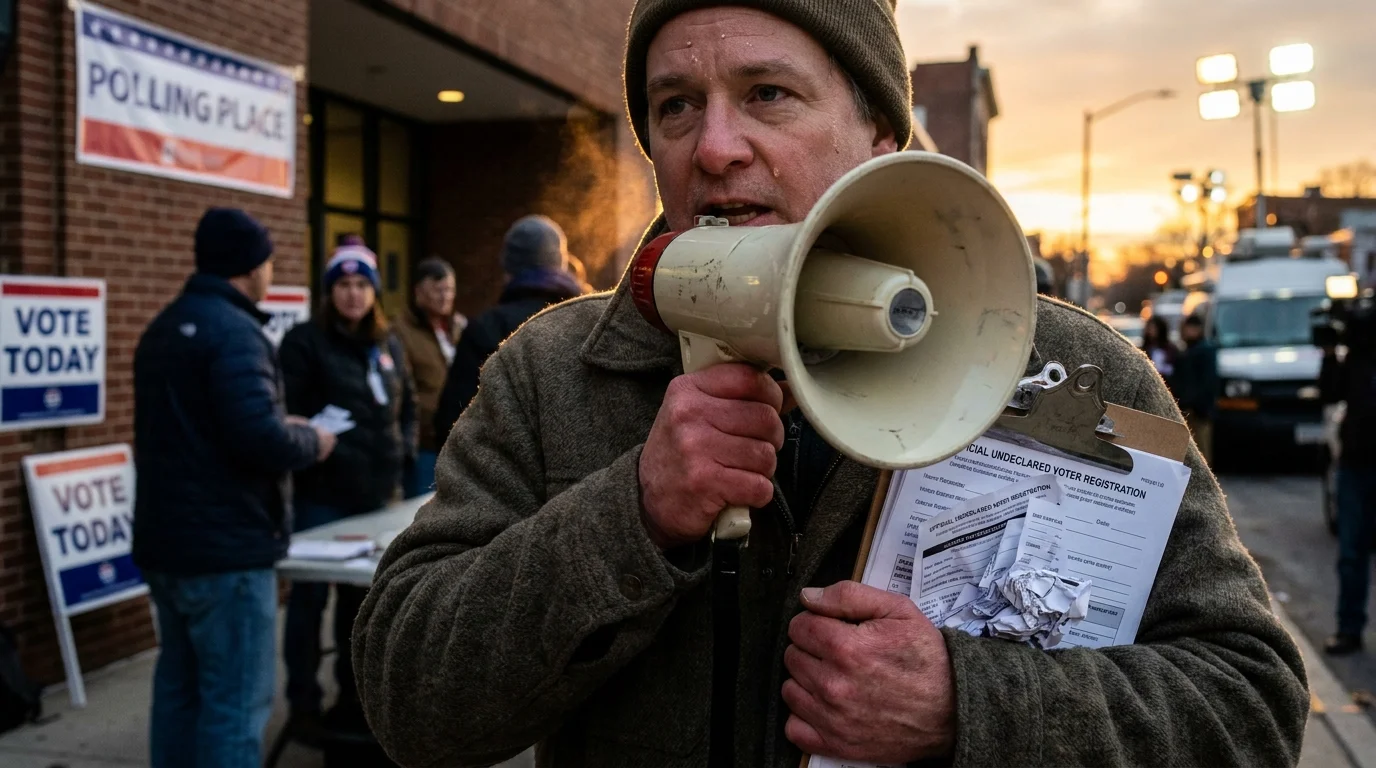
The damp chill of a January morning in Merrimack County clings to your coat long after you pull open the heavy gymnasium doors. Inside, the basketball court floor is covered in taped gray tarps that crinkle softly beneath salt-crusted boots, while the sharp scent of damp wool and institutional floor wax fills the hall. You hear the rhythmic clack of cardboard voting privacy booths shifting against folding tables, punctuated by neighbors exchanging hushed pleasantries over metal clipboards.
On national cable networks, anchors talk about primary season as a neat sequence of deterministic mathematical models and multimillion-dollar media buys. They point to polished national poll aggregates as though party members march in lockstep across state lines. But when you step up to the wooden check-in desk, the tidy graphics dissolve against the quiet reality of small-town administrative machinery.
Here, the ballot you receive is not determined by an algorithmic demographic cluster, but by a grease-pencil mark placed next to your name in a thick, three-ring binder. The real political leverage lives entirely within the gap between party affiliation and voter independence.
For decades, political campaigns have built their early strategies on a fragile assumption: that partisan loyalists run early voting states, leaving undecided participants to simply fall in line. That assumption consistently breaks down the moment undeclared residents exercise their statutory right to choose a primary ballot at the threshold of the booth.
The Granite Trap: Shifting Ballots Like Ballast on a Rolling Ship
To understand why frontrunner delegate arithmetic suddenly collapses on primary night, you have to look at the process not as an ideological coronation, but as the trimming of sails in variable weather. Political machines love predictability; they want sealed deck compartments where voters are neatly sorted by party label. Yet in New Hampshire, undeclared voters make up the largest individual voting bloc in the state, hovering near forty percent of the total electorate.
Think of undeclared voters as moving ballast on a cargo ship. If thousands of citizens step onto one side of the vessel without warning, the entire political vessel lists violently, dumping carefully calculated delegate projections into the Atlantic. What party operatives dismiss as fickle indecisiveness is actually a finely tuned survival instinct: independent voters refuse to lock their steering wheel straight when the road ahead is slick with ice.
- Federal transit concessions freeze out local vendors while hiking commuter ticket surcharges
- Natalie Harp memos trigger fierce debate prep clashes inside rival war rooms
- Nevada caucus organizers upend early primary momentum through aggressive hospitality union mobilizations
- Appropriations rider markups strip controversial policy bans behind locked committee doors
- Debate rebuttal phrasing shifts undecided voter sentiment through calculated pause timing
The system is intentionally constructed around this friction. An undeclared voter can walk into a polling station, declare a temporary preference for a single afternoon, cast a ballot on either party ticket, and return to independent status before walking past the exit doors. It is an administrative privilege that strips party apparatchiks of their usual leverage.
The Clerk’s Ledger: A View from the Polling Table
Sarah Linwood, a 58-year-old high school civics teacher and veteran supervisor of the checklist in Hillsborough County, has watched this dance unfold across seven presidential cycles. She keeps her red and blue pens neatly aligned on a laminate folding table next to a stack of pink return-of-status slips. ‘Every four years, campaign buses from Washington pull up with young staffers who think they have mapped out our precincts on their spreadsheets,’ Sarah notes, smoothing down the edges of her precinct register. ‘Then they watch hundreds of folks who never answered a single phone survey quietly take a ballot for the opposing party just to pump the brakes on someone getting too comfortable. It isn’t ideological betrayal; it’s balance.’
The Strategic Fracture: How Different Voters Wield the Undeclared Ballot
The myth of the independent voter suggests a group of people who cannot make up their minds. In truth, independent registration in an early open or semi-closed primary state is often a cold, calculated move. Depending on where your economic or social priorities sit, an undeclared ballot functions through entirely different operational styles.
For the Defensive Moderate
Defensive moderates view the primary not as a chance to pick their favorite philosopher, but as an insurance policy against political instability. They watch the opposing party’s race closely. When an extreme frontrunner begins pulling away with runaway momentum, moderates cross lines strategically to vote for the most pragmatic counter-candidate. By utilizing the temporary declaration rule, they pull the median center of gravity back toward sanity, denying an insurgent frontrunner the clean narrative sweep they need to lock down donors before South Carolina.
For the Pragmatic Localist
Localist voters care far less about national soundbites than they do about municipal tax burdens, heating oil subsidies, and regional infrastructure funds. They treat primary voting like an audit of regional promises. Because they aren’t beholden to party headquarters, they use early-state access to interrogate candidates face-to-face in church basements and diners. If a frontrunner ignores regional economic strain in favor of national culture-war slogans, localists withhold their votes or swing en masse to a secondary candidate who actually addressed their county’s bridge repair backlog.
For the Strategic Disrupter
This faction understands primary delegate mechanics on an architectural level. They recognize that denying a frontrunner a majority in early states creates a prolonged floor fight, forcing the eventual nominee to spend resources rather than saving them for the general election. They pick whichever primary ticket holds the most razor-thin margin, effectively throwing a wrench into the national committee’s coronation plans.
Mastering the Threshold: How to Protect Your Electoral Voice
Navigating semi-closed primary registration requires attention to local statutory deadlines rather than party rhetoric. If you live in an early-state landscape or wish to replicate this strategic independence in your own municipality, clarity on administrative rules is your best defense against disenfranchisement.
Preserving your independent leverage is not complicated, but it does demand precision at four key touchpoints:
- Confirm your official registration classification at least ninety days before the election. Do not rely on party affiliation assumptions from prior years.
- Request the primary ballot of your tactical choice at the polling desk on election day without letting poll workers influence your selection.
- Fill out your designated return-of-status paperwork immediately after sliding your ballot into the tabulator box.
- Verify that the checklist supervisor has recorded your transition back to undeclared before you cross the exit threshold.
Keep these operational markers in mind when preparing your primary voting strategy:
- Checklist cut-off dates: Many states lock voter affiliation changes three to six months prior to primary day. Know your specific state deadline.
- Identification requirements: Keep a government-issued photo ID handy, ensuring names match the state voter registry down to the middle initial.
- Ballot privacy zones: Know that state law guarantees you the right to inspect both party ballots before declaring your selection at the supervisor desk.
The Quiet Strength of an Open Deck
In an era dominated by hyper-partisan echo chambers and manufactured political outrage, the stubborn persistence of the undeclared voter remains one of the last organic checks on institutional hubris. Walking into a gymnasium on a sub-zero morning and refusing to surrender your ballot to a party boss is a quiet, radical act of civic balance.
When you keep your options open until the moment your pen touches the paper, you demand genuine accountability from people who would otherwise take your allegiance for granted. The system may run on high-dollar ad campaigns and national algorithms, but inside the small wooden voting booth, the power returns to the person holding the pen, breathing through a winter scarf, and deciding for themselves which way the ship ought to turn.
The most powerful voter in an early primary is the neighbor who refuses to let a national party decide what is possible before the polls even open.
| Key Point | Detail | Added Value for the Reader |
|---|---|---|
| Undeclared Status Mechanics | Allows immediate declaration and re-designation at the polling station. | Protects your long-term independence while enabling tactical voting in either primary. |
| Frontrunner Disruption | Independent blocs create unexpected swings that upend delegate projections. | Reveals why early-state polling consistently fails to predict actual margin outcomes. |
| Administrative Timelines | State-specific deadlines govern when you can alter your party registration before voting. | Prevents last-minute disenfranchisement by clarifying strict checklist calendar windows. |
Frequently Asked Questions
Can an undeclared voter cast a ballot in both primaries on the same day?
No. State election laws require you to choose exactly one party’s ballot per primary election cycle, maintaining the single-vote legal standard.Does declaring a party on primary day permanently change your registration?
Only if you skip the exit desk. If you fill out the return-of-status form before leaving the polling site, your undeclared standing remains intact.Why do national campaigns struggle to track independent primary turnout?
Undeclared voters rarely appear on targeted partisan calling lists and frequently decline automated polling, blinding statistical prediction models.What is the difference between an open primary and a semi-closed primary?
An open primary lets anyone pick any ballot without registering; a semi-closed primary requires unaffiliated voters to temporarily register with the party whose ballot they request.How do early primary delegate allocations affect the national convention?
Early delegates build early momentum, which directly unlocks or starves national campaign donor pipelines needed to compete in broader Super Tuesday states.