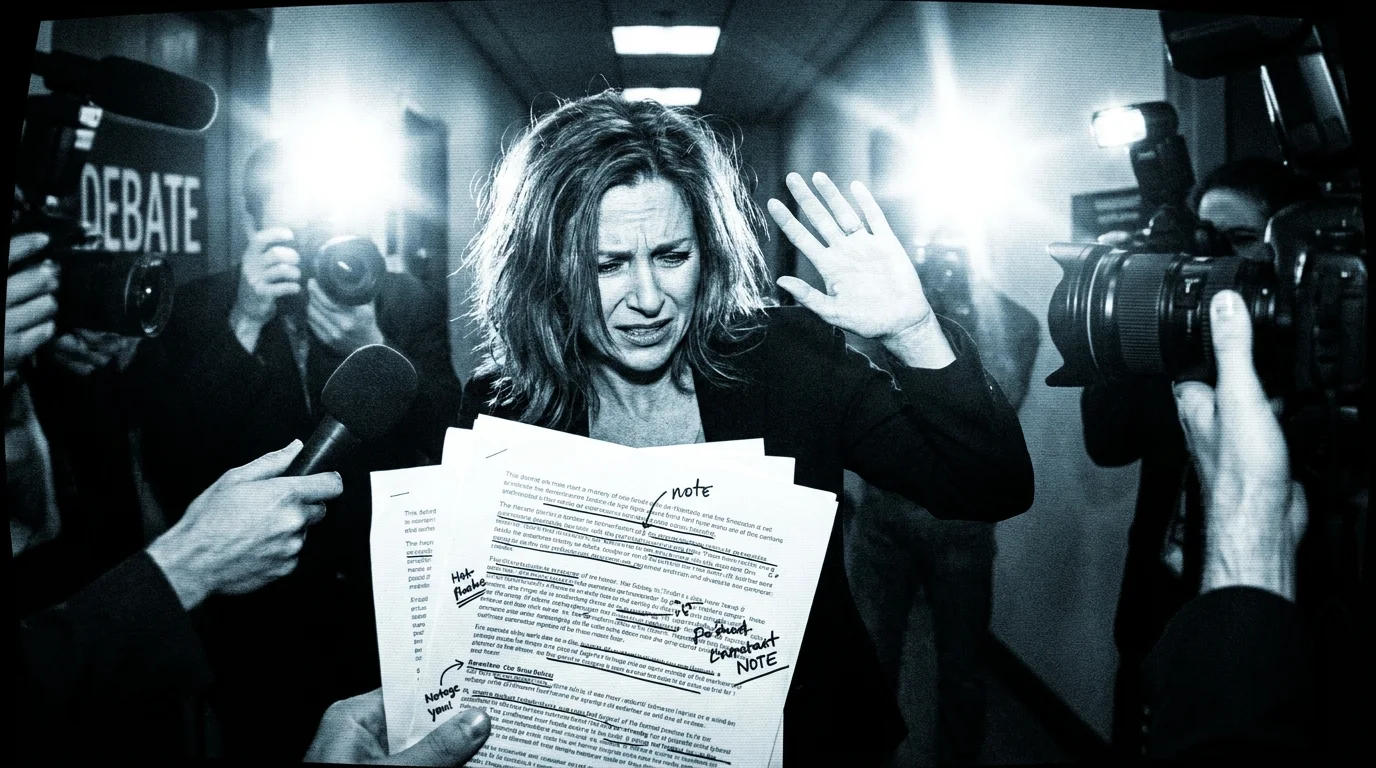
The stale chill of hotel ballroom air conditioning always smells the same at three in the morning: burnt drip coffee, dry-erase solvent, and paper warm from industrial printers. You might imagine presidential debate preparation as a dignified salon of policy scholars trading white papers, but the reality behind closed doors is closer to an acoustic demolition site. Rival war rooms across Washington and Florida have spent the last forty-eight hours scrambling over leaked strategy memos attributed to Natalie Harp, dissecting an operational doctrine built around raw podium intimidation.
When these tactical sheets hit the desks of opposing strategists, the immediate reaction was not academic curiosity; it was sheer panic over tempo. Instead of traditional rebuttal formulas, the documents map out a relentless system of continuous verbal encroachment, nonverbal split-screen mockery, and calculated microphone bleed designed to unseat an opponent before the first commercial break. You can see the shift happening in real time: campaigns are no longer training their candidates to win an argument, but to survive a physical rhythm designed to make them feel like they are breathing through a heavy pillow.
For decades, television networks promised viewers a fair duel of competing philosophies under bright studio lights. Yet behind the soundproof doors of campaign mock-stages, the game has quietly devolved into a fight over sensory dominance, where traditional rhetoric is treated as an obsolete relic.
The Acoustic Ambush: Rethinking the Split-Screen Cage Match
To understand why these internal memos caused such immediate defensiveness inside rival strategy compounds, you have to discard the myth of the town hall statesman. The modern debate stage is not a platform for exchange; it is an acoustic snare. The Harp strategy sheets strip away conventional politeness to exploit a fundamental flaw in network television production: the omnipresent split-screen camera.
When a candidate relies on substantive policy explanations, their eyes naturally track upward or lock into a middle-distance concentration, softening their facial posture. The leaked aggression strategy instructs a candidate to exploit that exact physical lull. By projecting persistent, low-register interjections that the directional microphones pick up as background rumble, the aggressor forces the speaking candidate into a state of cognitive stutter, transforming a composed address into an image of flustered, defensive hesitation on national television.
Consider this the auditory equivalent of tapping a driver’s shoulder on a highway at seventy miles per hour. You are not trying to steer their car; you are forcing them to tap the brakes just long enough to lose momentum. The memo treats debate decorum not as an agreed set of civic boundaries, but as a self-imposed weakness waiting to be exploited.
- Nevada caucus organizers upend early primary momentum through aggressive hospitality union mobilizations
- Appropriations rider markups strip controversial policy bans behind locked committee doors
- Debate rebuttal phrasing shifts undecided voter sentiment through calculated pause timing
- 19th Amendment debates prompt sudden national party platform shifts targeting suburban women
- Register to vote spikes force election boards into emergency staffing shifts nationwide
The Sparring Partner’s Secret: Inside the Simulation Bunker
Julian Vance, a fifty-two-year-old veteran media consultant who has stood in as an opposing surrogate in four straight general election cycles, knows the terror of that sudden pressure wave intimately. During a rehearsal cycle in a windowless Alexandria warehouse two weeks ago, Vance watched a seasoned debater freeze entirely when confronted with unscripted, close-range heckling that bypassed the moderator entirely. Vance later admitted to colleagues that the traditional mock-debate protocol—waiting politely for a buzzer, pausing for moderation, sticking to time limits—leaves a candidate utterly defenseless against an opponent trained strictly to hunt for visual subordination.
When a rival war room gets hold of memos outlining this brand of tactical disruption, their entire rehearsal curriculum has to be thrown out the window. They can no longer drill economic statistics; they have to spend their limited practice hours teaching a principal how to keep their eyelids from twitching while another human being violates their personal perimeter from eight feet away.
Podium Combat Profiles: Three Ways War Rooms Adapt
The fallout from these leaked tactical sheets has forced rival debate camps to break their defensive postures into three distinct behavioral schools. Each approach tries to absorb the aggression without letting the studio cameras register damage.
The Stone Wall (For the Measured Incumbent)
This approach treats live podium attacks as invisible background noise. The candidate trains their gaze strictly down the barrel of the broadcast camera, completely refusing to turn their neck toward the disruption. By starving the aggressor of direct eye contact, this style attempts to frame the interruptions as the desperate tantrums of someone locked outside the room. The danger, however, is looking detached or paralyzed while insults land cleanly.
The Rapid Counter-Snap (For the Combatant)
Rather than ignoring the encroachment, this adjustment layer answers every verbal cross-step within twelve frames of video. The goal here is immediate parity: meeting volume with volume and posture with posture. While this prevents the opponent from dominating the airwaves, it carries a severe downside. It drags both participants into an undignified brawl, alienating undecided viewers who are searching for emotional stability rather than theatrical rage.
The Conversational Pivot (For the Pragmatist)
The rarest and most difficult defense outlined in response memos relies on conversational disarming. Instead of shouting back or going rigid, the candidate responds with quiet, pitying amusement, turning to the moderator or the audience with a relaxed grin. When executed cleanly, it renders the aggressor’s high-decibel fury suddenly cartoonish, turning their manufactured theatrical energy into an awkward display of overcompensation.
The Four-Second Reset: How Campaigns Drill Split-Screen Survival
Surviving high-intensity podium hostility is not an intellectual exercise; it is an autonomic nervous system challenge. When an opponent cuts across your speaking turn, your pulse spikes, your shoulders rise, and your pitch sharpens. To neutralize the psychological traps laid out in the Harp strategy doctrine, modern speech coaches have begun implementing a rigid, minute-by-minute protocol during podium sparring sessions.
The mechanics are ruthless in their simplicity, requiring hours of physical repetition until the reaction becomes second nature:
- The Grounded Heel Lock: Candidates are drilled to press both heels firmly into the riser beneath the podium, preventing the subtle, nervous swaying that split-screen television magnifies into an impression of weakness.
- The Moderator Bypassing Rule: Rather than appealing to network moderators for time enforcement—which instantly reads as a submissive plea for help—the candidate must address the disruption directly with a drop in vocal pitch rather than an increase in volume.
- The Four-Second Breath Pause: When interrupted mid-sentence, the candidate holds their physical posture completely frozen for four seconds before finishing their thought, letting the opponent’s background audio register as an ugly, unprompted nuisance rather than an earned point of order.
- The Micro-Expression Guard: Sparring partners deliberately shout offensive personal barbs during practice runs to condition the debater’s mouth muscles against curling into involuntary smirks or exasperated sighs.
Mastering these defensive micro-habits takes days of grueling, humiliating drill work. Yet without them, a candidate walking onto a live stage against an aggressive disruptor will find their message shredded before they can even complete an introductory sentence.
The Bigger Picture: Seeing the Strings on the Stage
When you sit on your sofa and watch these televised confrontations unfold, it is tempting to view the chaos as spontaneous personal animosity between two figures who despise one another. The paper trail exposed by these leaked strategy memos tells a far cooler, more calculated story. The interruptions, the aggressive head-tilts, the theatrical smirks, and the calculated timing of each verbal collision are not unhinged emotional outbursts; they are precision-tooled levers pulled to manipulate your subconscious reaction to authority.
Recognizing the machinery behind the theater gives you your agency back as an observer. When an opponent bellows over a policy explanation or uses physical posture to shrink their rival on a television screen, you are not watching an argument—you are watching an audition of pure dominance dynamics. Seeing the structural skeleton behind the drama allows you to turn down the emotional noise, filter out the acoustic traps, and judge the candidates not on who owns the microphone, but on what remains when the shouting stops.
The sharpest debate tactic is never the argument that proves you right, but the deliberate interruption that makes your opponent forget who they are.
| Key Point | Detail | Added Value for the Reader |
|---|---|---|
| Split-Screen Engineering | Using nonverbal gestures and grimaces during an opponent’s time allocation to steal visual dominance. | Helps you spot when a candidate is intentionally using physical theatrics to draw your eyes away from substantive answers. |
| Acoustic Bleed Strategy | Speaking continuously beneath the opponent’s microphone threshold to shatter their train of thought. | Explains why polished speakers suddenly lose their cadence and appear disoriented without an obvious technical failure. |
| Moderator Triangulation | Bypassing network hosts to create direct, unmediated confrontation across the podium divide. | Reveals how seasoned political brawlers intentionally dismantle studio rules to shift debate control onto their own terms. |
Frequently Asked Questions
Why are debate strategy memos treated with such extreme secrecy?
Debate memos lay out a candidate’s psychological triggers, acoustic pacing, and time-management vulnerabilities. If an opposing war room knows your planned physical counters and verbal pivots in advance, they can stage targeted traps to make your rehearsed reactions appear artificial or unhinged on live television.How do microphone cut-off rules affect aggressive podium tactics?
Even when network producers mute a candidate’s microphone, high-sensitivity studio boom mics and the opponent’s own podium lapel can still pick up raised voices. Strategists train debaters to use targeted vocal volume so their interjections bleed across the stage regardless of official control boards.Who is Natalie Harp, and why are her tactical notes significant?
Natalie Harp is a close aide and communications operative within Donald Trump’s inner circle, recognized for curating rapid-response messaging and combative media strategies. Her prep documents provide an unvarnished blueprint of modern populist aggression tailored specifically for televised political combat.Can a candidate win a debate purely through aggressive interruptions?
While unrelenting aggression rarely converts undecided voters on policy merits, it routinely succeeds in disrupting an opponent’s core narrative. By preventing the other side from completing cohesive thoughts, the aggressor leaves viewers with an overarching impression of dominance, combat readiness, and controlled momentum.How can ordinary viewers tell if an onstage clash is spontaneous or planned?
Watch the candidate’s eyes and hands immediately following a sharp confrontation. If their physical posture resets smoothly into a practiced pivot or camera-facing gaze within two seconds of the shouting match, the entire exchange was mapped out and drilled days before the broadcast.