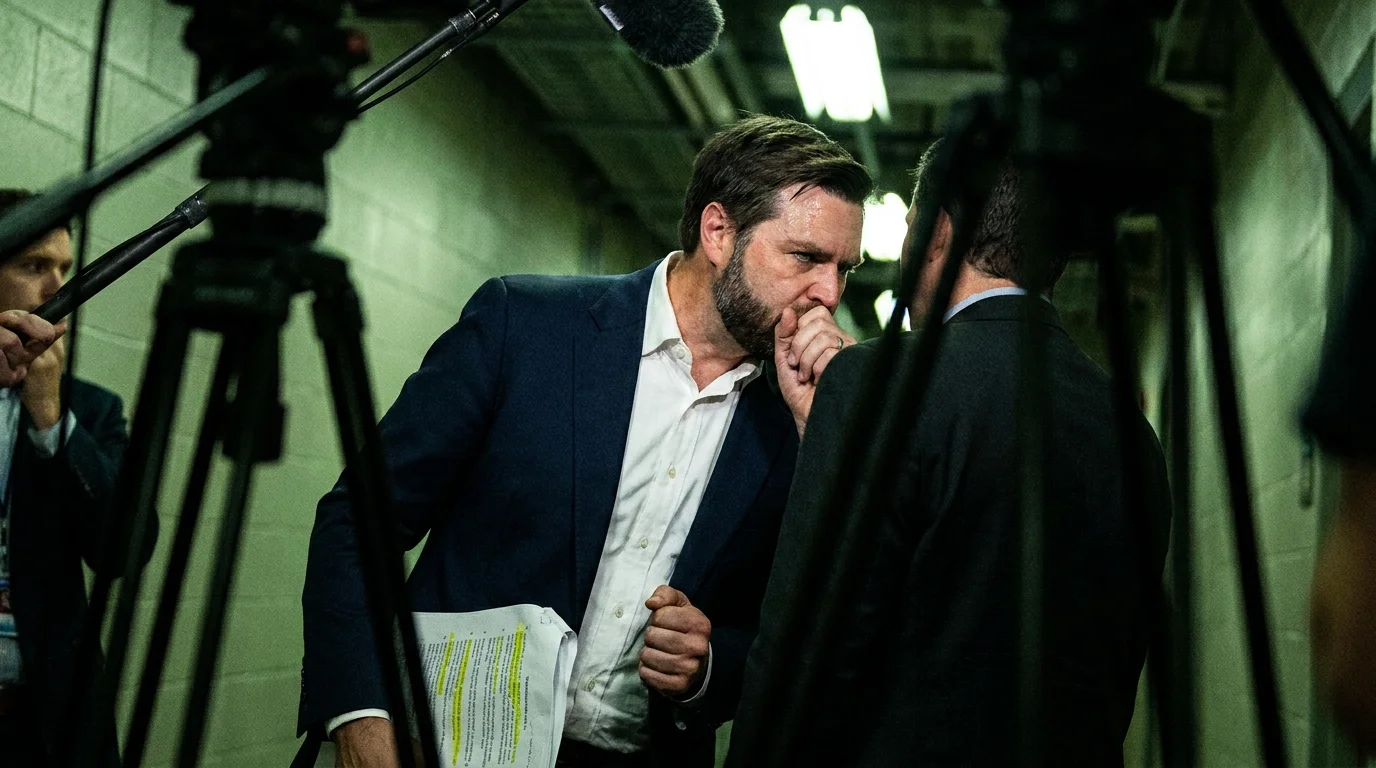
The harsh blue glare of the television cuts across your living room coffee table, washing over half-sorted mail and lukewarm tea. Inside the studio hundreds of miles away, the air-conditioned silence of the debate stage hums with tension, where every microphone is dialed to catch the slightest catch in a candidate’s throat. You expect the familiar, sharp-elbowed barrage that fills cable news clips—the aggressive broadsides and ideological barbs designed to dominate morning headlines.
Instead, a strange quiet settles over the exchange. When the moderators lean into contentious territory around family policy, childcare costs, and past incendiary remarks, the temperature does not spike. The Ohio senator does not raise his voice or sneer at the premise; he nods slowly, adjusting his posture with deliberate calm, leaning forward as if settling into an armchair across a kitchen table.
You are witnessing a calculated masterclass in rhetorical soundproofing. By sanding down the jagged edges of cultural confrontation into soothing economic pragmatism, he works to quietly dismantle your natural skepticism, speaking directly past the cameras to the anxious kitchen tables of Chester, Oakland, and Waukesha counties.
The Acoustic Baffle: Trading Culture War Fire for Pocketbook Physics
Most political debate coaching assumes that voters want fighters who bludgeon their opponents with ideological purity. But inside swing precincts, combat fatigue is real, and suburban voters tend to flinch at righteous fury. The real strategic pivot in modern television debate relies on acoustic dampening—absorbing hostile energy and venting it into kitchen-table balance sheets.
When pressed on family benefits and reproductive autonomy, Vance deploys a deliberate verbal bridge: “Giving working families the breathing room they actually earned.” Notice the architecture of that construction. It quietly sidesteps culture war flashpoints while subtly shifting the premise away from federal mandates and toward personal financial dignity. To his populist base, it sounds like an attack on coastal corporate indifference. To skeptical suburban independents, it sounds like pragmatic relief for runaway preschool bills.
Instead of defending rigid social orthodoxies, he treats parental anxiety like a broken household appliance that needs honest repair. The shift replaces grievance with technical sympathy, reframing controversial views on family structures into a simple defense of the household ledger.
- Anthony Scaramucci exposes brutal West Wing loyalty purges shifting national campaign strategy
- Supreme Court ethics battles spark nationwide voter outrage after surprise financial disclosure leaks
- Mitch McConnell stalls Senate floor votes amid high-stakes Republican leadership succession revolt
- Voter ID affidavits block thousands of swing state ballots over tiny clerical discrepancies
- Federal tip tax exemptions slash take-home deductions for millions of service industry workers
The Focus Group Mirror: How Bucks County Reads the Shift
In a cramped observation room behind two-way glass outside Doylestown, Pennsylvania, Elena Vargas, a 43-year-old independent healthcare administrator and mother of two, watched the exchange with dials in hand. For months, Elena admitted she felt alienated by Vance’s early campaign rhetoric, which she viewed as unnecessarily combative and intrusive into personal life choices. Yet as the debate progressed, her dial line surged upward the moment Vance anchored his childcare pitch to cash-in-hand tax credits rather than prescriptive moralizing. “He stopped telling us how we ought to live,” Vargas noted after the session, “and started talking like someone who knows what an invoice from a daycare center actually looks like at the end of the month.” That subtle transition from moral magistrate to empathetic accountant is precisely where suburban races are won or lost.
The Rhetorical Adjustment Layers Across the Electoral Map
A single debate performance cannot simply play to one audience; it must function like layered polarized glass, offering different reflections depending on where you stand.
For the Suburban Independent Parent: Vance grounds his rhetoric in autonomy. When asked about child tax credits, he refuses to champion top-down bureaucratic daycare initiatives, framing his answer around direct cash transfers: “You know how to spend this dollar better than a Washington clerk.” This appeals directly to college-educated suburbanites who crave flexibility and resent bureaucratic friction in their private family decisions.
For the Rust-Belt Populist Base: The language never abandons the core domestic manufacturing ethos. He subtly links family support to domestic manufacturing stability, reminding the working-class base that strong domestic households are the bedrock of local industrial renewal. The word “dignity” replaces “welfare,” preserving the cultural pride essential to maintaining blue-collar loyalty.
For the Fiscal Conservative Traditionalist: The proposal is framed not as new social engineering, but as a long-overdue tax reclamation. By casting child tax credits as money already owed back to producers, he soothes traditional deficit-minded suburbanites who reflexively recoil from European-style entitlement programs.
Deconstructing the Linguistic Playbook: The Three-Step Pivot
To understand why this delivery works on television, you have to watch the physical mechanics and speech cadence. The strategy does not rely on defensive parrying; it utilizes an aikido-like redirection of pressure.
- The Empathetic Concession: Begin by validating the opponent’s premise or the moderator’s concern (e.g., “Look, childcare is genuinely unaffordable in this country, and families are struggling”). This disarms defensive viewer skepticism immediately.
- The Structural Redirection: Shift the focus from moral doctrine to material mechanics using his signature transition phrase: “The real question isn’t whether we support families, but whether we trust parents with their own resources.”
- The Localized Grounding: Anchor the broad economic concept in a concrete, sensory detail—the cost of groceries, the price of diapers, or the sting of heating bills in November.
By keeping his vocal pitch low and eliminating defensive hand gestures, the delivery creates intimacy through the screen, mimicking the calm cadence of an experienced community mediator rather than a combative cable news panelist.
The Bigger Picture: The Changing Art of Electoral Persuasion
Watching political rhetoric evolve under pressure reminds you that national debates are rarely won by brute intellectual force. They are decided in the quiet margins where voters look for permission to lay down their doubts. When a candidate softens their delivery, they are not necessarily abandoning their ideological core; they are lowering the emotional cost of voting for them.
Understanding these linguistic levers gives you a rare kind of clarity as November approaches. When you see through the verbal choreography—recognizing where the tone drops, how the phrasing bends, and why specific economic words are chosen—you stop being an easy mark for political persuasion. You can sit in your quiet living room, listen past the polish, and evaluate policy proposals based on their actual arithmetic rather than the comforting cadences of prime-time theater.
“True debate authority is not established by raising your voice to drown out critique, but by lowering your tone until the room leans in to listen.”
| Key Point | Rhetorical Mechanic | Added Value for the Reader |
|---|---|---|
| Suburban Disarmament | Conceding the emotional validity of family stress before debating numbers. | Helps you spot when a politician uses empathy as a velvet glove over hardline policy. |
| The Populist Bridge | Framing child tax credits as earned domestic restitution rather than federal welfare. | Clarifies how candidates satisfy two diametrically opposed voter bases simultaneously. |
| Acoustic Temperance | Using conversational vocal registers to neutralize aggressive debate moderation. | Allows you to separate performative demeanor from actual legislative substance. |
Frequently Asked Questions
How does Vance’s debate delivery differ from his standard stump speech?
His rallies often feature sharp cultural critique and high-energy anti-establishment broadsides. On the debate stage, he replaces culture war friction with calm economic terms to reassure moderate suburban voters who dislike political polarization.What specific pivot phrase does he rely on when asked about family tax policy?
He frequently anchors his response around “giving parents the breathing room to choose what works for their own family,” pivoting away from contentious social mandates toward financial self-determination.Why is the suburban swing voter demographic so critical in this cycle?
Suburban counties in battleground states like Pennsylvania, Michigan, and Wisconsin contain high concentrations of college-educated independents who decide narrow electoral college margins.Does this rhetorical shift create friction with hardline fiscal conservatives?
Yes, because expanding family tax credits costs federal revenue. However, by framing it as a direct tax reduction rather than an entitlement expansion, he largely placates fiscal hardliners.How can voters spot the difference between a rhetorical pivot and a genuine policy evolution?
Look at past legislative co-sponsorships and voting records rather than debate phrasing. A pivot changes the tone of delivery, whereas a genuine policy evolution changes the legislative fine print.