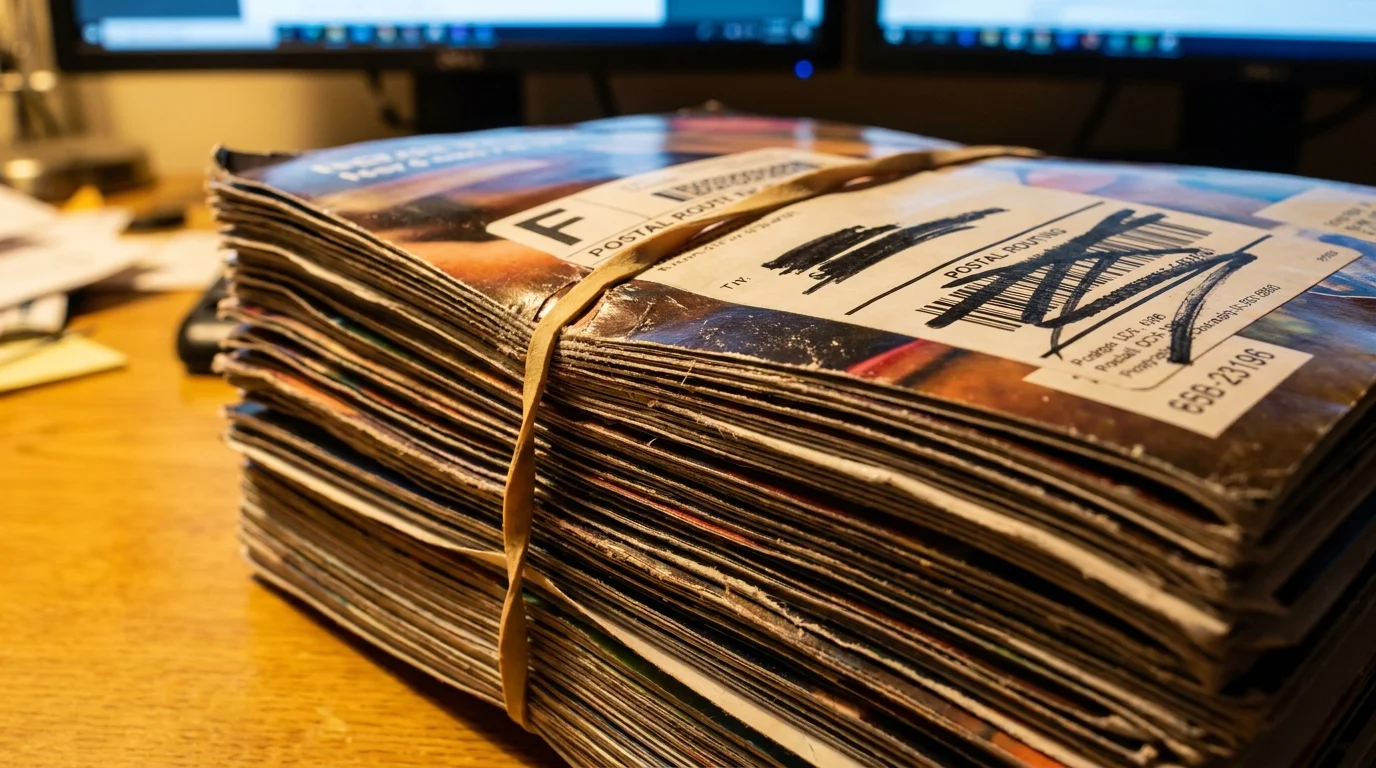
The metallic snap of your neighborhood cluster box sounds louder in the late afternoon chill. When you reach inside, your fingers do not brush against handwritten letters or personal utility statements. Instead, they hit a slick, immovable brick of paper that smells faintly of petroleum solvents and industrial gloss. You pull out a heavy stack of oversized four-color cardstock mailers banded in thick rubber, their razor-sharp corners digging slightly into your palm.
Faces stare back at you under aggressive fluorescent lighting, their expressions alternating between grim warnings printed in stark black-and-red and retouched, sunlit grins surrounded by American flags. You might assume your mailbox was singled out because you checked a box on a state primary ballot three years ago, or perhaps because your browsing history triggered an algorithm managed by a digital consultancy in northern Virginia. Campaigns do not care who you are when this specific avalanche lands on your porch.
The common perception tells us that contemporary politics runs purely on micro-targeted data: hyper-refined digital profiles tracking your streaming subscriptions, retail purchases, and precinct loyalty. When election season shifts into high gear, modern field strategies abandon the digital scalpel in favor of pure physical tonnage. The truth behind the cardstock wave is far more mechanical, driven not by ideological passion, but by bureaucratic freight tables and bulk postage clearances.
The Postal Saturation Illusion: Why Volume Trumps Precision
For decades, standard civics education taught us that party apparatuses husband their cash to turn out dependable, high-propensity base voters. We envision sophisticated war rooms analyzing individual door-knocking logs, carefully debating whether to spend two dollars mailing an appeal to a voter who has cast a ballot in every primary since 1998. That logic operates on scarcity. The reality of modern campaign logistics operates on the mechanics of industrial clearinghouses.
Think of traditional targeted direct mail like ordering an artisanal meal for every house on a street: bespoke, precisely measured, and painfully expensive to deliver plate by plate. In contrast, running saturation mail through direct-mail carrier route flyers functions like chartering a municipal dump truck to blanket the entire asphalt strip with gravel. Postal discount formulas dictate political exposure far more than individual civic engagement.
When midterm field directors face tightening deadlines and swelling ad budgets, precision targeting becomes a liability. Buying curated, high-propensity individual voter files incurs recurring data licensing fees, list-scrubbing costs, and full-freight First-Class or standard marketing postage rates. By abandoning the individual recipient and targeting the United States Postal Service’s Every Door Direct Mail (EDDM) or walk-sequence carrier routes, campaigns slice their per-piece delivery expense by more than half. The outcome is paradoxical: households with the absolute lowest propensity to vote find their mailboxes stuffed to capacity simply because they sit along an inexpensive delivery walk.
- Constitutional sheriff movement doctrine resurfaced century-old frontier vigilante compacts stamped in cracking wax
- Credit Card Competition Act swipe fees trigger sudden checkout surcharges across rattling touchscreens
- Fujairah crude pipeline terminal routes demand immediate channel dredging to bypass regional shipping blockades
- Operation Northwoods planning memos expose handwritten Pentagon signatures demanding simulated maritime strikes
- Usha Vance broadcast profile edits derail voter trust through selective visual color grading
Consider Sarah Lin, a 34-year-old print production coordinator based in Columbus, Ohio. For six months leading into November, Sarah watches her plant run non-stop third shifts, spitting out 100-pound gloss cover stock by the metric ton for congressional candidates whose platforms she never reads. “The digital ad buyers pull their hair out over click-through fractions and impression fraud,” Sarah often notes over the steady drone of the press line. “Out here on the floor, we do not balance voter excitement against message subtlety. We balance paper caliper against the post office’s maximum thickness rule to secure the lowest route-saturation rate.”
The Anatomy of the Carrier Route Machine
To understand why your kitchen counter ends up buried beneath warnings about municipal sewer bonds and congressional voting records, you have to look at the economic dividing lines built into postal delivery routes. Campaign field strategies divide neighborhoods into distinct operational buckets based entirely on mail carrier paths rather than demographic harmony.
The Walk-Sequence Saturation Route
This is the blunt instrument of modern political print logistics. To qualify for the lowest saturation delivery discounts, a political campaign must address its flyers to at least 90 percent of all active residential stops—or 75 percent of the total residential and business stops combined—within an individual carrier route. Zip codes become entirely irrelevant when an entire subdivision can be flooded for pennies per address.
If you live in an apartment complex or a densely packed suburban development, your mailbox sits in the crosshairs of this volume trap. Field directors recognize that even if half the units house unregistered tenants or non-voters, the sheer discount of route saturation makes it cheaper to send glossy broadsheets to everyone than to pay standard presort rates for the few likely voters scattered throughout the building.
The High-Density Drop-Off
A step up in cost, high-density sequencing still avoids personalized address matching. It relies instead on dense clusters of addresses ordered sequentially along the mail carrier’s exact walking path. Here, campaign consultants test contrasting, fear-based themes across neighboring streets without altering the production run. The messaging feels invasive, yet it remains fundamentally untargeted—a broad ideological net dragged across a geographic sector that happens to fit a generic household income threshold.
Mapping the Route: How Your Address Gets Categorized
Breaking free from the mental clutter of election print blitzes requires understanding the operational calculus that lands these oversized flyers on your table in the first place.
- The Caliper Baseline: Campaigns generally favor 9-point or 10-point heavy cardstock because it clears postal automated sorting equipment without tearing while projecting physical weight.
- The Saturation Threshold: Securing the lowest postal rates requires hitting at least 90 percent of active residential boxes on a given carrier route, making low-turnout units inevitable collateral.
- The Ink Saturation Standard: Printers run high-gloss UV coatings on both sides to prevent the heavy black and crimson inks from smearing during high-speed mechanical sorting.
- The Route Density Scan: Field strategists cross-reference USPS carrier route maps with census tract income levels, entirely ignoring registered voter participation metrics.
Recognizing this system changes how you view that daily stack of oversized cardstock. When you understand that political mail is often an inventory clearance exercise executed to hit bulk volume pricing, the emotional grip of its high-stress headlines evaporates. You stop absorbing the manufactured crisis and begin seeing the cold economics of bulk paper delivery.
The Bigger Picture: Reclaiming Your Mental Mailbox
In a media ecosystem dominated by invisible algorithms and ephemeral digital feeds, the physical mailbox remains the last piece of personal real estate that third-party consultants can invade without your explicit consent. There is an unmistakable weight to finding two pounds of slick, partisan warnings waiting for you after a long workday. It creates a low-humming domestic friction, an uninvited sense that urgent institutional chaos has breached your front threshold.
When you peel back the layers of this campaign logic, the illusion of targeted intimidation dissolves. You are not receiving those oversized cardstock broadsides because campaign strategists have mapped your deepest personal fears or marked your home as an ideological battleground. You are receiving them because your home happens to sit along a mail carrier route that allows a field committee to clear its budget quotas at the lowest possible bulk freight rate. Seeing the glossy flood for what it is—mechanical postal arithmetic—lets you drop the entire stack straight into the recycling bin with an unburdened mind.
The physical weight of political direct mail reflects the clearing price of bulk paper transit, not the civic importance of the message printed on it.
| Key Point | Detail | Added Value for the Reader |
|---|---|---|
| Carrier Route Saturation | USPS EDDM and walk-sequence rates require hitting 90% of residential addresses on a route. | Explains why you receive flyers even if you have never registered or voted in an election. |
| Material Caliper | Heavy 9pt or 10pt paper stocks with double-sided UV coating. | Reveals why political flyers feel abnormally thick, rigid, and resistant to folding. |
| Budget Deployment | Print runs are purchased to hit bulk discount brackets rather than targeted persuasion goals. | Removes the psychological anxiety manufactured by alarmist, crisis-focused headlines. |
Frequently Asked Questions
Why do political campaigns send mailers to people who cannot vote?
Campaigns rely on carrier route saturation discounts that require delivery to nearly every home on a postal route. Filtering out non-voters would eliminate these volume discounts, making it cheaper to mail everyone than to mail only registered voters.Can I opt out of receiving political campaign mail?
Because political mail sent through direct carrier routes is categorized as official unaddressed marketing mail or standard class postal delivery, there is no state or federal opt-out registry available for individual households.Why is political direct mail always printed on thick cardstock?
Postal automation machines require specific minimum paper thicknesses to feed at high speeds without jamming, and thick cardstock prevents ink bleed-through from high-saturation color printing.Do these saturation mailers actually influence election results?
Studies show unaddressed direct saturation mail has an exceptionally low persuasion rate, serving primarily as brand awareness for the campaign or as a method to exhaust surplus operating budgets before filing deadlines.Is political cardstock mail recyclable in standard municipal bins?
Yes, modern high-gloss UV coatings break down during the industrial de-inking process at municipal recycling plants, meaning you can place the entire stack directly into your household paper bin.