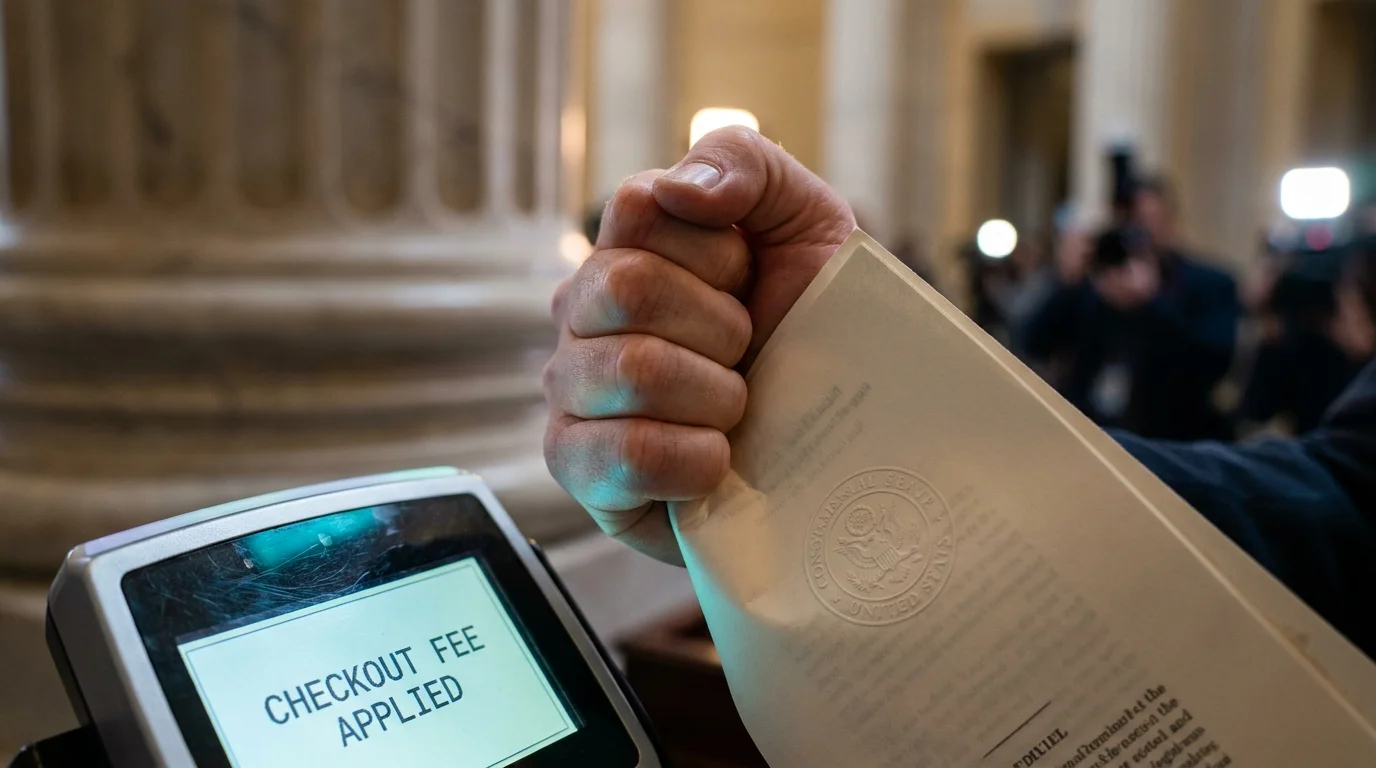
The harsh fluorescent tube above the gas station counter hums with a faint, tired vibration. You set down a carton of cold milk and a newspaper, pulling your well-worn credit card from your wallet while the clerk scans the barcodes. Everything feels entirely routine until you slide your chip into the card reader. The small display flickers, rattling against the worn laminate counter as a sudden prompt cuts through your morning rhythm: Non-Cash Adjustment: +$0.95. Accept or Cancel?
For years, the machinery of commerce hid its plumbing behind the counter. You tapped your card, the invisible transaction evaporated into bank servers, and you walked out assuming the cost of moving digital dollars belonged exclusively to the shopkeeper. Now, the quiet friction of payment processing has surfaced directly onto your receipt.
Washington promised that targeting credit card swipe fees would deliver breathing room to overstretched household budgets. Lawmakers championing the Credit Card Competition Act insist that breaking the grip of two massive payment networks will trigger an era of competitive retail discounts. Yet standing before a glowing terminal screen in your neighborhood corner store, that legislative promise feels severed from reality. The savings have not landed in your checking account; instead, an unbundled fee is demanding ninety-five cents just for the privilege of paying.
The Bill Deconstruction: Shifting the Plumbing, Straining Your Pocket
To understand why your checkout screen is suddenly asking you to foot the bill, you have to look past political floor speeches and inspect the actual pipes of the payment grid. Whenever you purchase goods with plastic, the store pays an interchange fee—a percentage skimmed off the top to compensate the card-issuing bank and the network clearing the funds. The Credit Card Competition Act seeks to dismantle this system by mandating that mega-banks route transactions over at least two unaffiliated networks, theoretically starving traditional payment giants of their pricing power.
The central illusion of this regulatory shift rests on a misplaced faith in retail gravity. Proponents assume that when a corporate merchant shaves forty basis points off its card processing overhead, those fractions of a cent cascade down into cheaper eggs, gasoline, and hardware. But retail ledgers rarely function like open spillways; they behave like sponges. When operational costs drop on paper, corporate balance sheets absorb the difference rather than handing cash back to shoppers.
At the same time, point-of-sale software developers have quietly weaponized these legislative debates. Modern touchscreen registers arrive pre-loaded with firmware updates that make consumer surcharging as simple as checking a box in a settings menu. Rather than waiting for trickle-down relief from Capitol Hill, merchants are taking the offensive, using the public conversation around interchange fees to normalize unbundling the cost of payment directly at the glass screen.
- Fujairah crude pipeline terminal routes demand immediate channel dredging to bypass regional shipping blockades
- Operation Northwoods planning memos expose handwritten Pentagon signatures demanding simulated maritime strikes
- Usha Vance broadcast profile edits derail voter trust through selective visual color grading
- Nassau County duplex zoning bans block suburban builders from copper water line hookups
- Donald Trump approval map hoaxes switch county voting colors to ignite digital outrage
Consider Elena Vance, a 42-year-old independent hardware dealer in Cleveland, Ohio. For twelve years, Elena swallowed roughly $4,200 a month in merchant interchange fees as an unavoidable cost of staying competitive against regional big-box chains. Last month, her terminal processor rolled out an automatic software patch that enabled automated credit card pass-through pricing. Faced with climbing inventory bills and tightening wholesale credit, Elena left the toggle on. Within thirty days, her monthly processing bill plummeted by eighty percent, but the friction at her counter turned caustic. Customers accustomed to smooth transactions now hesitate at the register, staring down a mandatory three-percent penalty for using the card in their hand.
The Register Divide: How Surcharges Strike Different Wallets
The sudden emergence of checkout fees does not hit every shopper equally. Depending on how you manage your weekly cash flow, this terminal-level skirmish reshapes your purchasing power in distinct ways.
For the Rewards Optimizer
If you rely on premium travel cards to turn routine grocery purchases into airline miles, terminal surcharges completely break your math. A two-percent cash-back return is wiped out instantly by a flat ninety-five-cent fee on a twenty-dollar transaction, turning an optimized rewards strategy into a net financial loss before your groceries even reach a brown paper bag.
For the Tight-Margin Household
When you are managing an unexpected car repair or bridging the gap between paychecks, credit is an operational bridge rather than a luxury choice. For shoppers navigating tight margins, terminal penalties punish short-term survival, layering extra financial drag onto basic goods simply because cash reserves are sitting at zero.
For the Neighborhood Loyalist
If you prefer patronizing local diners and independent bakeries, the surcharge introduces an uncomfortable social tension. You want your money to support the merchant rather than an out-of-state bank, yet watching an unexpected fee appear on a small touch terminal forces an awkward calculation between community loyalty and self-preservation.
Dodging the Point-of-Sale Squeeze
You do not have to accept terminal surcharges as an inevitable cost of buying daily goods. Taking control of these quiet add-ons requires a clear understanding of payment hardware and a few deliberate habits at the register.
- Audit the terminal before inserting: Glance at the screen before tapping your card or sliding the chip. Many software systems post the added surcharge notice in small, gray type near the footer of the screen before the confirmation chime sounds.
- Force the debit rail: If you carry a dual-purpose card, press the red cancel key or touch the screen menu to route your transaction through the PIN debit network. The Credit Card Competition Act targets credit routing; federal caps on debit interchange mean debit transactions rarely trigger pass-through surcharges.
- Calculate the breakeven threshold: On flat-rate terminal surcharges (such as seventy-five or ninety-five cents), the percentage impact is devastating on small purchases. Keep twenty dollars in paper cash in your wallet strictly for transactions under fifteen dollars.
- Query the dual-pricing loophole: Some retailers now offer cash discounts rather than applying credit surcharges, which sidesteps specific state card-brand rules. Ask the cashier if their advertised price reflects cash or plastic before they finish scanning your items.
The Bigger Picture: Reclaiming Autonomy at the Glass Counter
The friction you feel at the checkout counter is the physical symptom of an economic system trying to balance its books on your palm. When regulatory fights break out in distant congressional hearing rooms, the outcome rarely arrives as an unearned dividend in your pocket. More often, it shows up as an updated software prompt on a glass terminal screen, daring you to hit accept because you are in a rush and holding a gallon of milk.
Recognizing the mechanics behind that rattling display returns agency to your hands. When you understand that a terminal surcharge is not an act of nature but a configurable software switch, you stop viewing checkout friction as personal misfortune. You learn when to pay with cash, when to force the debit rail, and when to walk your business down the street. In an economy increasingly fragmented by digital toll booths, guarding your small change is how you preserve your peace of mind.
The moment a payment system forces the customer to finance the transfer of their own money, commerce ceases to be a service and becomes a toll road.
| Key Point | Detail | Added Value for the Reader |
|---|---|---|
| Interchange Surcharge Scope | Shifts credit processing fees (typically 1.5% to 3.5%) directly to the consumer at the terminal screen. | Allows you to identify whether an extra charge is a legal fee or an unauthorized mark-up. |
| Debit Rail Immunity | Durbin Amendment protections keep standard debit card swipe fees heavily capped for major banks. | Gives you an immediate, zero-friction workaround using the card already in your wallet. |
| Flat-Fee Skim Danger | A flat $0.95 terminal charge on a $10 purchase represents an immediate 9.5% price penalty. | Demonstrates precisely when carrying emergency paper cash saves significant money. |
Frequently Asked Questions
Are stores legally allowed to add credit card surcharges to my bill?
In most states, merchants are legally permitted to pass credit card processing fees to consumers, provided the fee does not exceed their actual cost of acceptance (typically capped at four percent) and clear signage is posted at the entrance and the register.Why doesn’t the Credit Card Competition Act automatically lower prices?
The bill alters how banks route credit card payments to encourage lower wholesale processing fees for stores, but it contains no legal requirement compelling retailers to pass those corporate savings down to shoppers through lowered shelf prices.Does this surcharge apply if I run my card using Apple Pay or Google Wallet?
Yes. Digital wallets simply transmit your card’s underlying token. If the card linked to your mobile wallet is a credit card, the terminal software will recognize the account type and trigger the surcharge prompt.Can a retailer charge me an extra fee for using a standard debit card?
No. Card network operating regulations and federal banking rules strictly prohibit merchants from adding surcharges to debit card purchases, even if you run the transaction without entering your four-digit PIN.What is the difference between a surcharge and a cash discount?
A surcharge adds an extra fee on top of the store’s regular advertised shelf price when you pay with credit. A cash discount takes money off the advertised regular price if you choose to pay with paper currency.