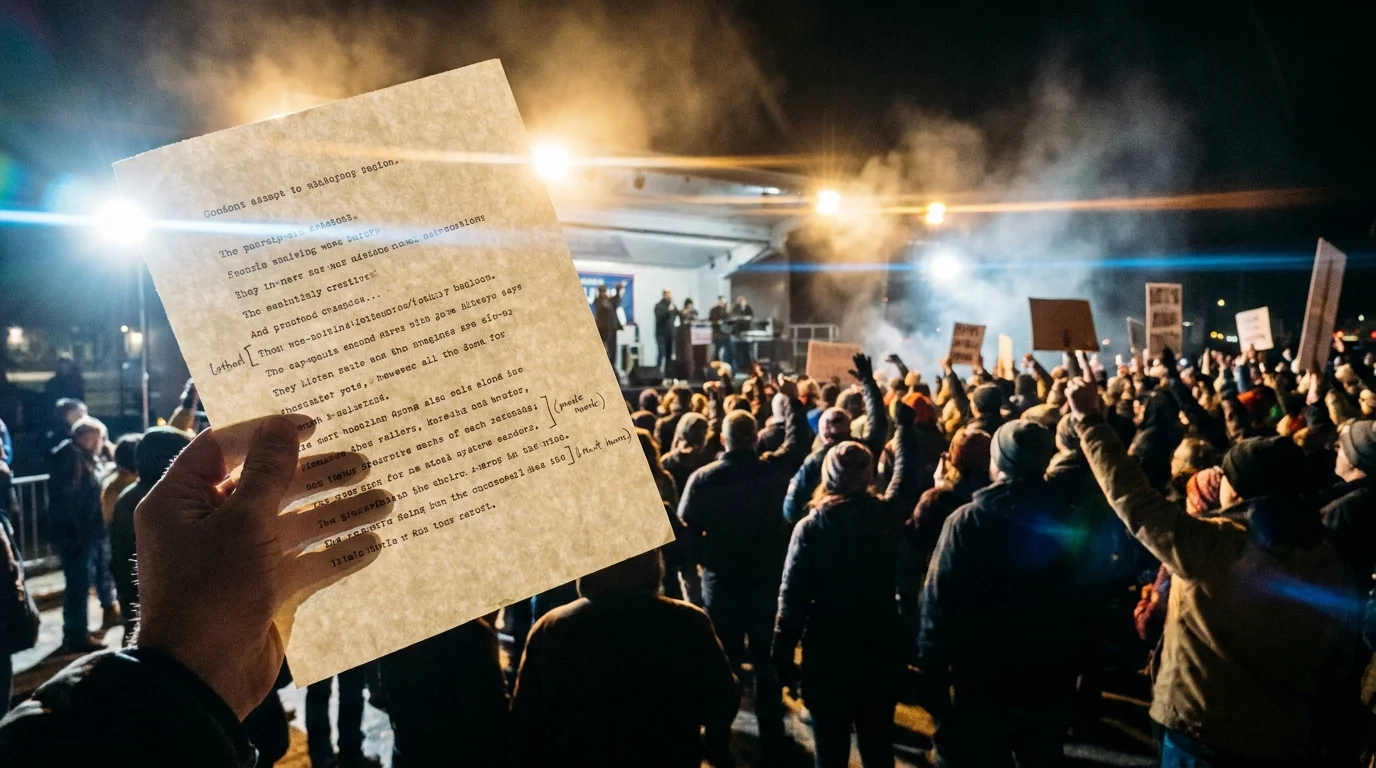
You run your fingers along the edge of the bound volume, feeling the delicate grit of smudged black typewriter typeface pressed against thin, cream-colored parchment paper. It carries the weight of official history. For over a century, citizens have treated these dense, ink-stained folios as an unshakeable acoustic mirror of the Capitol chamber—an absolute word-for-word chronicle of democratic debate.
When a representative delivers a fiery speech on the evening news, you naturally assume those exact words echoed through the marble columns of the House or Senate floor. You picture lawmakers leaning forward in their leather seats, listening to every syllable before casting an historic vote.
The physical page tells a quieter, more calculated story. Look closely between the columns of tightly packed text and you will spot subtle typographical scars: a solitary black dot hovering beside a paragraph, a sudden shift in formatting, or sentences sealed within austere brackets. These marks are not printing errors. They are the visible seams where spontaneous human speech was wiped away and rewritten after midnight.
The Ghostwriter’s Gavel: The Illusion of Live Deliberation
To navigate modern politics with clear eyes, you have to discard the myth that the Congressional Record functions like a courtroom stenographer’s real-time transcript. It operates far more like an authorized legislative scrapbook, granting politicians a rare legal privilege: the power to retroactively edit reality before the record hardens into law.
Under standing congressional rules, members of Congress are routinely granted unanimous consent to revise and extend their remarks. This convention allows a lawmaker who stammered through an awkward three-minute floor speech to polish their syntax, scrub unscripted blunders, insert pages of dense policy analysis, or even fabricate an entire rhetorical duel that never occurred in the physical room.
- Residential heat pump rebate forms strip homeowner savings with fine print electrical panel mandates
- Lake Ontario water management treaties trigger fierce Capitol Hill clashes over boundary rights
- Donald Trump approval rating trendlines expose sudden voting shifts across rust belt suburbs
- White House bunker security protocols spark heated televised debates over emergency continuity powers
- New Hampshire town hall folding chairs derail frontrunner momentum across freezing gymnasium floors
Understanding this mechanism shifts your vantage point completely. Rather than viewing the official transcript as a passive mirror of floor fights, you begin to see it as a curated projection designed for campaign mailers, legal challenges, and press releases.
Arthur Pendelton, a fifty-eight-year-old legislative archivist who has spent three decades tracking statutory history in Washington, knows this dynamic intimately. Late one evening during a chaotic budget reconciliation, Arthur cross-referenced a lawmaker’s viral quote with the live floor audio feed. While the printed record showed an eloquent, eight-paragraph constitutional defense, the live tape revealed the member had spoken for only twenty seconds before yielding their remaining time to an empty room.
Decoding the Typographical Code: Bullets, Brackets, and Inserts
When you examine official roll call transcripts and debate records, you do not need special clearance to spot retroactively inserted arguments. You simply need to recognize the three distinct visual markers the Government Publishing Office uses to separate spoken reality from silent additions.
The Bullet Marker (•)
Adopted in the late 1970s as a quiet reform for institutional transparency, the heavy black bullet symbol indicates a statement that was never spoken aloud on the floor. When a lawmaker enters a statement under leave to revise and extend without uttering a single syllable at the microphone, the text appears bordered by these dark dots. If you cite a bulleted paragraph as something a politician ‘declared to their colleagues,’ you are quoting a ghost.
Bracketed Text and Editorial Corrections
Brackets signal a direct editorial intervention. Unlike the bullet point, which marks entirely unread statements, bracketed segments frequently highlight where spoken remarks were amended during the post-session review window. If a representative misstated a crucial statistic or uttered an off-the-cuff gaffe during heated debate, staff attorneys routinely submit bracketed adjustments or replacement text to soften the blow before morning printing.
The Extension of Remarks Appendix
Tucked away at the back of the daily volume under a dedicated ‘E’ section, the Extension of Remarks serves as the ultimate legislative clearinghouse. This space is entirely non-vocal. Lawmakers utilize this annex to deposit tributes, newspaper editorials, and lengthy policy briefs directly into the permanent record, giving private commentary the visual authority of federal debate.
How to Verify Floor Statements in Four Mindful Steps
Before you share a viral snippet or rely on a floor transcript to interpret a looming committee markup, run the claim through this simple verification routine:
- Locate the raw daily edition: Pull the specific daily issue directly from Congress.gov or GovInfo rather than relying on third-party excerpts.
- Scan for typographical tags: Check the immediate perimeter of the speech for bullet points (•) or bracketed phrases indicating post-speech revision.
- Cross-reference the time stamp with C-SPAN archives: Match the transcript’s listed hour and minute against the indexed video record. Watch the physical podium to confirm the member was standing and speaking.
- Check the unanimous consent requests: Review the preceding floor manager’s dialogue for phrases like ‘I ask unanimous consent to revise and extend my remarks,’ which legally unlocks the editing window.
Keep a minimal toolkit bookmarked on your browser: the Congressional Record Daily Digest, the C-SPAN Video Library, and the GPO Style Manual. These three tools strip away political spin and reveal whether you are reading spontaneous governing or calculated public relations.
The Quiet Power of Reading Between the Lines
Discovering that official transcripts hold manufactured moments might feel disillusioning at first glance. Yet learning to read these bracketed lines and bullet markers grants you a profound advantage. It transforms you from a passive consumer of political theater into an active decoder of legislative strategy.
When you know how to distinguish an unscripted argument from a silent revision, the noise of partisan performance fades away. You gain the ability to judge lawmakers not by the polished prose their aides submitted at midnight, but by the raw, unedited choices they made when the country was actually watching.