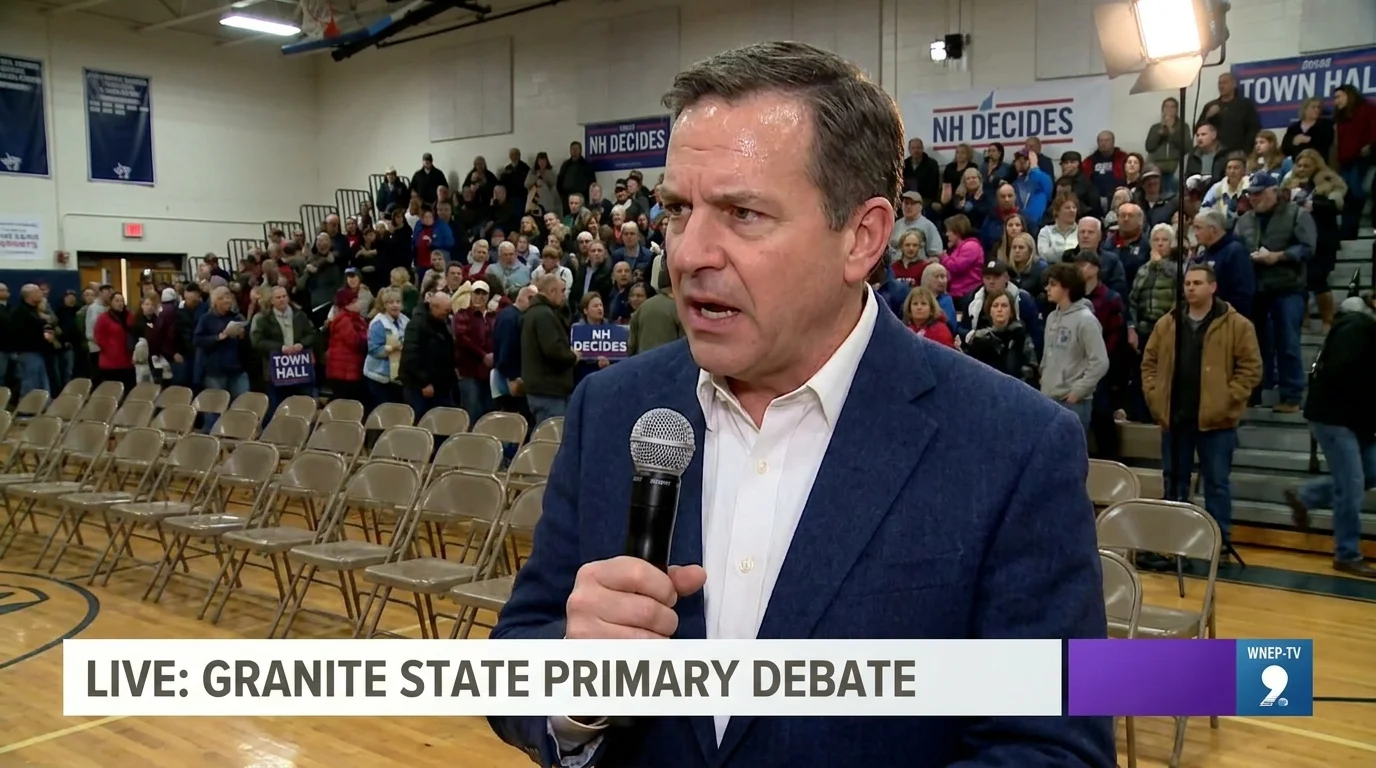
The radiator in the corner of the municipal gym clanks with an uneven, rhythmic thud, spitting dry heat against twenty-degree drafts rolling off the parking lot. You can smell wet wool, melted road salt, and scorched drip coffee pooling in styrofoam cups. Beneath your boots, the varnished pine basketball court groans under the weight of two hundred beige metal seats.
Then comes the sound that every national campaign manager dreads: the sharp, metallic scrape of chair legs dragging across hardwood as an undecided voter stands up to claim the microphone. There are no teleprompters here, no soft studio lighting, and no protective buffer of cable news talking heads.
For months, national frontrunners build fortress-like leads using hundred-million-dollar war chests, polished thirty-second digital spots, and tightly managed press scrums. Yet the moment they step onto freezing gymnasium floors in New Hampshire, that broadcast armor shears away. A single retired machinist asking a granular question about heating oil subsidies can freeze a ten-point polling lead in less than ninety seconds.
The Illusion of Broadcast Capital: Why the Gym Floor Still Dictates Power
Modern political machines treat voter acquisition like digital commerce, pouring fortunes into algorithmic ad buys and algorithmic targeting models. They operate under the belief that market saturation guarantees voter compliance. But the retail gauntlet of the early primary operates on an entirely different physical law.
When you sit in one of those cold metal chairs, advertising dollars lose their gravity. You are not consuming a brand; you are measuring the physical authenticity of a person standing twelve feet away on a scuffed free-throw line. If a candidate hesitates, deflects with a scripted talking point, or looks over your shoulder toward their press secretary, the entire room registers the evasion simultaneously.
What broadcast consultants view as an inefficient, archaic nuisance is actually an exquisite stress-test. The physical proximity forces a candidate’s nervous system to handle direct constituent friction without a script. A policy flaw that sounds smooth in a thirty-second spot curdles instantly when forced to answer to someone whose property taxes just doubled.
- Small-dollar donation processing fees trap unsuspecting contributors with preselected monthly charges
- Presidential emergency proclamation dossiers demand immediate executive compliance using gold foil stamps
- Congressional conference committee binders switch contested statutory language across blue lined notebooks
- Presidential debate makeup brushes block forehead sweat glare under blistering studio lighting
- Likely voter survey algorithms strip working class responses across evening phone call windows
The Grafton County Litmus Test
Consider Sarah Lindqvist, a 54-year-old municipal clerk from Grafton County who has attended thirty-two presidential town halls over four cycles. During a recent contested primary, a well-funded frontrunner arrived with an entourage of twenty staffers and attempted to brush off her question regarding rural hospital closures with a generic stump speech about healthcare access.
Lindqvist did not sit down. She kept her grip on the microphone, cited the exact operating deficit of her local regional clinic, and waited in silence for forty seconds while the candidate fumbled through briefing binders. The local newspaper ran the exchange on page one; within seventy-two hours, the candidate’s lead in the Merrimack Valley evaporated.
Anatomy of the Floor: The Three Interrogators Who Break Frontrunners
To understand why national momentum shatters in these rooms, you have to recognize that early primary crowds are not passive spectators. They divide into distinct, highly practiced archetypes that strip away political polish.
The Municipal Mechanic
This voter does not care about sweeping philosophical visions or geopolitical posturing. They want to know how federal funding formulas impact local culvert maintenance and school district matching grants. When candidates answer with national slogans, the room turns icy cold instantly.
The Single-Issue Purist
Often quiet until the final twenty minutes of a town hall, this citizen has tracked every floor vote a candidate has taken for the past fifteen years. They do not ask broad questions; they ask about an obscure amendment tucked into an omnibus budget bill in 2017. Stumbling here signals a lack of foundational homework.
The Pragmatic Skeptic
Sitting in the back row with their coat still zipped, this voter has seen five different presidents speak in this exact gym. They are immune to charismatic cadence. They are watching candidate body language: do the hands shake, do the eyes dart, does the voice tighten when challenged?
Navigating the Gauntlet: The Anatomy of Campaign Survival
Surviving the primary gauntlet requires abandoning the security blanket of national media strategy. Winning campaigns recognize that retail credibility is built through specific, tactile adjustments.
- Ditch the Podium: Standing behind a wooden lectern creates a physical barrier that New Hampshire voters interpret as fear; walking the floor demonstrates comfort under pressure.
- Acknowledge the Deficit: If a voter asks about an issue where your policy is thin, admitting you do not know and taking their contact information plays infinitely better than faking expertise.
- Surrender the Schedule: Rushing out of a town hall after forty minutes signals arrogance. Staying until the last folding chair is stacked proves respect for the process.
- Localize the Metric: Never cite national averages when you can cite the price of wood pellets in Coos County or commuter rail delays on the southern border.
Tactical Toolkit for the Retail Arena
Behind every successful town hall performance lies a disciplined set of non-negotiable operational rules:
Campaigns that survive allocate a minimum of forty-five minutes exclusively for unscripted questions, limit opening remarks to under eight minutes, and maintain direct eye contact with the interrogator for three full seconds after answering. These micro-habits anchor credibility faster than any prime-time media buy.
Why Friction Remains Our Best Democratic Filter
In an era where political communication is increasingly generated by predictive algorithms and delivered through isolated digital feeds, the physical town hall remains an indispensable sanctuary. It demands that power sit in an unheated room, breathe the same dry winter air as the public, and answer uncomfortable questions without an edit button.
When a candidate stumbles over the clatter of scraping metal chairs, it is not an accidental gaffe or an unfortunate campaign mishap. It is the system working precisely as intended, revealing the person beneath the brand before they are handed the levers of state power.
“The gymnasium floor does not care about your war chest; it only registers whether you can look a working parent in the eye and tell the truth.”
| Key Point | Detail | Added Value for the Reader |
|---|---|---|
| Physical Retail Setting | Small-scale gymnasiums and Grange halls with 50-300 attendees. | Exposes whether a candidate relies entirely on scriptwriters and handlers. |
| Unscripted Interrogation | Direct constituent questions without screening or media intermediaries. | Reveals actual policy depth and real-time stress tolerance. |
| Momentum Disruption | Local missteps ripple rapidly into national media coverage. | Demonstrates why early primary states punch above their demographic weight. |
Frequently Asked Questions
Why do small early states still hold so much primary influence?
Early voting states act as retail proving grounds where candidates cannot hide behind television advertisements, forcing them to engage directly with everyday voters.How do unscripted town halls expose policy weaknesses?
Constituents frequently ask hyper-specific questions about local economic impacts that scripted national talking points cannot adequately address.Can massive campaign spending overcome a poor retail showing?
Historical precedent shows that paid media rarely overcomes the reputational damage of an authentic, widely reported failure in small-group settings.What is the primary mistake national frontrunners make in New Hampshire?
Treating local voters as a passive backdrop for national cable news cameras rather than engaging with their specific community concerns.How has digital campaigning changed the traditional gymnasium town hall?
While digital tools amplify moments after they occur, the raw origin of political authenticity remains rooted in physical, face-to-face interaction.