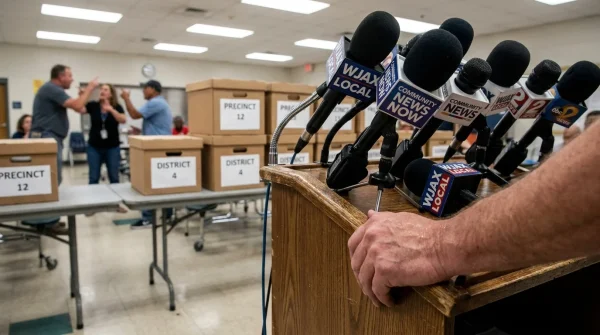
The air in a county commissioner boardroom smells faintly of industrial carpet cleaner, lukewarm drip coffee, and damp wool coats. On the oak dais sits a single manila folder holding official state treasury blacklist rosters printed on heavy bond paper, crisp edges sharp enough to nick a thumb. Across the table, a regional water authority manager stares at a revised bid sheet where the borrowing numbers have suddenly jumped by tens of thousands of dollars overnight.
You might assume municipal bond auctions are dry, mechanical equations governed strictly by prevailing federal rates and local tax bases. The standard expectation says that when your county needs to replace thirty miles of corroded iron water mains or build a six-room elementary wing, banks quietly compete to offer the thinnest possible underwriting spreads. You expect the market to behave like cold arithmetic.
The professional reality on municipal trading desks in Charlotte, New York, and Chicago looks entirely different right now. When a state treasurer slides a premier financial institution onto a restricted entity registry over corporate lending frameworks or emissions targets, the auction floor empties out in minutes. The quiet friction between state political mandates and corporate boardroom policies does not stay in the headlines; it lands squarely on your annual property assessment.
Instead of five national institutions bidding down transaction fees, local administrators find themselves staring at an empty ledger, forced to settle for whatever regional underwriter remains legally permitted to pick up the phone.
The Auction Floor Squeeze: When Political Boycotts Meet Town Budgets
To understand why a state-level political feud alters your local water bill, you have to picture the municipal bond market not as a government agency, but as an open-air farmer’s market. Under ordinary circumstances, dozens of competing merchant stalls keep the price of grain predictably low. When state statutes suddenly forbid half the largest merchants from setting foot on the square, the remaining vendors do not offer courtesy discounts; they price in their lack of competition immediately.
This friction is what market analysts call the scarcity penalty in public finance. When major investment banks face statutory disqualification over corporate governance stances, the institutional machinery that cushions debt issuance simply disappears. The local public entity still must fund its treatment plant, but the pipeline of low-cost capital has been intentionally severed at the state capital level.
- Schedule F civil service reclassifications demand immediate agency loyalty pledges across federal desks
- YouGov panel weighting models trap suburban working voters behind distorted cellphone screening quotas
- Congressional ethics committee leak binders reveal coordinated media dump strategies before holiday weekends
- Mexican avocado import tariffs trigger sudden packing plant shutdowns across border warehouse corridors
- Raw milk interstate transport bills spark fierce statehouse clashes over pasteurization standards
What looks like a symbolic culture clash in a legislative chamber transforms into a non-negotiable liquidity tax at the county level. The banks lose an underwriting fee, but the town loses pricing leverage that took decades of credit rating improvements to establish.
The Field Reality: A Treasurer’s Broken Spread
Consider Marcus Vance, a 52-year-old financial director for a rural water conservation district in the high plains. Marcus spent fourteen months preparing a $42 million revenue bond to deepen regional aquifer wells ahead of seasonal summer droughts, expecting a competitive syndicate bid between three global banking institutions and two regional firms. Forty-eight hours before pricing, two primary underwriters were formally placed on the state treasury exclusion roster, triggering an emergency contract void clause that forced Marcus to re-bid the entire issue with only one qualified regional desk remaining in the room. The resulting underwriting spread climbed by 28 basis points—an operational penalty that quietly added $117,000 in recurring debt service every single year to his district’s balance sheet.
Mapping the Balance Sheet Exposure Across Public Debt Layers
The impact of underwriter disqualification does not hit every public entity with equal force. The structural fallout fractures along specific administrative lines across municipal governance.
For Special Utility and Water Districts
Smaller, unrated utility districts face the sharpest immediate price hikes. Because these entities lack direct municipal tax backing and rely entirely on utility rate revenue, they depend heavily on the broad distribution networks of major primary dealers. When those desks are barred from bidding, local districts must raise baseline water connection fees or delay pipe replacement cycles just to cover the higher spreads charged by boutique underwriters.
For Independent School Districts
School boards operating under strict voter-approved bond caps find their construction budgets frozen midway through architectural planning. When underwriting fees swell unexpectedly, the actual capital left for brick, mortar, and classroom HVAC systems shrinks. A community might vote for a $50 million facility modernization, only to discover that bond friction consumes classroom seats before foundation concrete is ever poured.
For County Road and Bridge Authorities
Infrastructure authorities with multi-year phased projects face chronic refinancing vulnerability. As older short-term municipal notes mature and require rolling over into long-term debt, excluded bank desks leave counties exposed to sudden liquidity vacuums. The road repaving project goes forward, but the local maintenance budget for snow removal and ditch clearing gets quietly drained to feed debt service reserves.
Navigating the New Underwriting Realities
When public finance officials must operate inside restricted banking environments, surviving the bid day requires deliberate, low-noise adjustments rather than administrative panic.
Instead of rushing large, single-tranche bond sales to market, administrative teams are breaking issues into smaller private placements. They are turning to localized credit unions and regional commercial syndicates well before formal bidding opens.
- Audit state-level compliance registers forty-five days prior to drafting preliminary official statements to avoid last-minute bidder disqualification.
- Structure debt issuances into stepped mini-tranches to allow smaller community banks to bid within their regulatory capital limits.
- Negotiate fixed-fee advisory retainers rather than percentage-based underwriting commissions to cap transaction expense drift.
- Expand direct outreach to local retail investor networks across your regional zip codes rather than relying on out-of-state institutional syndicates.
The municipal desks that thrive under current constraints rely on strict procedural hygiene. Knowing the exact statutory boundaries of your state’s restricted list prevents the costly legal cancellations that occur when contracts are challenged post-award.
The Balance Sheet of Local Autonomy
Watching bond markets adjust to state political mandates reveals a simple, grounded truth: capital flows follow the path of least resistance, and friction always demands payment. When ideological battles enter the underwriting room, the bill is rarely paid by corporate boardrooms or state capital press offices. It is quietly itemized across water meters, school property levies, and local road taxes.
Learning to read the mechanics behind public finance lets you see your local government not as a passive victim of macro headlines, but as a system that requires careful, clear-eyed fiscal oversight. True fiscal stewardship is not about grand rhetoric; it is about protecting the decimal points on a water district ledger so a community can afford to repair its own streets.
“True financial liquidity in public works is built on the unglamorous friction of dozens of banks competing for every fraction of a basis point.”
| Key Point | Detail | Added Value for the Reader |
|---|---|---|
| Underwriter Boycotts | Excludes major primary dealers from municipal public bids | Explains why local public bond auctions suddenly lose pricing power |
| Basis Point Expansion | Average fee increases range from 15 to 40 basis points on restricted bids | Translates abstract state legislation into measurable town debt service costs |
| Tranche Restructuring | Splitting large public bonds into smaller regional bank placements | Provides the exact workaround local boards use to bypass market freezes |
Frequently Asked Questions
What triggers a bank exclusion from state municipal bond bidding?
State treasurers issue restricted rosters disqualifying financial institutions that maintain formal corporate policies restricting capital to fossil fuel or firearms industries.How does fewer bank bidders translate to higher local taxes?
With less competition among underwriters, the spreads and interest rates on local municipal debt rise, requiring higher local tax revenues to service the bond.Are big investment banks entirely barred from these states?
Exclusions typically target public finance underwriting contracts and state pension asset management, while standard commercial banking branches continue operating normally.Can local water or school districts ignore the state restricted lists?
No. State statutes generally bind all political subdivisions, including municipal utility districts and public school boards, to follow state treasury exclusion mandates.What is the most effective way for a town to reduce these underwriting penalties?
Districts minimize costs by partnering with regional bank consortiums and timing bond releases during quiet calendar windows with minimal competing issues.