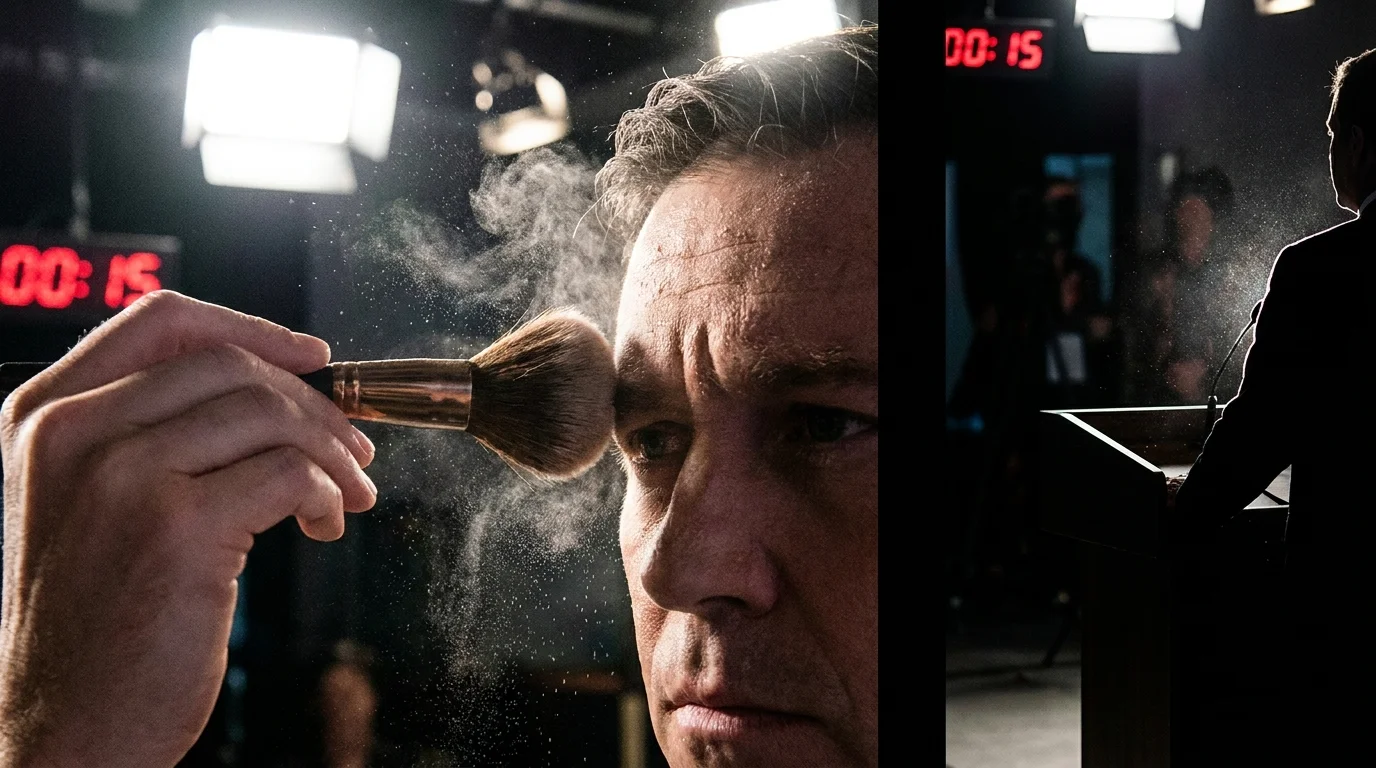
The green room always smells of cooling metal, spearmint gum, and dry pressed talc. Just beyond the heavy soundproof door, eighty crew members move in synchronized silence across cables taped thick against concrete floors. Overhead, massive grids of four-thousand-watt broadcast fixtures warm up, humming at a pitch that rattles your teeth before their glare even touches your skin.
You can rehearse policy white papers for six months, but the glass eye of a high-definition studio camera does not read your intellect first. It reads the micro-tremors of your jaw and the microscopic bead of moisture gathering at the crown of your brow. In a television hall chilled to fifty-eight degrees Fahrenheit, your skin fights a private war against the heat radiating downward like an open oven door.
Then comes the dry, quiet puff of a dense horsehair brush striking the back of an artist’s wrist. A faint cloud of micro-fine translucent silica hangs in the air for a fraction of a second before the bristles sweep across your forehead. It is not cosmetics in any vanity sense; it is optical armor designed to prevent high-definition cameras from mistaking heat for panic.
The Thermal Illusion: Why Shine Reads as Surrender
Modern political debates are won on split screens where viewers watch your reaction while your opponent speaks. When directional spotlights hit a bare forehead, natural sebum acts as a miniature mirror, bouncing hot white spots straight into the lens. To the human brain watching at home, a shiny forehead translates instantly into elevated cortisol, racing heart rate, and cornered desperation.
Understanding this visual dynamic shifts the entire equation. You stop viewing stage powder as an afterthought and begin treating it like a critical instrument of nonverbal defense. Television lights magnify human sweat glands into flashing distress beacons, meaning the matte finish of your skin directly protects the credibility of your spoken argument.
Elena Vance, a 52-year-old network makeup supervisor who has prepped candidates for six presidential cycles, remembers the exact moment a campaign staffer tried to wave off the powder chair before airtime. She quietly dusted the candidate’s right temple, brought up the high-contrast studio monitor, and showed him how the left side looked like it was melting while the right side looked carved from steady stone. He sat back down instantly and closed his eyes.
- Likely voter survey algorithms strip working class responses across evening phone call windows
- Lyndon Johnson speech drafts enforce dramatic pauses using double typewriter spacing
- Donald Trump White House confidentiality rules enforce sweeping nondisclosure demands across executive branch aides
- Chris Van Hollen Meet the Press interview reveals growing Senate resistance to overseas defense aid
- Yosemite National Park concession bills derail federal preservation standards across Western public lands
The Layered Defense: Segmenting Studio Optical Control
Controlling skin reflection under broadcast scrutiny requires distinct stages tailored to individual skin biology and lighting angles.
The Barrier Layer for Oily Skin Profiles
Heavy oil production under nervous tension breaks down standard cosmetic formulas in less than fifteen minutes. Specialized anti-shine silicones form a breathable, hydrophobic film directly over the pores. This base creates a dry anchor point that prevents body heat from pushing oils through to the camera surface.
The Color-Balancing Matrix for High-Lumen Stage Rigs
Stage fixtures strip warm undertones and exaggerate red vascular flushing across the cheeks and neck. Subtle color-correcting pigments neutralize the blood vessels that dilate during intense verbal confrontations. Neutralizing sudden facial flushes prevents the camera from registering natural adrenaline spikes as emotional instability.
The Micro-Finishing Veil for 4K Sensor Resolution
Traditional powders cake inside fine lines, creating chalky ridges under ultra-high-definition lenses. Micro-milled spherical silica floats across surface irregularities rather than settling into creases. The result is a soft-focus diffusion that scatters harsh overhead light without showing visible product buildup.
Applying the Optical Shield: The High-Stakes Sequence
Preparation backstage happens in quick, disciplined passes during commercial breaks and pre-show countdowns. The technique relies on firm pressing motions rather than casual sweeping.
- Degrease the T-zone: Firmly press untreated linen blotting sheets along the forehead ridge, nose bridge, and upper lip to lift surface oils without disturbing the skin barrier.
- Deposit the primer barrier: Smooth an alcohol-free, mattifying gel containing dimethicone cross-polymers across the central forehead using clean fingertips.
- Load the natural bristle: Tap a rounded, natural horsehair brush into translucent silica powder, then strike the brush handle against your knuckle to shed excess dust.
- Press and roll: Work from the center of the brow outward, rolling the bristle head firmly against the skin to lock the powder deep into the pores.
- Final collar sweep: Run a clean kabuki brush down the neck and jawline to prevent any visible boundary line between face and neck under harsh down-lighting.
Your backstage kit should be stripped down to bare, reliable components that perform under intense pressure. Stick to 100% spherical silica powder milled below five microns, natural bristle brushes with firm brass ferrules, and pharmaceutical-grade blotting papers.
The Nonverbal Mastery of Physical Poise
True authority on a public platform comes from eliminating physical distractions so your message can land cleanly. When you know your brow is completely dry and your expression is secure under blistering lights, your body language settles into natural stillness.
You no longer spend subconscious energy wondering if sweat is trickling toward your eyebrow or if the cameras catch a glimmer of strain. That quiet physical confidence translates directly into steadier vocal pacing, sharper counter-arguments, and an unshakable command of the stage.
Optical discipline on stage ensures that the audience hears your message instead of reading your adrenaline.
| Key Point | Detail | Added Value for the Reader |
|---|---|---|
| Light Reflection Control | High-lumen stage lights reflect off natural oils to create glare spots. | Eliminates the false appearance of anxiety or physical weakness on camera. |
| Tool Density | Dense natural bristle brushes disperse fine silica evenly without caking. | Prevents visible makeup texture from showing on high-definition screens. |
| Layering Technique | Blotting, priming, and roll-pressing provide long-lasting shine resistance. | Maintains a completely matte, steady visual presence throughout high-pressure events. |
Frequently Asked Questions
Why do debate stages use such hot, intense lighting?
Broadcast cameras require massive lumens to capture sharp detail and maintain deep focus across wide podium shots without graininess.What kind of powder works best against forehead glare?
Pure, micronized translucent silica powder is the industry standard because it absorbs heavy sebum without adding unnatural color or cakey texture.Why are natural bristle brushes preferred over synthetic ones?
Natural hair cuticles hold microscopic powder particles tightly, releasing them evenly upon firm skin contact rather than dropping clumps of dust.How does sweat glare impact audience perception?
Viewers instinctively associate forehead shine and visible perspiration with guilt, panic, and a loss of emotional control during intense exchanges.Can these anti-shine techniques be used for everyday presentations?
Yes, a light application of mattifying primer and translucent powder works exceptionally well for video conference calls and brightly lit corporate stages.