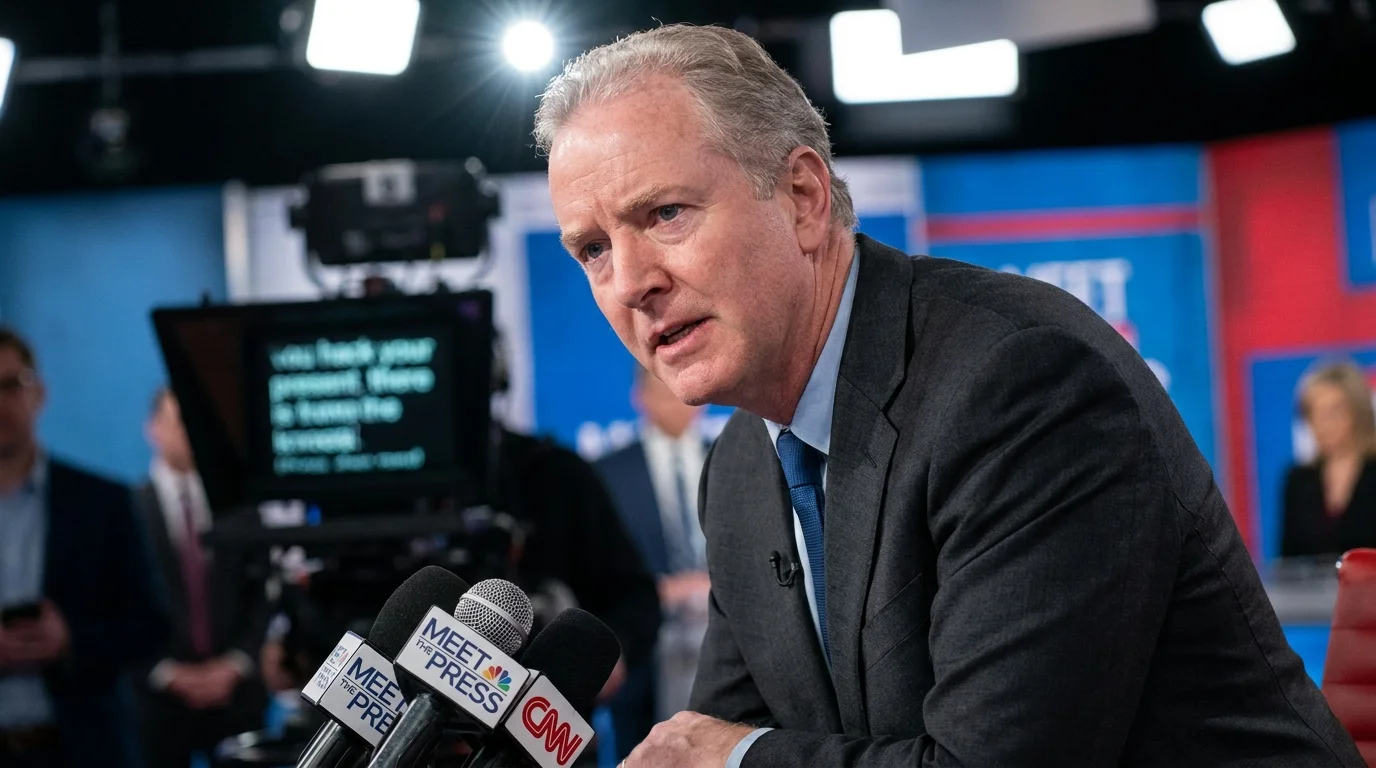
Sunday morning in a Washington television studio carries a peculiar, climate-controlled silence. Under the rigging of Studio 4B, the air smells faintly of ozone, floor wax, and cooled black coffee sitting in paper cups near the control console. Just beyond the glow of the stage monitors, the teleprompter reflection shimmers across the curved glass of camera three, scrolling through rehearsed talking points that rarely disrupt the beltway status quo.
Then the cadence broke. When Maryland Senator Chris Van Hollen leaned toward the lapel mic during his recent appearance on Meet the Press, he bypassed the usual diplomatic safe harbors. Instead, he zeroed in on binding statutory enforcement mechanisms tied directly to foreign security assistance, instantly setting off a real-time spike across search engines nationwide.
You could feel the digital tremor immediately. While Sunday morning broadcasts often drift into the background of a weekend routine, the sudden surge in search volume revealed something deeper: Americans across the political spectrum were scrambling to verify what happens when federal law collides with overseas military spending packages.
The Circuit Breaker: Moving Beyond Cable Talking Points
For decades, national foreign policy debates have operated like high-theater press conferences where rhetoric drifts away the moment the red camera light blinks off. But watching that broadcast, you witnessed a rare mechanical pivot—a switch from ideological posturing to statutory plumbing. The debate was no longer about general goodwill; it was about Section 620I of the Foreign Assistance Act and executive accountability.
Think of federal aid not as an open faucet, but as an electrical circuit equipped with hardwired breakers. Under US law, foreign governments receiving American military assistance cannot arbitrarily block or restrict the transport or delivery of US humanitarian assistance. If a foreign partner restricts that aid, the legal circuit breaker trips, requiring the executive branch to halt transfers unless explicit waivers are certified before Congress.
When a sitting member of the Senate Foreign Relations Committee openly challenges the administration to enforce those exact reporting rules on live television, the political calculus shifts. It transforms a vague foreign policy dispute into an enforceable compliance test that every taxpayer has a right to inspect.
- Yosemite National Park concession bills derail federal preservation standards across Western public lands
- District office citizen delegations switch lawmaker votes using single-page personal hardship files
- Taylor Force Act amendments trigger fierce foreign aid battles over frozen humanitarian accounts
- Precinct poll book check-ins block unregistered voters over tiny address hyphen mismatches
- TargetSmart voter scoring models force field organizers onto cracked suburban front porches
Marcus Vance, a forty-eight-year-old former Senate foreign policy staffer who now tracks defense appropriations, watched the exchange unfold from his home office in Arlington. He noted that the moment statutory compliance enters the public dialogue, the administration loses its ability to rely on soft diplomatic ambiguity. “The second a senator cites specific reporting mandates on Sunday morning,” Vance observed, “the agency desks have to spend Monday building a paper trail that can withstand judicial and public scrutiny.”
Where the Voter Fault Lines Are Forming
The sudden search interest following the interview is not confined to one party or philosophy. As Congressional debates over supplemental aid packages tighten, distinct voter segments are processing this legislative resistance through very different lenses.
For the Oversight Advocate
If your primary concern is governmental transparency, this moment represents a long-awaited return to regular order. You want to see statutory reporting requirements enforced as written, ensuring that foreign aid packages do not bypass Congressional intent or statutory conditions quietly signed into law.
For the Fiscal Realist
If you watch national policy through the lens of the federal balance sheet, this resistance signals a growing reluctance to write open-ended security checks. Accountability metrics protect domestic resources by ensuring that foreign aid is tied to measurable, rule-bound outcomes rather than indefinite commitments.
For the Constitutional Balance Purist
If you care about the balance of powers, the interview underscored the Senate’s constitutional duty to oversee foreign commerce and military commitments. When lawmakers assert their oversight role, it prevents the executive branch from exercising unchecked discretion over national defense resources.
How to Track the Real Legislative Paper Trail
Navigating the aftermath of high-stakes Sunday interviews does not require relying on breathless cable analysis. You can track whether these broadcast demands lead to actual legislative change by monitoring three specific tools.
- Check the Congressional Record for Floor Amendments: Search Congress.gov for amendments referencing Section 620I or National Security Memorandum reporting requirements attached to pending defense packages.
- Monitor Committee Oversight Transcripts: Review published hearings from the Senate Foreign Relations and Armed Services Committees, where administration officials must respond to formal inquiries under oath.
- Read CRS (Congressional Research Service) Briefings: Access publicly available CRS reports on foreign aid conditions to see how nonpartisan legal experts interpret the administration’s compliance mandates.
The Tactical Toolkit below outlines the exact thresholds and schedules driving this current Senate standoff.
Tactical Toolkit: The Oversight Checkpoints
• Statutory Lever: Section 620I of the Foreign Assistance Act (22 U.S.C. § 2378-1).
• Key Reporting Window: 30-day executive certification cycles.
• Primary Action Center: Senate Committee on Foreign Relations.
The Clarity of Watching the Levers Move
It is easy to feel exhausted by the perpetual churn of political headlines, where every televised exchange is framed as an explosive showdown. Yet when you understand the underlying legal machinery—the statutory clauses, the reporting windows, and the constitutional duties of oversight—the noise recedes.
Recognizing the difference between political posturing and statutory enforcement gives you a grounded vantage point. You no longer have to wonder what politicians mean when they argue on Sunday morning; you simply watch whether the legal levers they invoke actually move the machinery of state on Monday.
“True legislative power is rarely found in fiery rhetoric; it lives in the quiet statutory clauses that compel an administration to account for every dollar sent abroad.”
| Key Point | Detail | Added Value for the Reader |
|---|---|---|
| Statutory Mandate | Section 620I of the Foreign Assistance Act prohibits aid when humanitarian access is impeded. | Gives you the exact legal standard required to evaluate foreign assistance claims. |
| Executive Reporting | Requires formal certifications and written assessments delivered to Congressional committees. | Enables you to search public records for verified compliance rather than opinion pieces. |
| Public Search Surge | Real-time spike in voter interest following specific broadcast demands for legal accountability. | Highlights how grassroots awareness can hold both lawmakers and the executive branch accountable. |
Frequently Asked Questions
What triggered the search spike following the Sunday interview?
Viewers responded to direct calls for the enforcement of specific federal statutes governing foreign assistance, prompting immediate interest in US oversight laws.What is Section 620I of the Foreign Assistance Act?
It is a federal statute that restricts US security aid to any country that prohibits or restricts the transport or delivery of US humanitarian assistance.Can the President bypass these statutory aid requirements?
The executive branch can sometimes issue national security waivers, but doing so requires formal, written justification submitted directly to Congress.Why are Senate committees so central to this foreign aid debate?
The Senate Foreign Relations and Appropriations Committees control the language and conditions attached to overseas funding bills, giving them direct leverage over foreign policy execution.Where can I find nonpartisan updates on foreign aid legislation?
You can track introduced legislation, amendments, and statutory reporting requirements directly on Congress.gov and through the nonpartisan Congressional Research Service.