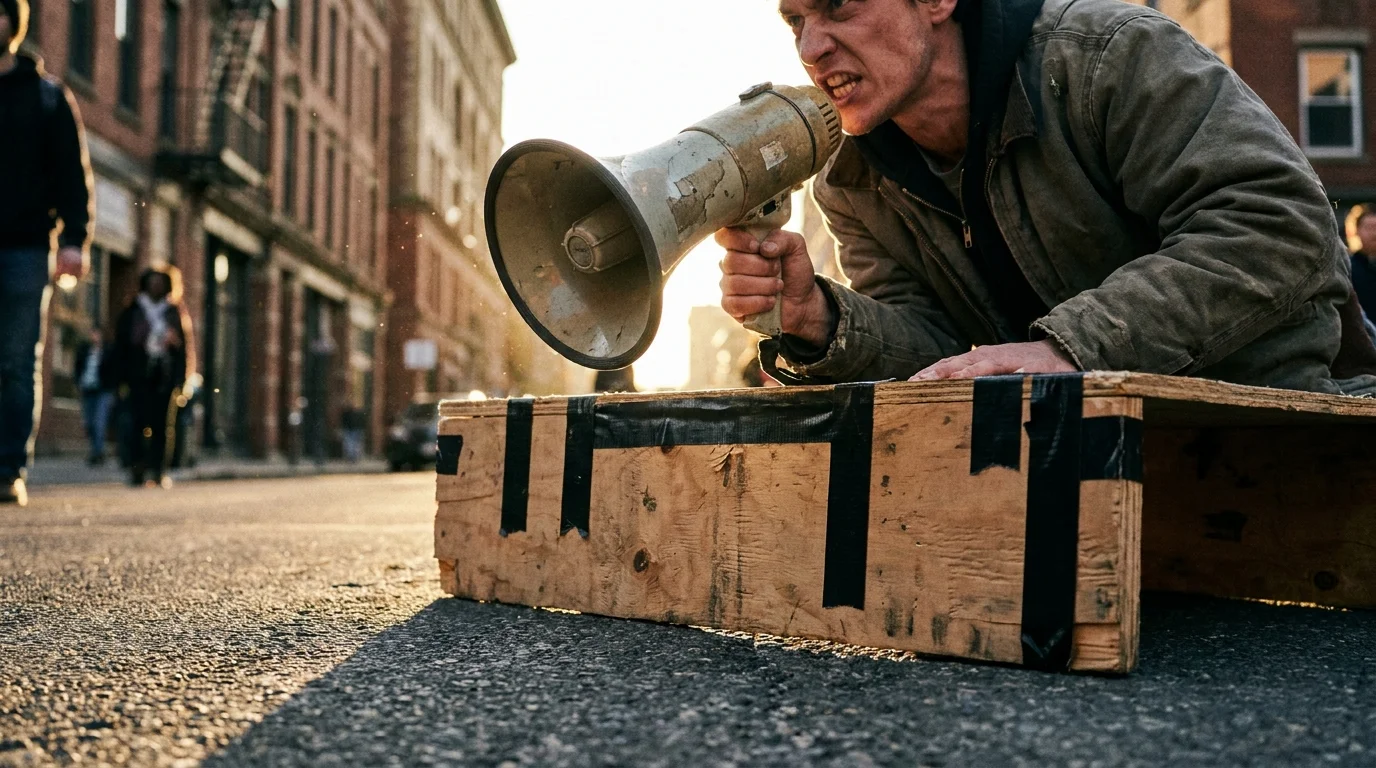
The scent of warm electronics, ozone, and fresh carpet adhesive hangs heavy in the cavernous broadcast hall. Hours before the house lights dim and forty million Americans tune in, the debate floor belongs entirely to technicians wielding laser measures, roll after roll of black gaffer tape, and raw sheets of three-quarter-inch birch plywood. You see a pristine, marble-finished podium on your living room screen, but beneath the broadcast sightline lies a chaotic assembly of rough lumber, leveling shims, and taped cables designed to level the visual playing field.
Television staging is a game of millimeters where natural charisma often plays second fiddle to broadcast geometry. When two political opponents square off, networks do not merely frame a spontaneous discussion; they engineer an optical truce. The unpainted plywood riser block taped with black gaffer adhesive serves as the foundation of this manufactured parity, built specifically to place opposing sets of eyes along the exact same horizontal grid line.
Yet, when a shorter candidate steps onto that elevated wooden perch to match a taller rival, a severe optical trap snaps shut behind them. Modern broadcast sets rely on high-output LED backlights, wash panels bathed in cool cyan and sapphire, mounted low along the back risers. By lifting a shorter figure four to eight inches into the air, stage managers unintentionally push their silhouette directly into the hottest center of those glaring blue fixtures.
Instead of projecting an aura of equal stature, the candidate gets haloed in harsh digital glow. Their dark suiting bleeds into the neon wash, their gestures become rim-lit outlines, and every subtle twitch is magnified against a wall of intense cobalt luminance. The broadcast illusion backfires instantly on split-screen feeds.
The Geometry of Authority: How Eyelines Shape Perception
For decades, political lore maintained that television dominance was purely rhetorical: the crisp one-liner, the steady gaze, the refusal to sweat under tungsten bulbs. In reality, modern debate dominance is largely an optical balance crafted by camera switchers. When two candidates appear on a fifty-fifty vertical split screen, human psychology naturally judges the person whose head occupies less upper third frame space as defensive, diminished, or physically subordinate.
To counter this instinct, campaign managers spend weeks negotiating exact lectern parameters. Staging contracts resemble corporate merger agreements, specifying the height of lectern desks, the angle of microphone goosenecks, and the mandatory deployment of riser platforms. If a challenger stands five feet six inches tall against an incumbent measuring six feet two, the production crew measures the distance from floor to pupil and constructs a customized wooden box. Equalizing height creates immediate symmetry, but it destroys the natural lighting focal points calibrated for the primary stage floor.
- National security directives demand midnight classified clearances inside embossed crimson leather binders
- House Rules Committee markups enforce midnight floor compromises using scratched red grease pens
- South Carolina primary bus tours force candidates onto sticky church folding chairs
- Donorbox mobile checkout screens trigger preselected tipping fees on cracked smartphone glass
- Pew Research phone scripts switch evening callback quotas after loud dinner clatter interrupts
Elena Vance, a 52-year-old veteran stage lighting director who has managed six presidential and gubernatorial debate cycles, recalls the frantic backstage scramble of these platform builds. During a high-stakes Midwest gubernatorial debate in 2022, she watched an advance team insist on a seven-inch box to match a former college athlete opponent. The moment the red camera tally lights went live, the candidate was trapped directly in the throw of two 500-watt floor floods, making their skin tones turn ghostly white while the taller candidate stood comfortably in the warm, diffused key light above the backlight beam.
The Split-Screen Trap: Staging Profiles Under the Lens
Not every campaign handles the physical platform the same way. The optical physics of debate stages create very distinct problems depending on candidate stature, build, and movement habits. Understanding these dynamics changes how you interpret every broadcast debate.
For the Statistically Compact Debater
When you stand on a high riser box, your center of gravity shifts. You are confined to a narrow, eighteen-by-twenty-four-inch footprint behind the wooden lectern rail. Stepping back to let a point breathe—a classic oratorical habit—risks stepping off the ledge in live television history. Furthermore, the elevated stance forces floor cameras to tilt upward, catching you in unflattering low-angle perspectives that highlight jawlines while pushing your shoulders into the glaring backdrop lamps.
For the Naturally Broad-Shouldered Debater
Tall candidates often face the inverse problem: podium compression. When their podium is not custom-built and rests on the standard stage floor, they must hunch over microphones designed for standard heights, creating a defensive, predatory silhouette. Physical comfort dictates rhetorical rhythm, and spending ninety minutes fighting a lectern rail saps mental stamina faster than aggressive questioning.
Mindful Observation: How to Spot Staging Engineering Live
The next time you watch a televised debate, look past the polished talking points and observe the structural architecture supporting each candidate. Networks attempt to hide these adjustments, but the visual cues are unmistakable if you know where the lens meets the wood.
- Watch the split-screen waistline: If both candidates have their heads positioned at identical screen heights, check the distance from their belt line to the podium rim. A deep lectern lip indicates a candidate standing flat, while an exposed midsection reveals an elevated riser block.
- Track the blue lens flare: Look at the edges of their dark jackets. A heavy cyan glow around the shoulders indicates a candidate who has been lifted directly into the stage’s lower LED wash arrays.
- Examine the foot shuffle: When a speaker shifts weight, observe their vertical stability. Speakers on riser boxes keep their feet tightly parallel, unable to adopt a wide, rooted stance.
- Notice the microphone drop: When audio techs angle a microphone down rather than up, the candidate is standing significantly higher than the podium was designed to accommodate.
The tactical toolkit of debate staging rests on specific parameters that campaign advance teams measure to the millimeter:
- Base riser height: Typically 3 to 7 inches of dense plywood wrapped in non-reflective stage felt.
- Backlight throw angle: 35 to 45 degrees, which hits an elevated speaker directly at shoulder level.
- Platform footprint: Exactly 24 inches wide by 30 inches deep, secured with 2-inch black gaffer tape along every contact seam.
- Split-screen frame margin: The top of the candidate’s hair is locked precisely 10% below the upper television frame border.
The Bigger Picture: Reclaiming Your Critical Lens
Recognizing the invisible architecture of a debate stage changes the way you consume political discourse. What feels like an organic display of authority, confidence, or agitation is often the direct consequence of stage design, optic angles, and timber carpentry. Awareness transforms your passive viewing into active, critical analysis.
When a candidate appears stiff, overly illuminated, or swallowed by the glowing sapphire set pieces, you no longer have to wonder if they lost their composure. You can see the mechanics at play: the unpainted riser, the laser sightline, and the battle between physical reality and broadcast engineering. In an era dominated by hyper-polished imagery, seeing the stage for what it truly is—a constructed box under hot glass—is the sharpest tool a citizen can hold.
“Every inch of perceived dominance on a television stage is negotiated with a tape measure, a carpenter’s pencil, and a lighting grid long before the first question is spoken.”
| Key Point | Detail | Added Value for the Reader |
|---|---|---|
| Plywood Riser Blocks | Custom wooden step platforms (3–8 inches) installed behind the podium. | Explains why shorter candidates often look static or physically restricted during debates. |
| LED Backlight Traps | Low-mounted blue LED arrays focused across the floor plane. | Helps you identify artificial visual washing and unnatural haloing around candidates. |
| Split-Screen Alignment | Camera cropping to force equal eye levels across different heights. | Reveals why screen presence is an engineering choice rather than raw charisma. |
Frequently Asked Questions
Why do debate organizers use riser blocks instead of adjusting podium heights?
Podiums on national broadcast sets are custom-fabricated, heavy display pieces integrated with LED logos, wiring, and network branding. Building static podiums and adjusting candidate height with concealed wooden foot risers is far faster and structurally safer during multi-candidate debates.Do candidate contracts really specify platform dimensions?
Yes. Campaign advance teams negotiate detailed staging memoranda covering podium spacing, lectern incline angles, microphone placement, platform carpet textures, and exact camera eyeline elevations down to fractions of an inch.How does blue backlighting affect television viewers psychologically?
Cool sapphire and cyan backlights provide modern visual contrast against warm skin tones. However, if a candidate is elevated into the beam path, the harsh backscatter washes out shoulder definitions, creating a cold, detached silhouette that viewers often interpret as discomfort or aloofness.Can a candidate refuse to use a riser block?
Candidates can decline a riser block, but doing so forces broadcast directors to either frame them with excessive empty space above their heads or zoom in tightly, which alters perceived body language compared to their opponent on split screens.What is the best visual clue that a candidate is standing on a platform?
Look at their posture and podium overlap. If a candidate’s jacket buttons appear well above the podium desk while their opponent’s chest is partially obscured, they are standing on an elevated box to match eyelines.