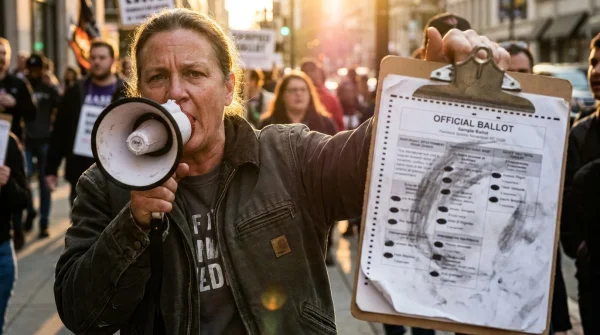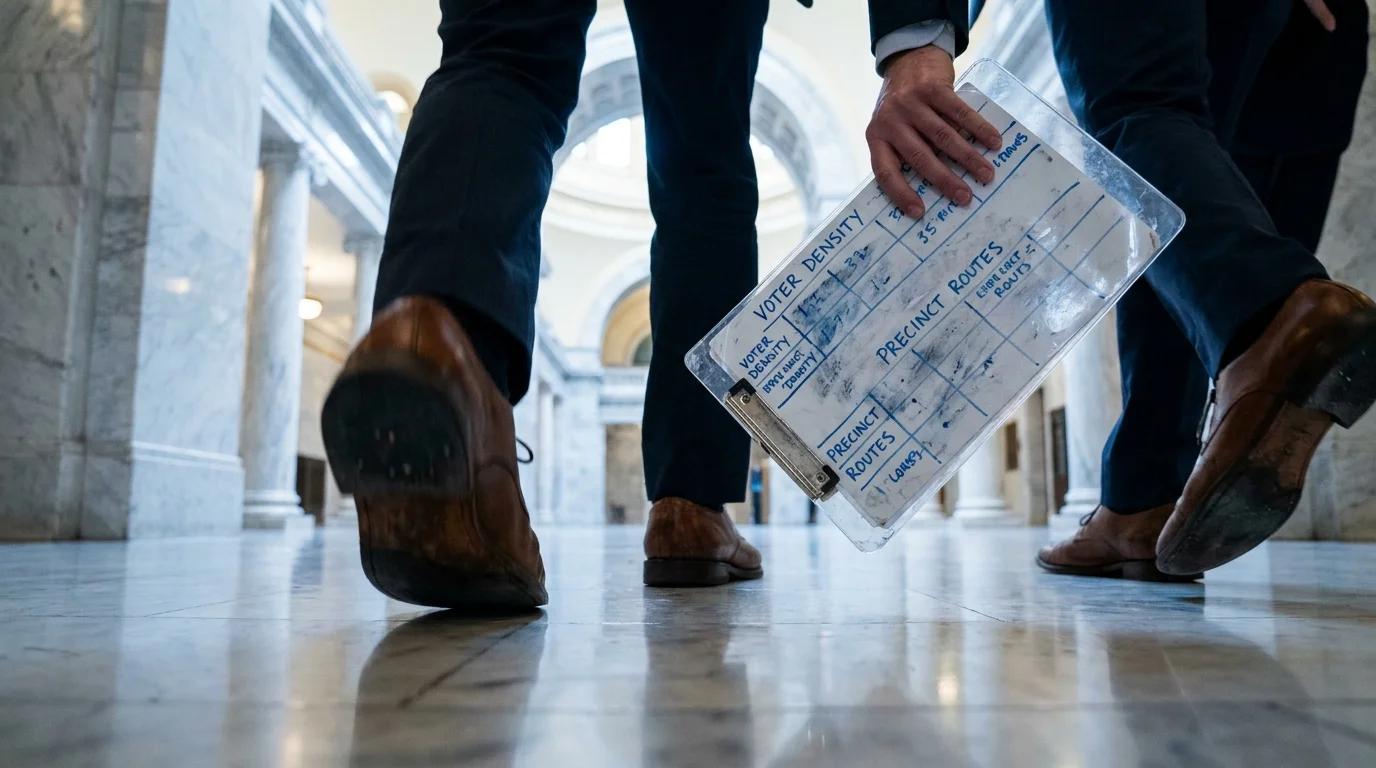
The heat rises straight through the soles of worn sneakers by mid-afternoon, shimmering off freshly sealed suburban blacktop like a mirage. You can smell the hot tar mixed with lawn fertilizer and dry grass clippings baked under ninety-degree sun. In your left hand, the plastic edge of a laminated precinct walking clipboard digs into your palm, its grid lines marked with faded blue dry-erase ink showing where your afternoon route begins and where it abruptly ends.
Cable news panels and national strategy memos want you to believe political campaigns run on algorithmic ad buys and seven-figure digital video drops. Yet when a special election tightens into a single-digit fight, the million-dollar servers go quiet, and the entire outcome rests on whether two dozen exhausted field organizers can survive twelve miles of blistered asphalt before the porch lights switch on.
You look down at your sheet: a zigzag of forty-two houses scattered across eight disconnected blocks. You are holding a turf packet, the ground-level blueprint of American electoral friction. It is not an invitation to stroll; it is a brutally calculated balance sheet of human energy, door-to-door friction, and raw voter behavior.
The Geometry of the Cut: Why Algorithms Hate Cul-de-Sacs
Modern campaigns run on an unwritten physical law: every step you take on concrete without a doorstep in sight is a wasted vote. Campaign software can pull millions of voter files in seconds, but field directors look at your precinct map the way an old-school cargo pilot looks at a fuel gauge. They see time, elevation, gate latches, and the physical drag of suburban sprawl.
Consider Marcus Vance, a thirty-one-year-old regional field director managing three competitive legislative districts outside Columbus. Late on Thursday nights before weekend canvass launches, Marcus sits under buzzing fluorescent tubes, trimming voter universes by hand. He pulls up satellite maps and deliberately draws jagged boundaries that slice right through wealthy subdivisions, cutting out long, winding cul-de-sacs with three-hundred-foot setbacks. Every long driveway costs two doors that could have been knocked on a tighter street grid.
- Child Tax Credit phaseout brackets trap working parents with sudden clawback bills
- Tea Party tax day flyers resurfaced 1970s suburban property revolts with neon yellow mimeographs
- Deepfake candidate voice clips expose synthetic frequency lines under free audio spectrograms
- Pete Hegseth general dismissals derail Pentagon leadership stability sparking urgent Capitol Hill hearings
- Omnibus appropriations rider slips switch contentious funding lines with hurried pencil scratches
When a field office finalizes its walk sheets, it is not trying to reach every voter. It is solving a ruthless packing problem. If a volunteer spends ninety seconds walking between front doors in a dense pre-war neighborhood, their conversation rate stays high. Send that same volunteer down an isolated court where houses sit behind half-acre lawns, and their walk-to-talk ratio collapses into exhaustion.
The Anatomy of Turf Packet Economics
Campaign software divides target precincts into distinct geographic zones called ‘turf.’ But how that turf is diced determines whether an organizer builds momentum or burns out before dinner.
The Dense Grid (Pre-War Walksheds)
In older inner-ring suburbs and downtown wards, homes sit twenty feet apart with sidewalks on both sides. Organizers refer to this as high-yield territory. You can hit sixty doors an hour here if you keep your clipboard tucked and your stride steady. The challenge is not physical distance; it is psychological fatigue from rapid-fire conversations and porch-step interruptions.
The Subdivided Trench (Cul-de-Sac Realities)
Post-1980 suburban developments are designed for cars, not clipboards. Without through-streets, an organizer walking a cul-de-sac must double back over the exact same asphalt they just crossed. Field directors apply a steep discount to these areas, often assigning them exclusively to weekend drivers with pairs of canvassers who hop in and out of running sedans.
Mindful Field Craft: How to Run a Walk Route Without Breaking
Canvassing successfully is an athletic discipline masquerading as a civic chore. If you move without a systemic approach, blistered arches and empty water bottles will cut your shift short within ninety minutes.
- Audit the packet before stepping out: Spend two minutes at your car hood tracing the blue marker line to identify natural turnaround loops rather than following house numbers linearly.
- Protect the walk-to-talk ratio: If a gate is chained or a walkway is blocked by construction, mark the sheet immediately and pivot to the next address without lingering.
- Preserve the clipboard surface: Keep a dry rag in your back pocket; sweat and humidity turn dry-erase tracking into an illegible smear within thirty minutes of hard pacing.
- Anchor your pace at sixty paces per minute: Rushing between doors spikes your heart rate and makes your opening greeting sound frantic when a resident opens the door.
The Tactical Toolkit for six hours on blacktop includes: zinc-based blister balm applied before lacing up, a wide-brim canvas cap, two 32-ounce insulated bottles (one ice water, one electrolyte mix), and a fine-tip dry-erase marker with an eraser cap attached directly to your clipboard clip.
The Unbroken Line on the Pavement
When the sun finally dips below the tree line and the pavement stops radiating heat, your legs will ache with a deep, bone-level fatigue. But as you hand your smudged, sweat-stained packet back across the folding table at field headquarters, you understand something television analysts never grasp.
Elections are not decided in pristine broadcast studios or corporate ad agencies. Real power is built door-by-door through the stubborn determination of someone willing to walk another mile of asphalt just to ask a stranger what matters to their family.
The sharpest predictive model in the world remains entirely useless until an organizer presses a blistered thumb against a front doorbell.
| Key Point | Detail | Added Value for the Reader |
|---|---|---|
| Cul-de-Sac Trimming | Field directors intentionally cut low-density dead-end streets from walk maps. | Explains why canvassers frequently bypass specific suburban blocks entirely. |
| Walk-to-Talk Ratio | The proportion of time spent moving between homes versus speaking with voters. | Reveals how campaign field performance is measured beyond simple door counts. |
| Turf Boundary Logic | Precinct packets are grouped by sidewalk continuity rather than simple geography. | Helps volunteers navigate daily route assignments with minimal physical strain. |
Frequently Asked Questions
Why did a canvasser skip my house but knock on both of my neighbors’ doors?
Campaign walk lists are target-specific based on voting history and party registration models; packets exclude houses that do not fit the specific outreach profile for that day.How many doors does an organizer typically knock in a standard four-hour shift?
In an average suburban neighborhood, a disciplined canvasser hits between 60 and 90 doors, resulting in roughly 15 to 25 live conversations.Why do field offices still use paper clipboards instead of purely mobile apps?
Paper turf packets never run out of battery in high heat, do not glitch without cell reception, and allow instant visual routing adjustments on the fly.What is the best way to handle loose dogs while working a turf packet?
Never enter a closed gate without clear sightlines to the porch; note the hazard on the packet margin and move directly to the next scheduled address.How do organizers prioritize multi-story apartment buildings on their route?
Apartment complexes offer maximum door density per hour, but organizers must verify access codes and building entry policies before scheduling the turf.