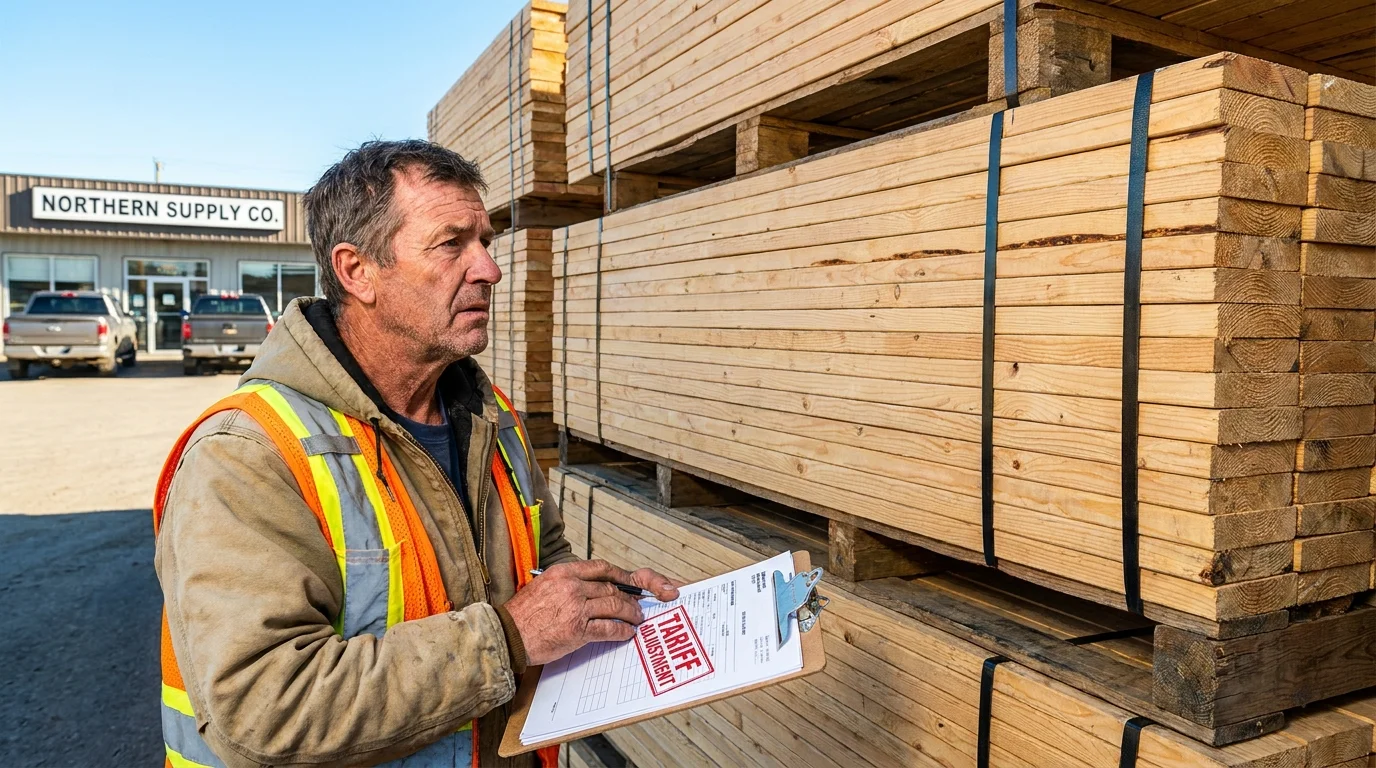
The damp chill of an early northern border morning smells distinctively of sawdust, diesel exhaust, and wet spruce. You walk across a plywood subfloor that feels stiff beneath your work boots, listening to the metallic hum of a delivery flatbed backing toward the curb. For months, the blueprints sat neatly rolled on your dashboard, every cut-list accounted for down to the last box of galvanized nails.
Then the invoice prints out at the supply counter, and your stomach drops. You notice that framing lumber jumped double digits overnight, not because your local yard ran out of studs, but because an administrative signature in Washington quietly recalibrated an import duty on Canadian softwood.
We are taught to think of international trade feuds as theatrical squabbles confined to mahogany committee rooms and twenty-four-hour cable news tickers. We imagine diplomats trading barbed press releases while our daily domestic routines hum along unaffected. But out here along the northern border tier, where towns in Maine, New York, Minnesota, and Washington have traded freely across river crossings for over a century, the border is not an abstract line on a policy map. It is the lumberyard three miles up the road.
When federal rhetoric pivots toward punitive cross-border duties, the fallout lands squarely on the residential foundation. Framing packages stall out, contracts freeze mid-pour, and families looking to build a starter home find themselves priced out before the first header is raised.
The Border Ledger: How Political Slogans Become Framing Surcharges
To navigate the sudden turbulence in building estimates, you have to discard the myth that timber tariffs simply protect domestic forestry jobs. Viewing cross-border timber through that patriotic lens is like staring at a garden hose kinked twenty feet upstream and wondering why your garden bed is bone dry. The mechanics are far more mechanical than ideological.
United States sawmills simply do not cut enough structural spruce-pine-fir (SPF) to satisfy the framing demands of our domestic residential market. When Washington places a retaliatory surcharge on Canadian timber crossing the 49th parallel, it does not magically conjure new mature pine stands in Georgia or Oregon overnight. Instead, the duty acts as an immediate toll booth fee added to every board-foot that rolls across the border on flatbed trucks.
Because wholesalers operate on thin margins, they cannot absorb that government-mandated friction. The price surge rolls downhill within forty-eight hours, directly hitting local distributors, regional framers, and ultimately your checkbook. What was pitched on Sunday talk shows as a hardline geopolitical posture functions in practice as a direct, unvoted sales tax on shelter.
- Raw milk deregulation bills trigger intense pushback from state dairy inspectors
- Club for Growth primary bids target veteran House incumbents across southern districts
- Lead service line mandates shift heavy compliance costs onto county property tax assessments
- Turnout propensity weighting models derail working-class voter forecasts until election night precinct totals
- John Fetterman floor demands force high-stakes Senate showdown over domestic steel manufacturing permits
Marcus Lindqvist, a 48-year-old framing contractor in Whatcom County, Washington, felt that systemic shock firsthand when two multi-family duplex permits were approved in late autumn. His Canadian supplier, located just twenty-two miles north across the British Columbia border, had to pass along a twenty percent tariff surcharge within seventy-two hours of a new federal trade announcement. Marcus had to sit down at a kitchen table with young clients to explain why their agreed-upon framing package had spiked by fourteen thousand dollars before the foundation forms were even stripped.
Navigating the Fallout: Three Profiles Under the Price Squeeze
The impact of cross-border duties rarely falls evenly across the construction landscape. Depending on the scale and scope of what you are building, the sudden friction demands distinctly different tactical adjustments.
The Independent Custom Builder
If you run a boutique building crew or are building a custom home, your primary threat is fixed-price vulnerability. Relying on traditional thirty-day supply quotes will leave you swallowing cost overruns out of your own profit margin.
You need to pivot toward open-book cost-plus contracts that incorporate transparent lumber indexing. Point your clients toward real-time wholesale indexes so they see that price spikes originate at the international crossing, not in your labor markup.
The Speculative Subdivision Developer
When you are managing multi-lot residential developments, carrying costs quickly multiply across stalled permitting phases. Holding land while waiting for tariff negotiations to soften is a dangerous game that bleeds interest payments to regional lenders.
Your best move is early structural redesign. Swapping conventional two-by-six stick framing for engineered floor trusses and advanced framing techniques—placing studs at twenty-four inches on center rather than sixteen—can trim your overall board-foot requirements by nearly fifteen percent without compromising load-bearing integrity.
The Rural Homeowner and Renovator
If you are self-funding a garage addition or farmhouse expansion, you lack the bulk purchasing leverage of commercial operations. You are at the mercy of whatever retail prices sit on the shelf at the regional lumberyard.
For you, the answer lies in local timber networks. Many northern border counties host small-scale, independent portable sawmills milling native hemlock, cedar, or white pine that completely bypass international supply chains and federal tariff schedules.
Shielding Your Build: Practical Countermeasures for Volatile Framing Costs
You cannot change federal tariff policy from your job trailer, but you can change how you insulate your project against political crossfire. Approaching your framing budget with tactical discipline keeps your framing crew swinging hammers while others are stuck arguing over revised estimates.
- Shorten your quote commitment windows: Request that suppliers break your lumber orders into smaller, bi-weekly phase deliveries rather than locking in a single massive wholesale bid during volatile tariff debates.
- Incorporate clear escalation clauses: Write contracts that explicitly link framing material costs to regional commodity market benchmarks, sharing price fluctuations fairly between contractor and owner.
- Audit local species substitutions: Consult your local municipal building inspector about using locally milled domestic species or Southern Yellow Pine for interior non-bearing partitions to preserve your budget for exterior envelope requirements.
- Pre-order structural framing hardware early: While lumber grabs the headlines, specialized hurricane ties, engineered hangers, and threaded rod systems frequently experience mirror price spikes during trade friction; purchase these components in bulk up front.
Treat your materials procurement like a dynamic trade desk. A calm, measured contractor who understands supply chain choke points is worth far more than one who simply shrugs and passes on unexpected invoices.
Reclaiming Stability on the Jobsite
There is an old saying among veteran timber framers that wood remembers every winter it weathered before it met the saw. In northern border towns, where the tree line ignores human border checkpoints, building a home has always required an intimate understanding of the elements. Today, the most unpredictable element is not an early November blizzard, but the shifting political winds blowing out of Washington.
When you learn to see trade rhetoric for what it actually is—a predictable, artificial supply disruption—you stop feeling like a victim of distant policy debates. You begin budgeting with margin, building with flexibility, and protecting your projects with practical foresight. Shelter remains one of our most fundamental human needs, and keeping those foundations affordable is a craft that begins with understanding every single dollar stamped onto the side of a two-by-four.
The lumberyard does not argue with politics; it simply tallies the cost and hands the bill to the person swinging the hammer.
| Key Point | Detail | Added Value for the Reader |
|---|---|---|
| Tariff Pass-Through | Duties added to imported Canadian SPF lumber are collected at points of entry and passed directly to retail yards. | Helps you understand that regional price spikes are regulatory costs rather than local supplier gouging. |
| Advanced Framing | Utilizing 24-inch on-center stud spacing and single top plates where structural codes permit. | Reduces lumber volume needs by up to 15% without sacrificing residential structural stability. |
| Contract Indexing | Inserting language that tethers agreed bids to public lumber price indices with specific cap thresholds. | Protects your operating margin from being erased by midnight executive policy pivots. |
Frequently Asked Questions
Why do northern border builders rely so heavily on Canadian timber instead of domestic wood?
Geographical logistics play a massive role. Canadian sawmills in British Columbia, Ontario, and Quebec are often hundreds of miles closer to northern border job sites than domestic southern pine plantations, keeping baseline freight costs lower under normal trade conditions.How quickly does tariff rhetoric in Washington impact local lumberyard prices?
Wholesale lumber futures respond instantly to trade policy statements. Most regional distributors update their contractor price sheets within forty-eight to seventy-two hours of an announced tariff adjustment to avoid getting caught holding underpriced inventory.Does a tariff hike on softwood lumber affect the entire house or just the framing?
While it primarily hits the structural skeleton—two-by-fours, two-by-sixes, trusses, and plywood or OSB sheathing—the cost ripple extends to exterior wood trim, roof rafters, and secondary structures like detached garages and decks.Can I legally substitute locally harvested lumber from small mills to beat the duties?
Yes, but with caveats. Most municipal building codes require structural dimensional lumber to bear an approved grading stamp from an accredited agency. Always verify with your local code official before purchasing unstamped lumber from independent sawmills.What is the simplest contractual way to protect against sudden material price spikes?
Include an explicit lumber price contingency clause in your build agreement. This specifies that any change in material prices beyond a five-percent window between contract signing and delivery will be documented by supplier receipts and adjusted accordingly.