The stainless steel bulkhead in a farm milkhouse hums with a low, bone-deep vibration. Step inside before sunrise in Lancaster County or Upstate New York, and the air greets you thick with the sweet, grassy scent of warm cud, wet concrete, and cold condensation dripping from overhead copper pipes. For generations, this room was a quiet temple of routine, governed by the rhythmic click-hiss of vacuum pulsators and the cold precision of bulk tanks calibrated strictly to 38 degrees Fahrenheit.
Today, that quiet hum has turned into a high-stakes legal fault line. You might hear neighbors chatting by the farm gate about food sovereignty and ancestral diets, picturing a pastoral return to simpler times where you buy unprocessed sustenance straight from the bulk tank. The reality inside the pasteurizer tells an entirely different story, one marked by fractured regulatory boundaries and emergency statehouse showdowns.
Behind the glossy rhetoric of personal freedom, statehouse corridors across the nation are shaking. Rural lawmakers are quietly tucking unpasteurized food measures into sprawling omnibus agricultural acts, systematically bypassing the Pasteurized Milk Ordinance that has anchored American public health since 1924. When those statutory guardrails snap, the clash lands directly on your kitchen counter, turning routine grocery choices into an unmapped legal frontier.
The Thermal Trap: Rethinking the Pasteurization Shield
For nearly a century, American dairy policy functioned on a singular mechanical principle: heat is non-negotiable. The industrial vat pasteurizer was treated not merely as equipment, but as a public safety levee holding back invisible tides of Campylobacter, Listeria, and E. coli. If you breach that levee through statutory exemptions, the entire downstream liability structure collapses on the individual farmer and the unwary shopper.
The push for deregulation reframes this mechanical shield as bureaucratic censorship of your food supply. Advocates argue that modern on-farm hygiene, chilled plate heat exchangers, and closed-loop robotic milkers eliminate the risks that plagued crowded inner-city swill dairies a century ago. Yet state sanitarians view this shift through a cold mathematical lens: biological variation cannot be bargained with through a committee markup.
When a state legislature legalizes raw milk retail sales under the guise of cottage food expansions, it does not just permit a product; it removes mandatory testing cadences. Overnight, state dairy laboratories lose their statutory power to halt contaminated batch distribution before tanker trucks roll out, transferring the entire burden of pathogen detection onto family refrigerators.
- Club for Growth primary bids target veteran House incumbents across southern districts
- Lead service line mandates shift heavy compliance costs onto county property tax assessments
- Turnout propensity weighting models derail working-class voter forecasts until election night precinct totals
- John Fetterman floor demands force high-stakes Senate showdown over domestic steel manufacturing permits
- James Talarico debate clashes trigger fierce floor arguments over private school voucher funds
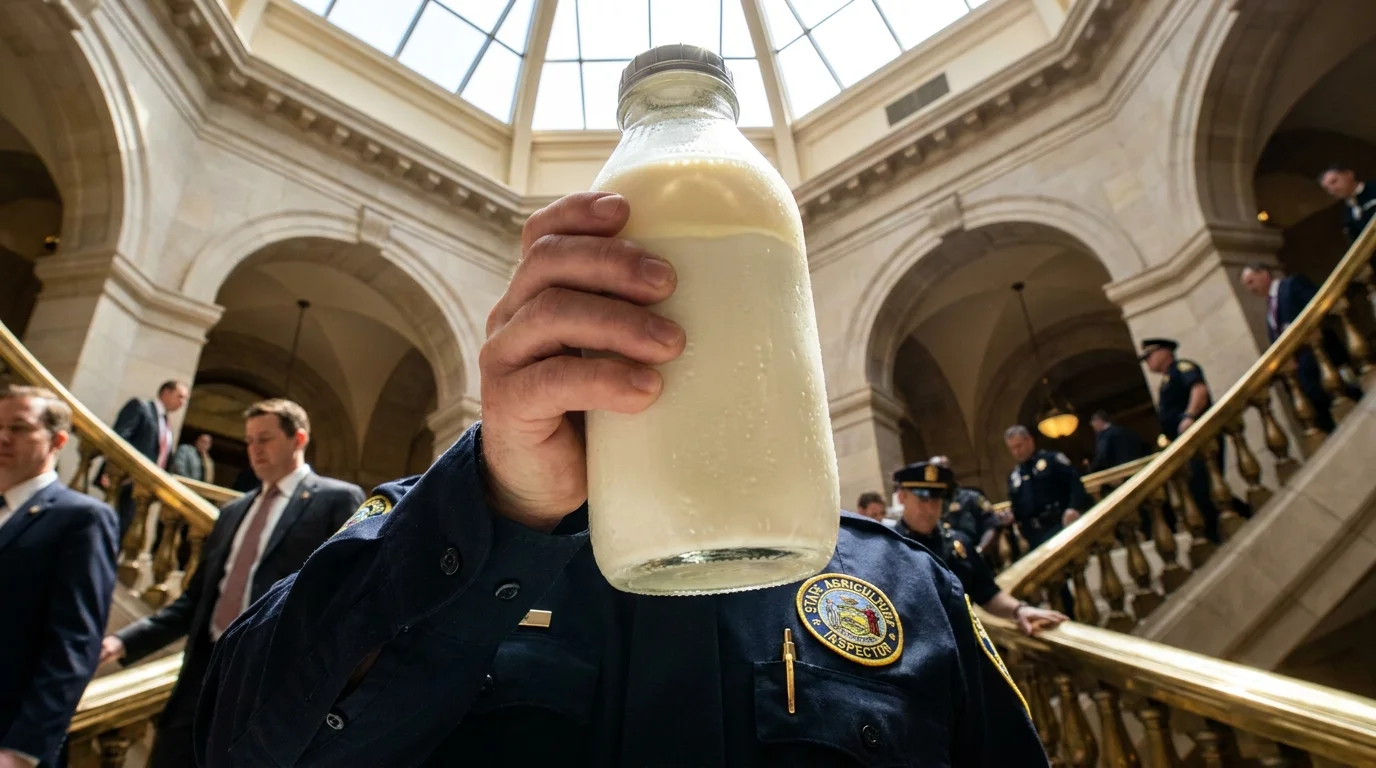
Consider Marcus Campbell, a 52-year-old third-generation dairy inspector in south-central Pennsylvania. Standing in calf-deep mud last November outside an unlicensed micro-dairy, Campbell held a manila folder filled with cease-and-desist orders issued by the state Department of Agriculture, only to find the local sheriff refusing to enforce them because the county had just declared itself an agricultural sanctuary. “We aren’t trying to crush the small producer,” Campbell remarked quietly, adjusting his plastic boot covers. “We are trying to make sure a five-year-old doesn’t spend three months on renal dialysis because a barn cooling compressor tripped during a thunderstorm.”
The Regulatory Fracture: How Exemption Models Split Your State
The legislative wave hitting state capitals is not uniform. Instead, it moves through distinct statutory tiers, each presenting a different risk profile and legal exposure for consumers trying to navigate their local food shed.
The Herd-Share Subterfuge: In states where retail sales remain strictly outlawed, lawmakers and legal collectives often exploit private contract law. You purchase a paper deed representing a fractional share of a dairy cow, turning you into a partial owner. Because you technically own the animal, state sanitarians cannot inspect the transaction as a commercial retail sale. The farm circumvents routine microbial plate counts, leaving you reliant entirely on the producer’s personal cleaning rigor.
The Farm-Gate Exemption: This model permits transactions only if your boots physically touch the farmer’s gravel driveway. State agencies lose jurisdiction the moment commercial distribution corridors are removed. For rural families, this offers direct producer contact, but it entirely strips away retail insurance protections; if a batch turns bad, homeowner and farm liability policies frequently deny claims tied to unpasteurized products.
The Open-Shelf Mandate: The most contentious frontier places raw fluid milk directly onto independent grocery shelves adjacent to conventional cartons. Here, state inspectors face severe jurisdiction gridlock. Department of Health inspectors monitor retail shelves, while Department of Agriculture agents monitor herds, creating an administrative blindspot where neither agency takes responsibility for in-transit refrigeration breaks.
Navigating the Farm Gate: A Pragmatic Field Protocol
If you choose to source fluid dairy outside conventional pasteurized supply chains, passive trust is your greatest vulnerability. You must replace regulatory assumptions with hands-on verification, looking at farm mechanics with the critical eye of a field technician.
- Audit the Chilling Curve: Inspect the farm’s bulk tank chart recorder. Milk must drop below 40 degrees Fahrenheit within two hours of milking; anything slower allows thermophilic bacteria to multiply exponentially.
- Demand Third-Party Lab Sheets: Request monthly standard plate count (SPC) and somatic cell count (SCC) results. Reliable producers test bi-weekly, aiming for an SPC under 5,000 CFU/mL and an SCC below 150,000 cells/mL.
- Inspect Clean-In-Place (CIP) Wash Cycles: Ask to see the pipeline washing setup. Proper sanitization demands water reaching at least 160 degrees Fahrenheit during the alkaline detergent cycle to melt milk fats from stainless steel joints.
- Verify Cold-Chain Custody: Never transport raw glass jugs without an insulated cooler packed with frozen ice packs. In-car trunk temperatures can spike 15 degrees in twenty minutes, destabilizing the natural microbial ecology.
Your tactical toolkit should be straightforward: keep a calibrated digital stem thermometer in your vehicle, carry commercial chlorine test strips to verify sanitize-rinse buckets if you volunteer on-farm, and always retain the batch production lot code written on your jug cap for at least twenty-one days.
The Broader Ledger: Reclaiming True Public Health Literacy
The fiery debate over raw milk deregulation is not genuinely about milk at all. It is a referendum on institutional trust, a cultural rebellion against industrialized processing that often treats food as an inert commodity rather than living sustenance. When you seek unprocessed food, you are often seeking an authentic connection to the land and the hands that tend it.
Yet genuine empowerment does not come from ignoring microbiological reality or celebrating deregulation for the sheer thrill of political defiance. Real agency emerges when you understand the invisible mechanics that keep communities safe from preventable illness. When you hold an unpasteurized jar up to the morning light, you are taking full ownership of a biological process that modern law spent a century mastering. That ownership requires diligence, humility, and an unflinching respect for the microscopic world.
“A clean barn floor guarantees good intentions, but only cold copper pipes and constant lab assays guarantee safe food.”
| Key Point | Detail | Added Value for the Reader |
|---|---|---|
| Regulatory Jurisdiction | State Agriculture vs. Health Departments | Reveals which agency possesses inspection and enforcement teeth in your county. |
| Thermal Processing | High-Temperature Short-Time (161°F for 15s) | Explains the baseline threshold required to neutralize heat-resistant pathogens. |
| Chilling Velocity | Sub-40°F cooling within 120 minutes | Provides a measurable on-farm metric to audit before purchasing fluid milk. |
Frequently Asked Questions
Is raw milk actually healthier than pasteurized milk?
While raw milk preserves active enzymes and native proteins that pasteurization denatures, major nutritional components like calcium, protein, and fat remain virtually identical. Nutritional benefits must be weighed carefully against exposure to zoonotic pathogens.Why are state dairy inspectors so aggressively opposed to deregulation?
Inspectors track systemic public health impacts rather than individual preferences. An outbreak linked to one farm often exhausts local epidemiological resources, strains pediatric wards, and erodes market consumer trust across the entire regional dairy sector.Does freezing raw milk kill harmful bacteria like Listeria?
No. Freezing suspends bacterial activity but preserves pathogens unharmed. Once the milk thaws on your counter or in your refrigerator, any dormant bacteria present will immediately resume cellular replication.What is the single most critical on-farm safety measure to check?
Look directly at the bulk cooling tank’s thermometer and maintenance log. If the milk is not chilled rapidly below 38 degrees Fahrenheit immediately after leaving the cow, all other sanitation efforts are rendered largely irrelevant.Are herd-share agreements legally binding protection for consumers?
No. Herd-share agreements primarily serve to shield the farm owner from unlicensed commercial distribution charges. They offer almost zero product liability warranty or medical financial coverage to the individual consumer if illness occurs.