The late afternoon sun sinks behind the concrete sound barriers of the interstate, turning the asphalt into a shimmering basin of exhaust and heat. Red taillights bleed together in a continuous, pulsing ribbon as your transmission drops into idle. Glaring illuminated vinyl stretched tight across rusted steel frames looms overhead, casting high-wattage campaign slogans across your windshield while your foot remains pressed against the brake pedal.
You might assume the political strategist behind that towering sign simply bought the spot with the highest daily vehicle volume. It seems logical that a million passing cars equals a million swayed minds.
Yet if you are moving at seventy miles per hour, that message is nothing more than a split-second smudge against the skyline. The campaign backer knows this, and they didn’t pay for your speed—they paid for your stillness. Deceleration is the real currency traded behind closed doors in modern outdoor media rooms.
The Velocity Myth: Why Crawling Traffic Costs Triple
For decades, commercial advertisers chased raw daily effective circulation numbers, treating highway billboards like static print ads spread across open plains. Political media consultants, however, operate on a starkly different psychological principle: captive frustration breeds cognitive retention. When your car drops below twenty miles per hour on a treacherous S-curve or an infamous interchange, your eyes naturally wander upward searching for distraction from the bumper ahead.
A driver moving at full cruising velocity glances at roadside signage for roughly 1.4 seconds before peripheral vision cuts off the angle. Drop that speed down to a grinding crawl, and that glance stretches into forty-five continuous seconds of involuntary exposure. Media buyers pay triple rates for specific highway bends not because of how many cars pass through, but because of how long those vehicles are forced to linger beneath the vinyl.
Marcus Vance, a forty-seven-year-old political media strategist based in northern Virginia, spent two decades mapping the morning gridlock along Interstate 66. “Our clients used to demand clear, straight stretches of open highway where their signs looked pretty at noon,” Marcus notes with a wry grin. “Now, we run speed telemetry data pulled from commercial navigation apps before we place a single bid. If the morning commuter isn’t trapped in first gear for at least thirty seconds beneath the face of that board, we walk away from the contract.”
The Spatial Playbook: Three Ways Placements Exploit Your Delay
Modern outdoor political ad buying is no longer about geographic coverage; it is an exercise in applied behavioral friction. Media buyers divide suburban arteries into distinct psychological zones, calibrating their investments based on voter frustration levels.
- Supreme Court mail ballot rulings derail late envelope deadlines across competitive county boards
- Social Security COLA formulas demand Chained CPI cuts stripping monthly grocery checks
- Ed Markey primary challengers resurfaced veteran congressional votes sparking heated union splits
- United States Attorney appointments switch Senate battle lines over swift federal oversight
- Brooklyn Democratic Party rule changes derail progressive precinct power across urban districts
The Bottleneck Squeeze: These boards sit directly ahead of notorious highway merges where four lanes compress into two. As drivers fight for lane position and repeatedly check mirrors, the campaign slogan operates as an unavoidable visual anchor at the exact focal point of highway tension.
The Signal Stagnation Zone: Placed along multi-lane suburban boulevards just before major timed intersections, these boards target voters idling through two or three full red-light cycles. Extended dwell times create familiarity that mimics grassroots name recognition by the time primary election morning arrives.
The Off-Ramp Funnel: Positioned above tight deceleration loops where highway speeds drop abruptly onto city streets, these units capture commuters when their attention is heightened and their vehicle is slowing down to navigate tight radius turns.
Mapping the Trap: How Campaigns Engineer Captive Exposure
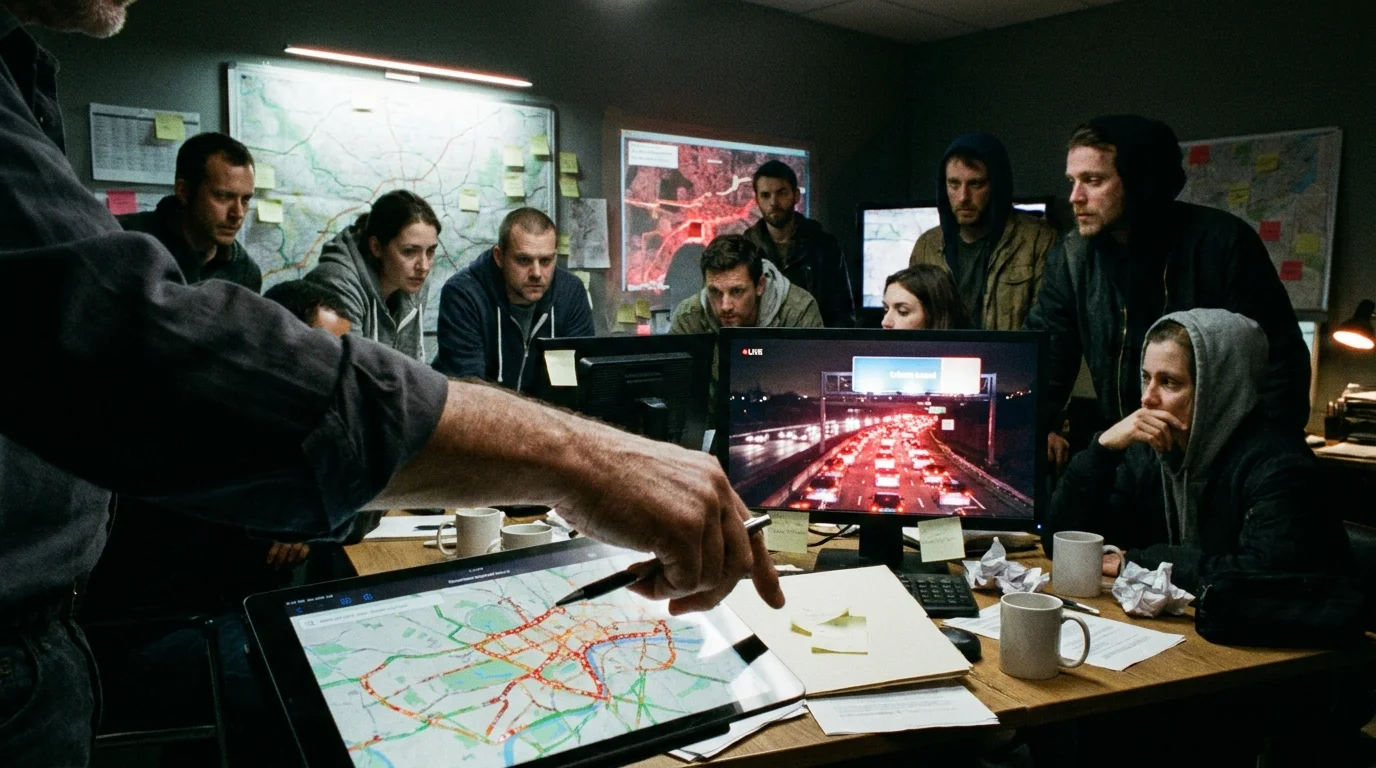
Understanding how media buyers construct these placements allows you to see the road through the eyes of an operative rather than a targeted motorist. The process relies on hyper-local velocity audits rather than broad demographic surveys.
- Speed Variance Audits: Consultants cross-reference Department of Transportation road sensors with live routing data to pinpoint corridor segments where average rush-hour speeds fall under twenty miles per hour.
- Sightline Geometry: Sign structures are selected based on horizontal curvature, ensuring the vinyl faces directly into the windshield rather than sitting perpendicular to the road edge.
- Micro-Targeted Flight Windows: Contracts are structured around narrow four-week windows preceding early voting deadlines, prioritizing high-friction corridors in pivotal legislative districts.
Tactical Toolkit: The Friction Metrics Behind Roadside Placements
- Dwell Index: Minimum calculated exposure threshold of twenty-five continuous seconds per vehicle passage.
- Velocity Cap: Optimal road speed target set between eight and eighteen miles per hour during peak commute hours.
- Angular Offset: Sign orientation within twelve degrees of the driver’s forward horizon to maximize involuntary gaze retention.
Reading the Roadside with Clear Eyes
When you sit in stalled traffic tomorrow morning, take a closer look at the bold lettering looming over the highway shoulder. The placement is neither an accident of geography nor a simple billboard rental; it is a calculated bet on your daily frustration and stalled momentum.
Recognizing the mechanics behind these roadside contracts strips away their subconscious weight. Awareness breaks the psychological hold of captive exposure, turning an engineered distraction back into what it truly is: plain vinyl hanging from a steel post above an all-too-familiar commute.
“When traffic stops moving, the driver’s windshield turns into an unskippable political broadcast screen.”
| Placement Factor | Traditional Billboard Metric | Strategic Political Value |
|---|---|---|
| Primary Selection Metric | Gross Daily Traffic Volume | Average Deceleration and Dwell Time |
| Optimal Vehicle Speed | 55 to 70 MPH (High Flow) | Under 20 MPH (Forced Bottleneck) |
| Driver Focus Dynamic | Peripheral, fleeting glance (1-2 seconds) | Direct visual anchor during idle delay (30+ seconds) |
| Rate Valuation | Standard market base rate | Up to 300% premium for persistent gridlock zones |
Frequently Asked Questions
Why do political campaigns prefer slow traffic over high-speed freeways?
Campaigns prioritize dwell time over raw vehicle counts because lingering in view of a sign produces substantially higher message recall than passing it in two seconds.
How do media buyers identify these exact traffic bottlenecks?
Buyers analyze aggregated GPS telemetry and regional transit sensor feeds to find roadway stretches where morning and evening commuter speeds consistently collapse.
Do billboard companies charge more for boards located near bottlenecks?
Yes, outdoor advertising operators assign premium rate tiers to locations with documented congestion, knowing political and corporate buyers compete aggressively for high dwell times.
Are digital LED billboards used differently than printed vinyl boards in traffic jams?
Digital boards cycle multiple advertisers every few seconds, making them effective only in severe gridlock where a stalled driver witnesses several full ad loops before moving forward.
How can voters inoculate themselves against captive roadside advertising?
Recognizing that billboard placements are engineered around commute delays helps you critically evaluate political messaging rather than passively absorbing repeated visual cues.