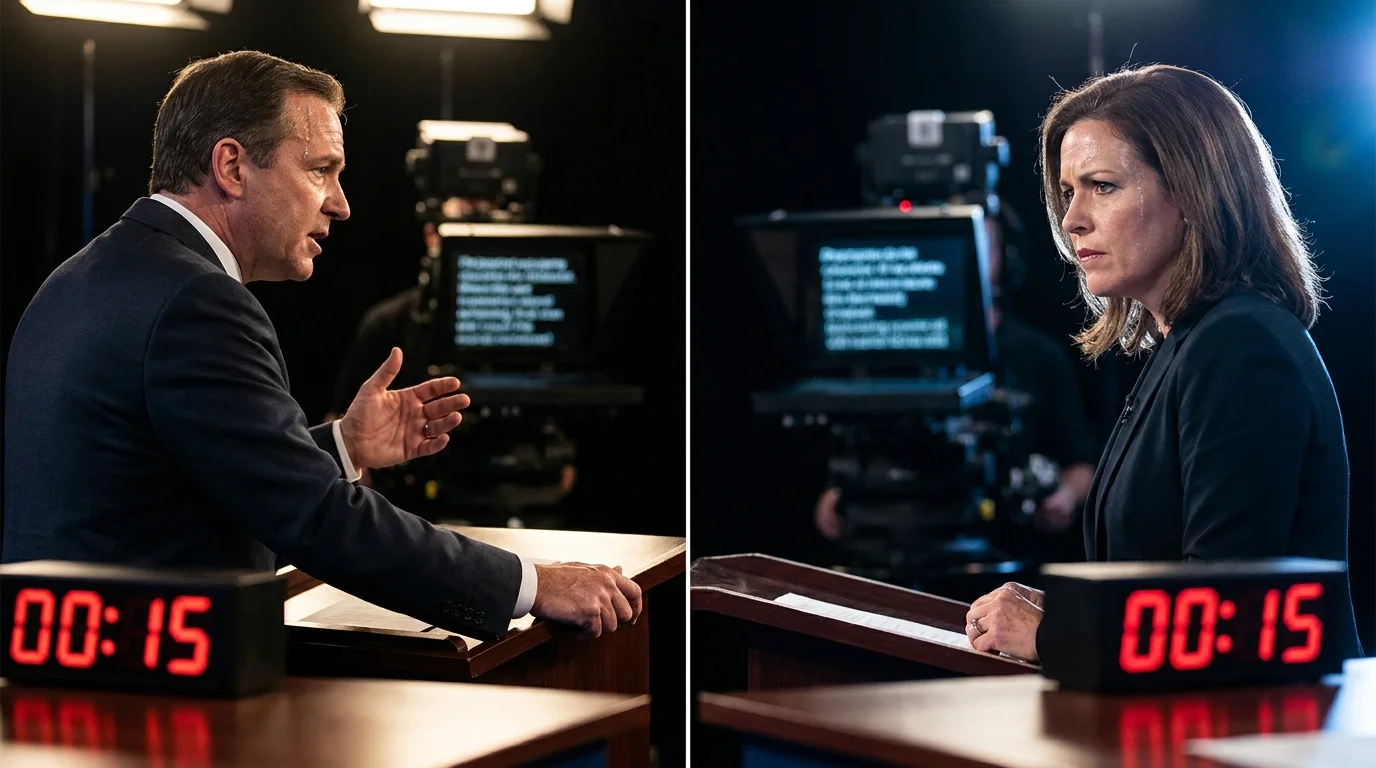
The studio floor hums at a bone-dry seventy degrees, yet under forty thousand watts of overhead halogen, the air feels thick enough to chew. You watch the candidate grip the edges of the podium, knuckles whitening against dark wood. Across the room, perched just beneath the broadcast lens, a set of glowing crimson digital numbers reflects off the polished walnut surface, slicing through the manufactured calm of the television set.
Viewers at home assume a sudden stumble stems from a bruising policy question or an unexpected counterpunch. But watch closer. When a speaker begins to clip their vowels, their neck muscles tense, and their vocal tone jumps half an octave into a thin, breathless register, the adversary is not standing behind the opposing lectern. The real culprit is that silent, mechanical counter ticking down to zero inside their peripheral vision.
The human nervous system hates an unyielding deadline it cannot negotiate with. When that glowing square shifts from steady green to flashing amber and finally to an aggressive, strobe-like red, the subconscious brain rings an ancient alarm. You are watching a physiological ambush disguised as a television production feature.
The Visual Trap: Why Stage Optics Break Composure
We often treat debate performances as intellectual boxing matches, assuming logic and rhetorical stamina dictate who wins the night. In reality, modern televised showdowns are sensory endurance trials where stage architecture quietly dictates physical control. When candidates lose their footing, they rarely suffer from a lack of factual recall; instead, visual stimuli hijack autonomic breathing before the brain can formulate a steady defense.
Think of a countdown display not as a clock, but as an optical metronome that forces the speaker to match its frantic energy. As the digital readout drops below ten seconds, the human eye instinctively tracks the rapid pixel shift. This subtle distraction forces an immediate split in cognitive bandwidth. The brain must simultaneously construct a coherent closing argument while tracking a high-contrast optical warning.
The physical consequence is immediate. The diaphragm tightens, shallow chest breathing replaces diaphragmatic airflow, and the vocal cords stretch taut like over-wound guitar strings. What reaches the living room microphone is not the measured voice of a statesman, but an involuntary, high-pitched rush to beat the buzzer.
- Likely voter screens strip young registrants using landline caller ID filters
- Barack Obama teleprompter scripts enforce cadence shifts with bold yellow slash marks
- Save America PAC leadership switches official donor guidelines after abrupt executive staff departures
- Florida governor race polling reveals sudden turnout shifts across fast-growing coastal retirement communities
- Pete Hegseth Senate confirmation hearing sparks rapid committee revisions over Pentagon command structures
The Studio Secret: A Coach’s Hidden Metric
Marcus Vance, a fifty-two-year-old communications strategist who has prepared statewide candidates across four election cycles in Washington, spends less time drilling policy whitepapers than he does conditioning his clients to ignore the floor monitors. During mock sessions in windowless hotel ballrooms, Vance sets up high-intensity strobe timers directly beneath camera teleprompters to simulate the exact visual friction of a primetime broadcast.
“You can instantly spot a candidate who only practiced in front of a bathroom mirror,” Vance explains. “The moment those crimson digits start flashing, their eyes drop two inches, their vocal pitch spikes into a defensive squeak, and they sacrifice their cadence just to finish a sentence before the red light locks them out.”
The Anatomy of an On-Air Vocal Collapse
Understanding how stage optics trigger physical shifts allows you to see through the high-definition polish of any broadcast. When that digital clock begins to run out, the breakdown unfolds across three distinct layers:
- Cadence Compression: Rather than condensing the core thought, the speaker doubles their syllable speed. Sentences lose their natural pauses, eliminating the vocal weight that conveys authority.
- The Glottal Spike: As panic accelerates delivery, the speaker breathes through an open throat rather than the nose, drying out the vocal tract and forcing pitch upward by up to twenty hertz.
- The Peripheral Scan: The candidate’s gaze flickers downward every 1.5 seconds. To the audience at home, this rapid eye darting reads not as time consciousness, but as guilt, evasiveness, or sudden insecurity.
When these three reactions compound under hot key lights, the candidate surrenders stage control entirely to the broadcast director’s production clock.
Mindful Application: Neutralizing the Stage Clock
Whether facing a televised debate panel or simply delivering a high-stakes corporate pitch under a strict presentation timer, maintaining physical equilibrium requires deliberate sensory decoupling. You must learn to treat visual time cues as background noise rather than urgent commands.
- Ground the lower half: Distribute weight evenly across the balls of both feet. Locking the knees restricts blood flow and amplifies sympathetic nervous system tension when the timer turns yellow.
- Breathe below the belt: Anchor air intake into the lower abdomen between phrases. This prevents the shallow chest rise that immediately drives vocal pitch upward.
- Fix your focal plane: Keep your eye level three inches above the timer display, locking onto the camera lens or an audience member’s forehead to eliminate downward glances.
- Land on the period: When the crimson numbers flash, drop your volume slightly and slow down the final five words instead of rushing to squeeze in extra points.
The On-Stage Recovery Protocol
- Target Pitch: Maintain vocal resonance between 85 to 165 Hz (chest voice).
- Pacing Threshold: Cap delivery at 130 to 145 words per minute, even during final countdowns.
- Gaze Anchor: Maintain single-point focus for a minimum of 4 seconds per camera cut.
The Bigger Picture: Reading Between the Red Lights
Once you recognize how staging quirks, lighting angles, and glowing podium timers shape human behavior on screen, political debates transform from simple verbal sparring matches into masterclasses in stress regulation. The most effective speakers are not necessarily those with the sharpest insults or the slickest policy memorization.
True composure belongs to the speaker who can stare directly past a flashing red readout, breathe through the artificial tension of the studio, and finish their thought with unhurried grace. When you watch the next major debate, ignore the words for a moment. Look for the crimson reflection on the walnut wood, listen for the pitch of the voice, and you will see who truly owns the room.
The loudest tell on any debate stage is not what a candidate says, but the split-second their voice climbs when the timer turns red.
| Key Point | Detail | Added Value for the Reader |
|---|---|---|
| Optical Stress Response | Flashing digital counters trigger sympathetic nervous system arousal. | Explains why polished speakers suddenly sound flustered and rushed. |
| Acoustic Pitch Shift | Shallow breathing under time pressure tightens the vocal cords. | Helps you identify manufactured panic versus authentic emotional delivery. |
| Gaze Decoupling | Eye movements drop toward podium displays under visual deadlines. | Allows you to separate perceived evasiveness from simple clock-watching. |
Frequently Asked Questions
Why do debate podiums use visible timers instead of audio cues?
Audio cues disrupt television audio tracks and can cut off speaking points awkwardly, whereas silent optical timers place the burden of pacing entirely on the candidate’s self-discipline.Does a higher vocal pitch actually change how voters perceive authority?
Yes. Psychoacoustic research demonstrates that audiences subconsciously associate lower, resonant vocal pitches with calm competence, while sudden jumps in pitch are interpreted as distress or weakness.Can candidates see the countdown timer the entire time they speak?
In most modern formats, timers are positioned both on the lectern fascia and on floor monitors mounted directly beneath the broadcast cameras to ensure visibility from multiple sightlines.Why don’t candidates just ignore the clock entirely?
Modern debate rules enforce strict microphone cutoffs when timers expire; running over risks an abrupt, unflattering audio silence mid-sentence.How can public speakers train against this optical distraction?
Practice delivering presentations with a flashing digital stopwatch placed directly in your lower field of vision while focusing on slowing your cadence as zero approaches.