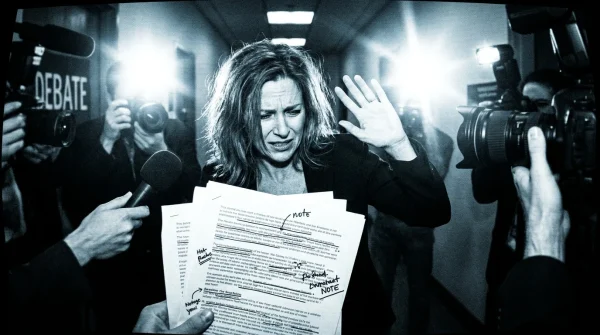
The basement room beneath the Capitol visitor center smells faintly of industrial carpet cleaner, lukewarm hotel urn coffee, and damp wool coats dried too fast on radiator coils. When the heavy doors thud shut on a Tuesday morning party meeting, the noise of the marble hallways cuts out completely. Outside, television cameras wait for disciplined podium soundbites. Inside Room HVC-215, there are no teleprompters, no rehearsed smiles, and none of the airbrushed solidarity that fills Sunday morning political panels.
You see two hundred politicians jammed into rows of tight chairs, their phones glowing with panicked texts from campaign managers back home. When House Democratic Leader Hakeem Jeffries stepped up to the lectern, the usual murmur of staff chatter dried up instantly. He had called this meeting to lock down discipline on upcoming fiscal and border floor votes, expecting his team to hold the perimeter. Instead, he met a wall of cold, unblinking resistance from members who represent districts where national party orthodoxies get people tossed out of office.
The tension snap in that room wasn’t polite or subtle; it felt like breathing through a pillow during a summer thunderstorm. A cluster of moderate lawmakers—holding fragile suburban and rural districts from Pennsylvania to California—openly pushed back against party marching orders. They made it plain that their survival in November mattered far more than any leadership whipping operation designed to produce an artificial 100 percent party-line card.
The Illusion of the Iron Whip
For years, cable news has trained you to look at congressional politics like an automated machine where leaders flip switches and backbenchers march in lockstep. We tell ourselves that party chiefs wield absolute power, using campaign checks and committee gavels like iron leashes. But that mental model fails the moment inflation bites at the kitchen table or local district margins shrink below two percentage points.
True power in a narrowly split chamber operates less like an army and more like a row of independent franchise owners sharing a single brand awning. Survival overrides partisan loyalty every time local voter sentiment threatens to pull the ground out from under an elected official’s feet. When party leadership demands a sacrificial vote to protect a high-altitude national talking point, frontline lawmakers recognize a bad transaction immediately.
What exploded in that room was not an academic debate over legislative wording, but an urgent clash over physical political existence. For moderate members from swing districts, crossing leadership on specific border enforcement measures and energy spending votes is not an act of disloyalty. It is the only reason they have a seat in Washington at all.
The View from the Frontline Ledger
Consider Greg Miller, a 48-year-old chief of staff who has spent nineteen years navigating purple industrial districts along the Ohio and Pennsylvania borders. During that closed caucus session, Miller sat against the perimeter wall, watching his boss’s name flash red on leadership’s internal vote tally spreadsheet. The whip team had spent three days sending escalating memos, subtly reminding frontline offices about campaign committee grant distributions and prized subcommittee assignments.
- Provisional ballot envelopes strip thousands of valid votes over minor flap sealing errors
- State turnpike concessions trap daily highway commuters under inflated private food pricing
- Fifth Circuit injunctions freeze federal contractor pay rules hours before sunrise deadlines
- Joe diGenova recordings spark fierce primetime debate clash over justice department loyalties
- Iowa caucus precincts override national polling momentum through obscure delegate allocation formulas
Miller’s boss didn’t budge. In their home county, diesel prices remain stubbornly high, local factories face brutal overseas competition, and voters routinely split their tickets between a conservative sheriff and a moderate congressman. Miller leaned over to a colleague from Virginia and whispered what every battleground member was thinking: leadership can be mad at you for three legislative weeks, but if you listen to them, your local constituents will fire you on the first Tuesday of November.
Deconstructing the Caucus Fault Lines
To understand why this revolt caught leadership off guard, you have to separate the House minority into three distinct survival profiles. Each group plays by entirely different electoral rules, answering to radically different audiences.
The Battleground Frontliners
These are the members representing districts won by narrow, single-digit margins. They do not have the luxury of voting on ideological principle because their seats sit on a razor’s edge. Their political lives hinge on proving to independent voters that they are not rubber stamps for national leaders based in Brooklyn or San Francisco.
For these lawmakers, breaking ranks on controversial floor amendments is not a betrayal; it is an active campaign asset. They take the leadership reprimand gladly because a public scolding from party brass plays exceptionally well in local newspaper editorials back home.
The Ideological Core
Occupying deep-blue metropolitan seats, this contingent views every deviation from progressive party platforms as an inexcusable compromise. Their primary threats never come from the opposition party; they come from energetic primary challengers running to their left. Because their general elections are settled before summer ends, they operate with an urgency focused entirely on national movement benchmarks.
When these members hear moderates demanding split-ticket votes, they interpret it as moral weakness. This ideological clash turns private strategy sessions into tense ideological tribunals, leaving leadership caught directly between structural purity and the raw arithmetic of winning an actual majority.
The Quiet Majority Pragmatists
Occupying the middle ground are senior institutionalists who simply want legislation that can clear the Senate and reach a presidential desk. They view sudden partisan rebellions as tactical headaches that waste floor time and derail appropriations. Yet even this quiet middle is beginning to fray as district polling shows working-class households tuning out national leadership talking points.
How to Decode the Next House Floor Showdown
Watching this friction play out on C-SPAN gives you a masterclass in modern legislative survival if you know what signs to watch for. You do not need an insider pass to see through party spin; you just need to track the procedural friction points.
- Watch the Rule Votes: Before the House votes on any major bill, members cast a vote on the ‘rule’ governing debate. Traditionally, parties vote unanimously along party lines here. The moment moderates start threatening to sink a rule, leadership knows they have lost operational control of the floor.
- Track the Late Floor Board Flips: During electronic voting, glance at the digital board in the final two minutes. Frontline members rarely vote early; they stand in the well, watching whether leadership has enough votes without them before casting their tally.
- Audit Member Press Releases: When a lawmaker breaks rank, check how fast their district communications hit local newsrooms. If a release lands within eight minutes of the gavel falling, the defiance was not spontaneous; it was planned and poll-tested for weeks.
- Notice the Seating Chart Shifts: Friction inside the Capitol shows up in posture. When members start avoiding their traditional regional row seating and huddle near the back rail with across-the-aisle colleagues, caucus discipline has ruptured.
Keep a simple tactical toolkit on your browser bookmarks. Use Congress.gov roll call trackers alongside the Cook Political Report district index to see if your own representative is voting to appease national party leaders or to defend your specific neighborhood economy.
The Autonomy of Your Local Ballot
When you watch a leader like Hakeem Jeffries struggle to contain a mutiny within his ranks, it is easy to view it as Capitol Hill dysfunction. But looked at from another angle, intra-party friction is often the only proof that representative democracy is still breathing.
A monolithic party that marches in unbroken uniformity is rarely serving the wildly diverse economic realities of five hundred distinct congressional districts. When your representative breaks with their party boss, it signals that the pressure you apply at the town hall, the county fair, and the ballot box still carries more weight than an angry memo drafted in a leadership suite.
Real legislative leverage never belongs to the people standing at the lectern; it belongs to the backbenchers who are entirely unafraid to lose the leader’s phone number.
| Key Point | Detail | Added Value for the Reader |
|---|---|---|
| Floor Rule Disruption | Moderates hold procedural debate rules hostage to force floor amendments. | Allows you to spot legislative rebellion hours before headline news picks it up. |
| District-First Economics | Frontline members prioritize local energy, tax, and manufacturing jobs over party unity. | Clarifies why your representative might suddenly vote against national party rhetoric. |
| The Survival Calculus | Party whips lose influence when electoral survival margins drop below three percent. | Shows you how narrow majorities give everyday voters outsized power over policy outcomes. |
Frequently Asked Questions
Why does party leadership care so much about maintaining total voting unity?
Narrow majorities leave zero margin for error. If leadership allows three or four members to defect without consequence, the floodgates open, destroying their ability to pass policy or negotiate deals from a position of institutional strength.Do members face real punishment when they break party ranks?
Yes, leadership can strip committee assignments, withhold campaign funding transfers, or stall local district infrastructure projects. However, frontline members calculate that losing a committee seat is better than losing their job entirely on election night.What is a ‘rule vote’ and why is it so significant in these rebellions?
A rule vote establishes the parameters of debate, including which amendments are allowed on the floor. Voting against your own party’s rule is historically considered the ultimate betrayal, making it the most potent weapon moderates possess.How does this revolt affect everyday households?
When rank-and-file members break lines, extreme or highly partisan policy proposals stall. This forces leadership to rewrite bills toward the center, often stripping out controversial taxes, fees, or regulatory mandates that hit consumer pocketbooks.Where can I see my representative’s actual voting record without party spin?
You can consult the official Clerk of the United States House of Representatives website (clerk.house.gov) or Congress.gov, where every recorded roll call vote is archived chronologically without public relations framing.