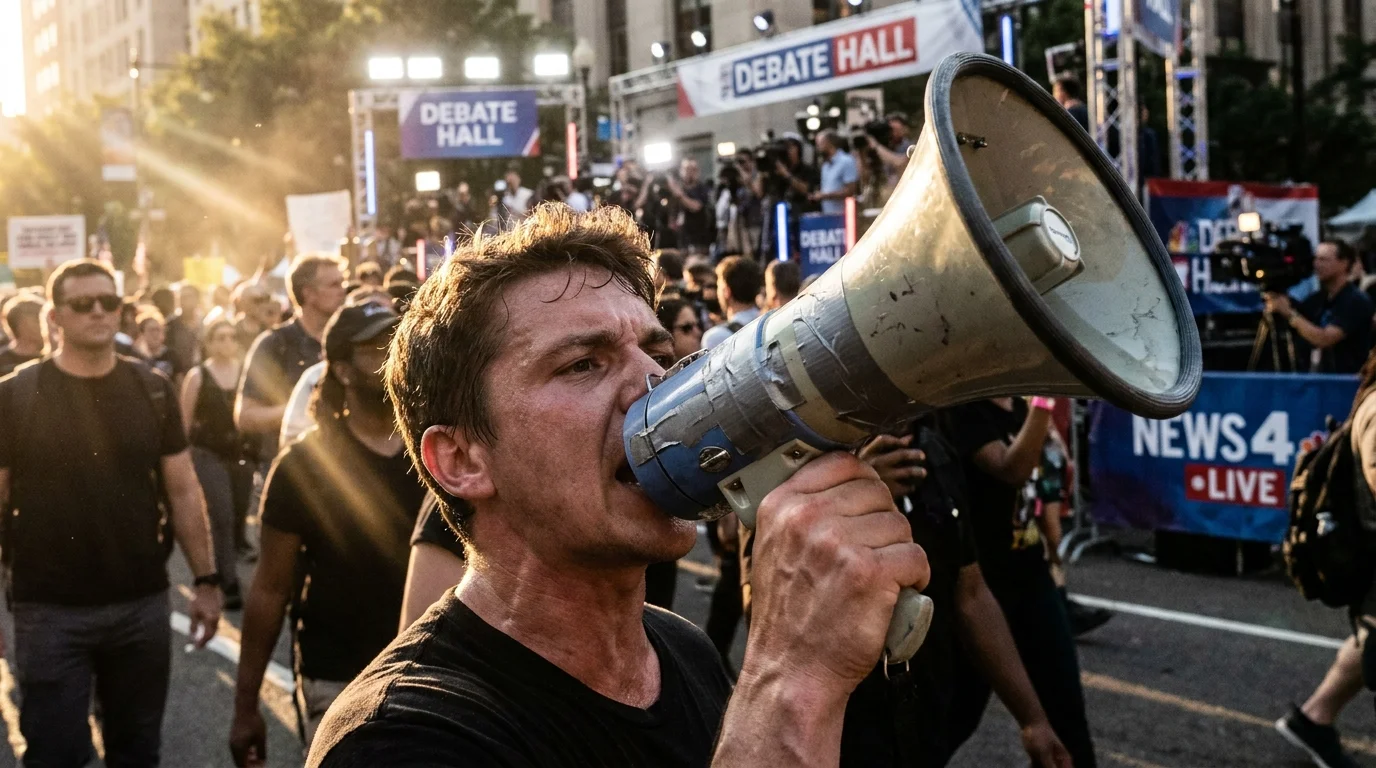
The studio floor was freezing under the halogen wash, cold enough that you could watch the production crew huddling by the stage wings in down vests. At your kitchen table miles away, the television glass cast a cool, flicker-blue haze across cooling mugs of tea and scattered mail. When the moderators brought up the audio, the nervous hum of the audience snapped off completely. It was not the usual scripted theater of rehearsed talking points; it was that sudden, sharp intake of air you hear when somebody drops a drinking glass on hardwood.
You could hear the crackle of telephone static pulsing through the hall speakers before the candidate at podium three leaned into his microphone. The newly surfaced Joe diGenova recordings did not sound like legal arguments or measured counsel. They carried the raw, raspy cadence of an operator breathing through a pillow, discussing federal prosecutorial levers as if they were simple chess pawns on a parlor board. In an instant, the evening stopped being about domestic tax formulas or border fences.
Watching the stage monitor split four ways, you could see the exact moment the political math shifted. Two candidates braced their forearms flat against the podium edges, visibly recalculating their prepared attacks in real time while their opponents pounced. The theater of forensic impartiality vanished, replaced by an abrasive struggle over who truly pulls the levers inside the Department of Justice when the lights go down.
The Acoustic Trap and the Lever of Loyalty
Most viewers watch a televised debate looking for who delivers the crispiest zinger or who blinks first under scrutiny. That is how traditional commentary trains us to watch. But inside the mechanics of institutional power, these public spectacles operate on a completely different frequency: they are acoustic traps designed to test systemic loyalty under sudden stress.
Think of an unsealed telephone wire like an ungrounded copper wire running through an old house. For months, it sits silently inside the plaster while everyone assumes the circuitry is clean. Then lightning strikes, and the insulation burns away in seconds, revealing the bare metal beneath. Surfaced call audio exposes raw calculations that professional campaign staffers spend entire careers attempting to sterilize.
When those tapes crackled through the hall, the dispute was not about whether someone had an abrasive conversational style behind closed doors. The confrontation forced a live, unyielding public reckoning: does the nation’s premier law enforcement apparatus function as an objective constitutional buffer, or has it devolved into a private bodyguard service for political factions? Once that question is spoken aloud on live television, nobody on that stage is allowed to look away.
- Iowa caucus precincts override national polling momentum through obscure delegate allocation formulas
- Senate Finance Committee drafts reveal how secret tax exemptions pass without floor debate
- Ron DeSantis debate cadences expose calculated rhetorical traps designed for undecided voters
- Iranian protest rallies force sudden White House foreign policy platform pivot
- James Talarico survey spikes trigger immediate panic across Texas Republican leadership
The War Room Ledger
Consider Marcus Vance, a 48-year-old rapid-response strategist who spent thirteen years running opposition research out of a windowless brick row house in Richmond. Marcus keeps an old brass desk bell on his desk—a souvenir from his early days running local state senate campaigns—and he will tell you that true debate pivot points never happen on policy merits; they happen when an archive turns audible. When words remain on paper, the human brain treats them as debatable abstractions. But the moment an authentic human voice hits the ear canal with colloquial intimacy, the defensive wall crumbles. Marcus watched the dials spike sharply on his diagnostic screens the second that tape played, recognizing immediately that the carefully built policy decks were useless for the rest of the night.
Dissecting the On-Stage Factions
Watching candidates react to compromised tapes requires recognizing the specific survival archetypes playing out across the debate risers. Each faction navigates the fallout through an entirely different lens of self-preservation.
The Constitutional Institutionalist
This faction treats the audio as proof of institutional decay. Rather than attacking diGenova as an isolated rogue agent, they point to the recordings as symptom and proof that standard barriers between executive authority and the courtroom have rotted away entirely. They frame prosecutorial neutrality as fragile, demanding systemic overhauls, independent inspector general investigations, and immediate testimony under oath.
The Executive Loyalist
For these contenders, survival depends on aggressive defense through counter-offense. They dismiss the calls as selective leaks, private banter taken out of context, or typical Washington legal posturing blown up by an antagonistic press. Their objective is to redirect your gaze immediately toward the opposing party’s past enforcement double standards, normalizing the backchannel conduct as necessary resistance against a biased bureaucracy.
The Tactical Neutral
Caught squarely in the crossfire, the fence-sitters try desperately to steer the conversation back to kitchen-table pocketbook issues. They understand that lingering on federal subpoenas and backroom loyalties alienates swing voters who are worried about grocery inflation and mortgage rates. Yet on this night, that avoidance sounded less like discipline and more like an uncomfortable evasion.
Reading the Signals: A Citizen’s Forensic Playbook
When explosive audio leaks dominate your newsfeed and primetime screens, you do not have to fall into the outrage loop. You can break down the performance using a quiet, structured set of mental filters.
Watch the staging rather than the fury. When a candidate uses another person’s recorded words on stage, they are attempting to lock their rival into an impossible evidentiary bind. Here is how to trace the mechanics behind the curtain:
- Listen for the prepositional shift: Notice when a speaker shifts from arguing whether an event happened to defending why someone was justified in saying it.
- Track eye line changes: When a sudden question on backchannel recordings drops, watch whether the candidate looks directly into the lens or glances instinctively at the timer screens.
- Monitor the proxy evasion: Take note of when an advocate attacks the courier of the leak rather than denying the substance of the audio itself.
- Audit the silence: The most revealing reaction is often the candidate who chooses not to jump in, hoping the dust settles without forcing their allegiance onto the official record.
Keep a tactical toolkit close when evaluating these moments: take note of the recording’s verified chain of custody, identify the exact date stamp versus when the federal actions occurred, and cross-reference the spoken claims against unsealed court dockets rather than morning-after pundit panels.
Beyond the Studio Glare
When the broadcast credits rolled and the stage lights finally snapped off, the lingering tension did not stay behind on the podiums. It followed viewers right back out into their everyday routines. It sits in the lingering, uncomfortable suspicion that the rules governing ordinary citizens bear little resemblance to the backchannel maneuvering of high-level operators.
Understanding how recorded words are wielded on a national stage gives you back your own perspective. Clarity is the ultimate civic defense against political vertigo. When you see through the high-volume clashes and recognize the machinery of institutional allegiance underneath, the spectacle loses its power to disorient you, leaving behind a grounded, sharper view of how power actually talks when it thinks no one is listening.
The true measure of legal authority is not whether it can survive an attack on the debate stage, but whether it operates by the same quiet standard behind closed doors.
| Key Point | Detail | Added Value for the Reader |
|---|---|---|
| Acoustic Impact | Spoken audio bypasses typical defensive cognitive skepticism far quicker than printed text transcripts. | Helps you recognize why audio clips alter voter perception faster than print reports. |
| Institutional Loyalty | The debate exposed deep divides over whether federal prosecutors serve the presidency or the law. | Clarifies how candidate positions directly shape future judicial appointments and regulatory oversight. |
| Pivot Dynamics | Candidates spent critical airtime either validating or discrediting third-party legal backchannels. | Allows you to separate performative studio outrage from actionable policy proposals. |
Frequently Asked Questions
What were the Joe diGenova recordings referenced during the debate?
They refer to newly surfaced telephone call audio featuring long-time legal strategist Joe diGenova discussing internal Department of Justice dynamics and prosecutorial loyalties in sensitive cases.Why did the audio trigger such a fierce confrontation on stage?
Candidates used the specific statements in the audio to force rivals into publicly defending or condemning backchannel political influence over federal investigations.Did the candidates dispute the authenticity of the audio clips?
While the baseline existence of the conversations was widely acknowledged, debate arguments centered on the context of the remarks, whether they represented serious policy directives, and how the audio was obtained.How do debate clashes like this affect ordinary voters?
These moments signal how future presidential administrations will handle executive appointments, oversight investigations, and the perceived independence of law enforcement bodies.What should I look for when evaluating audio leaks in political races?
Examine the chain of custody, verify the contextual date of the recording against actual judicial filings, and note whether spokespeople dispute the facts or merely attack the timing of the release.