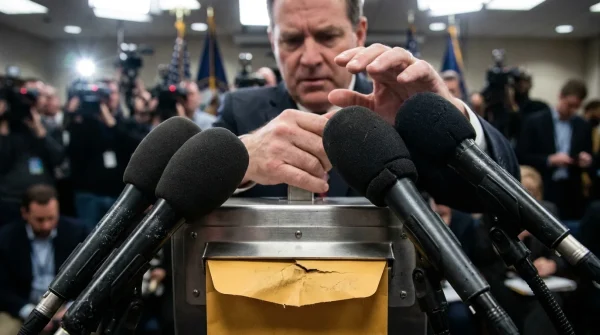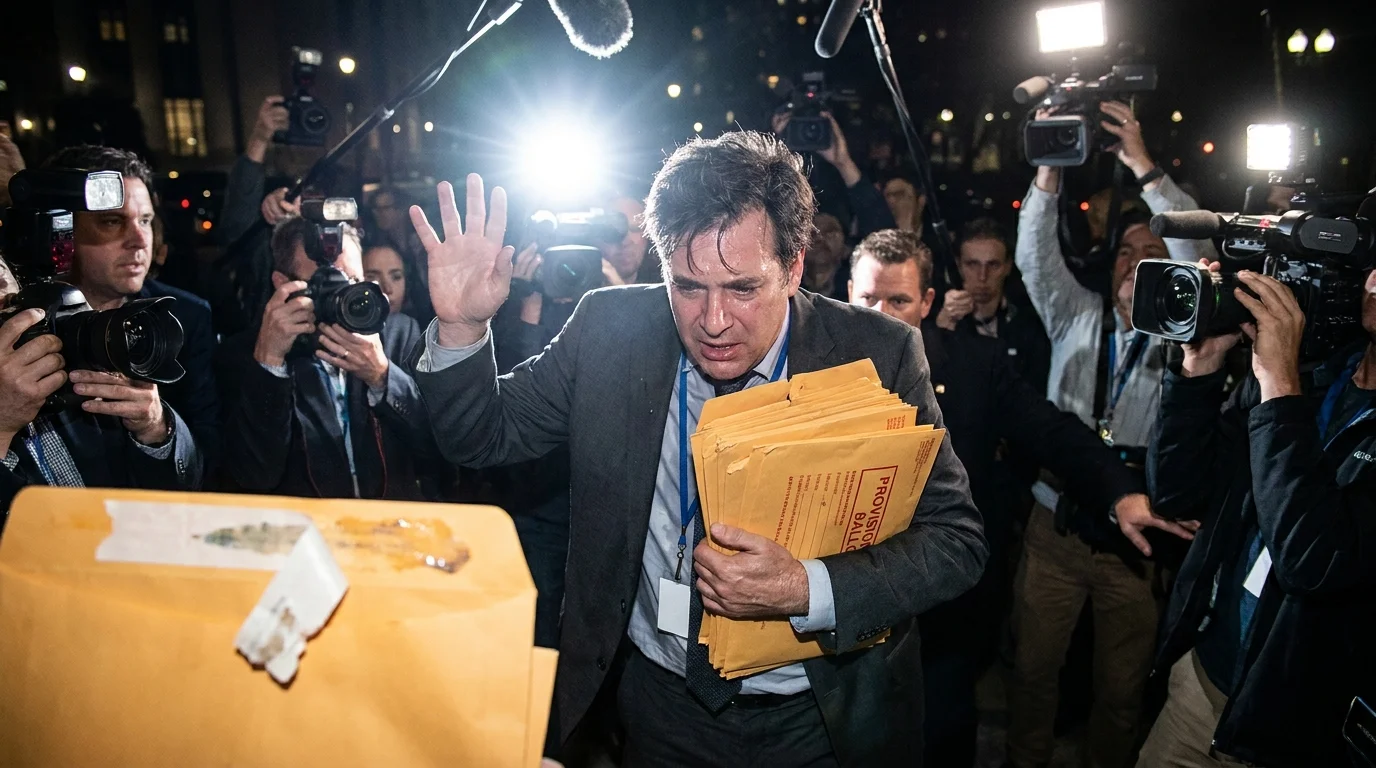
The harsh hum of fluorescent warehouse lighting reflects off long rows of folding tables. In county election hubs from Pennsylvania to Maricopa, the air smells of old corrugated cardboard, sterile hand sanitizer, and warm paper dust. You hear the rhythmic, hollow scrape of sorting bins sliding across laminate surfaces, accompanied by the occasional sharp snap of plastic seals breaking.
You might picture election workers spending their night verifying party registrations, cross-checking state databases, or deciphering ambiguous pencil marks inside candidate ovals. That is the civic ritual taught in school textbooks. But in the quiet backroom hours before canvassing boards convene, a far more mundane filter decides your vote’s fate.
A worker wearing latex gloves slides a steel metric ruler under the edge of a heavy paper sleeve. If the gummed seam yields by a fraction of an inch—or if an unmoistened corner lifts like a dry autumn leaf—that envelope stops moving forward. Before your choices are counted, a physical paper bond determines whether you spoke at all.
Thousands of eligible voters walk away from precinct polling tables confident they did their civic duty after a clerical glitch forced them onto a backup slip. Yet, behind locked double doors, clerks toss these envelopes into quarantine bins based entirely on the mechanical geometry of the adhesive flap.
The Anatomy of the Paper Vault
Most citizens treat a provisional ballot envelope like an ordinary birthday card mailing: lick the flap, press lightly with a thumb, and slide it across the registration desk. That casual habit is where your vote falls into a structural trap. In the administrative reality of election administration, these security mailers are not envelopes; they are tamper-evident legal vessels that operate under the strict mechanics of evidentiary custody.
Think of the sealing process not as closing correspondence, but as setting a pressure-sensitive padlock. If an evidence bag at a crime scene shows an unsealed corner, defense attorneys toss it out of court on chain-of-custody grounds. County election boards use that exact evidentiary standard when reviewing provisional ballot envelopes. If the flap can be lifted without ripping the paper grain, clerks legally presume the envelope could have been compromised in transit.
What feels like a harmless clerical technicality to you is viewed by election statutes as a security breach. Clerks do not seek fraud; they enforce zero-tolerance physical tolerances designed to survive rigorous partisan audit challenges.
- State turnpike concessions trap daily highway commuters under inflated private food pricing
- Fifth Circuit injunctions freeze federal contractor pay rules hours before sunrise deadlines
- Joe diGenova recordings spark fierce primetime debate clash over justice department loyalties
- Iowa caucus precincts override national polling momentum through obscure delegate allocation formulas
- Senate Finance Committee drafts reveal how secret tax exemptions pass without floor debate
The Table-Two Inspection at the County Warehouse
Consider Elena Alvarez, a 54-year-old lead canvass clerk in a swing county outside Philadelphia. For twelve hours straight on election night, Elena sits at what staffers call ‘Table Two,’ equipped with a bright desk lamp, an angled stainless-steel palette knife, and an intake ledger. Elena does not look at political party affiliations or voter names; masking sheets cover those sections before packets reach her workstation. Her sole task is running that thin metal blade along the top perimeter of every provisional ballot envelope. If the blade slips cleanly under an unsealed flap edge deeper than three-eighths of an inch without tearing the paper fibers, she must apply a red stamp: Defective Seal – Ballot Rejected. Elena hates the task, knowing an earnest citizen waited in line for hours only to have their ballot neutralized by dry envelope glue, yet state audit compliance leaves her zero discretion.
Flap Fault Lines: The Four Points of Administrative Failure
Election precincts process hundreds of provisional envelopes under rushed, chaotic conditions. Understanding how election workers inspect these covers reveals why simple handling mistakes trigger sudden disqualifications.
The Dry Corner Exception
Most people moisten only the center of an envelope’s adhesive strip, leaving the outer edges dry. When election mailers are stacked fifty deep into nylon courier bags, corner friction pulls those unglued edges upward. Clerks classify lifted corners as potential unauthorized entry points, invalidating the inner ballot before signature verification even starts.
The Moisture Dissolution Trap
Over-wetting the water-soluble dextrin gum on county envelopes creates the opposite disaster. Excess saliva or sponge water washes the glue straight out of the seal track and soaks into the porous recycled cardstock. Once dry, the flap pops open with zero adhesive resistance when shifted during transit, mimicking deliberate tampering.
Tape and Foreign Adhesive Disqualifications
Realizing the flap feels loose, well-meaning voters often ask a precinct worker for clear tape, or use a sticker from their purse to pin it shut. In almost every state election code, introducing an unauthorized third-party adhesive automatically spoils the document. Foreign tape alters envelope weight and violates uniform ballot security standards, resulting in an immediate rejection.
The Bulging Sleeve Gap
Provisional packets often contain multi-page affidavits, secrecy envelopes, and explanatory stubs. If an inner secrecy packet sits misaligned against the bottom fold, the envelope bows outward. This thickness pulls the outer sealing flap taut, creating tiny gaps along the side seams where a clerk’s inspection pick can slide through effortlessly.
Mindful Sealing: Protecting Your Physical Ballot
Treating your provisional packet with mechanical precision ensures your ballot survives the intake gauntlet. Election clerks do not have the power to reject an envelope that displays full structural adhesion along the entire seam perimeter.
When completing a provisional voting session, move deliberately through these physical steps:
- Inspect the manufacturer gumline before inserting documents to verify the factory glue strip is uniform and free of dry patches.
- Flatten all inner materials completely so the contents rest flush against the bottom crease without creating middle bulk.
- Moisten the entire adhesive track evenly from corner to corner using a dampened sponge rather than your tongue to avoid stripping the glue.
- Apply steady, distributed pressure along the entire flap edge for a full fifteen seconds to allow the paper fibers to fuse properly.
- Examine both outer flap corners to ensure zero lifting occurs before handing the sleeve back to the precinct worker.
Keep your own physical toolkit in mind during provisional voting: insist on using a desktop water dauber rather than guessing with saliva, verify the packet lays completely flat, and visually confirm the precinct judge signs along the inspection boundary before you step away from the desk.
The Bigger Picture: Preserving the Fragile Thread of Consent
When you stand in a voting booth, your focus stays fixed on monumental decisions: foreign policy, taxation, judicial appointments, and the character of national leaders. It feels counterintuitive that something as grand as democratic representation hinges on a water-soluble glue strip designed in the nineteenth century.
Yet civic agency has always rested on fragile material structures. Recognizing that your ballot envelope is a piece of strict administrative evidence—rather than casual correspondence—changes how you interact with the process. Precision protects your voice when political winds try to silence it over clerical technicalities.
When you take the extra twenty seconds to inspect the seal, flatten the interior documents, and secure the edges, you remove administrative pretexts for disenfranchisement. You ensure that when Elena sits at her inspection table beneath the warehouse lights, her metal blade finds nothing but unbroken paper grain.
The legitimacy of an entire election often rests not on bold legal arguments, but on whether half an inch of adhesive holds fast under pressure.
| Key Point | Detail | Added Value for the Reader |
|---|---|---|
| Adhesive Inspection | Clerks use thin steel probes to test envelope seam integrity. | Knowing this helps you inspect edges before leaving the precinct. |
| Foreign Adhesives | Using scotch tape or stickers triggers automatic disqualification. | Prevents you from attempting quick fixes that spoil your ballot. |
| Corner Gapping | Dry edges mimic tampering and invalidate the inner contents. | Reminds you to apply even moisture across the entire flap width. |
Frequently Asked Questions
Can I use tape if the provisional envelope flap won’t stick?
No. Applying household tape, stickers, or glue sticks violates chain-of-custody rules and almost always voids the ballot. Request a replacement envelope immediately from the election worker.Why do election workers reject ballots for tiny seam gaps?
Statutes require provisional envelopes to be tamper-evident. If a clerk can insert an inspection tool under the flap without ripping the paper, the envelope is legally considered unsealed and compromised.Can I fix or ‘cure’ an envelope rejected for a sealing error?
In most states, signature mismatches can be cured, but physical envelope defects cannot. Once an envelope fails the physical integrity inspection, it is permanently discarded.Does lick-sealing cause ballots to fail?
Yes, frequently. Saliva often dissolves the factory dextrin glue or applies uneven moisture, causing the flap to pop open once it dries inside storage bins.What should I do if a poll worker hands me a damaged envelope?
Politely decline to use it and ask for a fresh, undamaged envelope packet. You have the legal right to an unblemished provisional voting sleeve.